 Fifth Generation
 Fifth Generation
 13. William TILLEY [2920] (Mary RYDER8, William6, Thomas2, William1) was born about 1837 in Berkshire, England and died on 20 Sep 1869 in Virginia, South Australia aged about 32.
General Notes:
1869 SA Death 36/170 TILLEY William undefined Port Gawler (Resided: Virginia; age 33y)
Other Records
• Census: England, 6 Jun 1841, Bier Lane, Clewer, Berkshire, England. William is recorded as Son age 4 born in this county
William married Ann Jane HEFFORD [3135], daughter of William HEFFORD [8051] and Charlotte [8058], on 10 Mar 1857 in Res William Hefford nr Nairne, South Australia. Ann was born on 24 Jul 1839 in Kettering, Northants, England, was baptised on 14 Feb 1840 in St Peter & St Paul, Kettering, Norhants, England, died on 7 Mar 1919 in Broken Hill, New South Wales, Australia at age 79, and was buried on 8 Mar 1919 in Broken Hill Cemetery, New South Wales, Australia.
Marriage Notes:
1857 SA Marriage 29/133 TILLEY William HEFFORD Ann Jane Mount Barker
General Notes:
1839 England & Wales FreeBDM 3Qtr - Ann J Hefford
1919 NSW Death 2773/1919 STRUCKMYER ANN J (HEFFORD) 85 YRS BROKEN HILL BROKEN HILL
The Advertiser (Adelaide) Monday 10 March 1919
Funeral Notice:
FORD.-THE FRIENDS of Mrs. C. FORD, New Market-street, are respectfully informed that the Remains of her late MOTHER (A. J. Struckmeyer) were laid to rest in the Broken Hill Cemetery on March 8th.
Chronicle (Adelaide) Saturday 13 March 1920
In Memoriam:
STRUCKMEYER.- In loving remembrance of our dear mother and grandmother, who passed away at Broken Hill, March 7, 1919.- Still lovingly remembered by her loving daughter and, son-in-law, H. and C. Ford, and family.
Other Records
• Census: England, 6 Jun 1841, East side Silver street, Kettering. Ann is recorded as Dau age 1y
Children from this marriage were:
+ 31 F i. Ellen Charlotte TILLEY [3138] was born on 24 Sep 1857 in Hay Valley, Nairne South Australia and died on 28 Mar 1864 in Kanmantoo, Nairne, South Australia at age 6.
+ 32 F ii. Mary TILLEY [3139] was born on 4 Aug 1859 in Tothills Creek, South Australia and died on 19 Jul 1883 in Leeor, Victoria, Australia at age 23.
+ 33 M iii. Johathan TILLEY [3136] was born on 28 May 1861 in Nairne, South Australia and died on 30 Jun 1861 in Valleys, Nairne, South Australia. (Twin)
+ 34 M iv. William TILLEY [3137] was born on 28 May 1861 in Nairne, South Australia and died on 7 Jun 1861 in Valleys, Nairne, South Australia. (Twin)
+ 35 F v. Matilda TILLEY [3140] was born on 18 Jun 1862 in Kanmantoo, Nairne, South Australia and died on 18 Mar 1864 in Kanmantoo, Nairne, South Australia at age 1.
+ 36 M vi. William Augustus Charles TILLEY [3141] was born on 14 Jul 1864 in Kanmantoo, Nairne, South Australia.
+ 37 F vii. Bertha Amelia TILLEY [3142] was born on 27 May 1866 in Kanmantoo, Nairne, South Australia and died on 5 Sep 1866 in Virginia, South Australia.
+ 38 M viii. Ernest Alfred TILLEY [3143] was born on 26 Jul 1867 in Virginia, South Australia, died on 31 Jan 1939 in Naracoorte, South Australia at age 71, and was buried in Lucindale Cemetery, South Australia.
+ 39 F ix. Bertha TILLEY [3144] was born on 12 Jun 1869 in Virginia, South Australia.
14. Mary Ann TILLEY [2921] (Mary RYDER8, William6, Thomas2, William1) was born on 2 Mar 1839 in Berkshire, England and died on 29 Jul 1908 in Adelaide, South Australia at age 69.
General Notes:
1908 SA Death 335/106 PERRY Mary Henry PERRY (H) Adelaide
The Express and Telegraph (Adelaide) 30 July 1908
Death Notice:
PERRY.-On the 29th July, at her late residence, Buxton-street, North Adelaide, Mary, the dearly beloved wife of Henry Perry, aged 69 years.
The Register (Adelaide) Tuesday 4 August 2008
Thanks Notice:
MR. H. PERRY and, FAMILY, Buxton street, North Adelaide, wish to tender their sincere THANKS to all kind Friends for letters, floral tributes, and expressions of sympathy in their recent sad bereavement .
Other Records
• Census: England, 6 Jun 1841, Bier Lane, Clewer, Berkshire, England. Mary is recorded as Daughter age 2 born in same county.
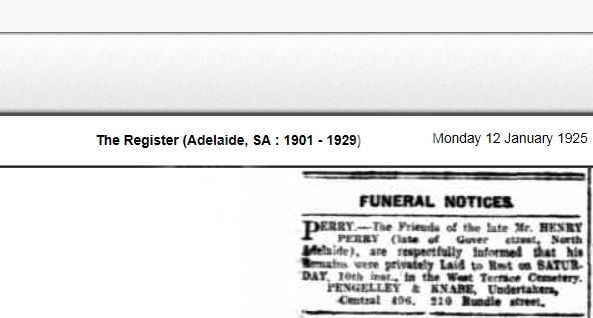
Mary married Henry John PERRY [2922], son of Edward PERRY [8066], on 26 Dec 1861 in Res of Jonathan Tilley (Vallies), South Australia. Henry was born about 1839 in Richmond, Surrey, England, died on 8 Jan 1925 in Adelaide, South Australia aged about 86, and was buried on 10 Jan 1925 in West Terrace Cemetery, Adelaide, South Australia.
Marriage Notes:
1861 SA Marriage 48/304 PERRY Henry TILLEY Mary Nairne
General Notes:
1925 SA Death 475/577 PERRY Henry undefined Adelaide
The Register (Adelaide) Monday 12 January 1925
Death Notice:
PERRY-On the 8th January, Henry Perry, late of Gover street, North Adelaide, aged 85 years. At Rest.
Children from this marriage were:
+ 40 M i. Henry PERRY [2923] was born on 4 Jan 1864 in Port Gawler, South Australia and died on 10 Jan 1864 in Port Gawler, South Australia.
+ 41 M ii. William James PERRY [2924] was born on 2 Jan 1865 in Port Gawler, South Australia, died on 20 Jun 1947 in Broken Hill, New South Wales, Australia at age 82, and was cremated on 23 Jun 1947 in Broken Hill Cemetery, Cath-X.
+ 42 F iii. Mary Ada PERRY [2935] was born on 20 May 1867 in Grace Plains, South Australia and died on 2 Jul 1923 in Adelaide, South Australia at age 56.
+ 43 F iv. Louisa Dearsley PERRY [2936] was born on 6 Aug 1869 in Auburn, South Australia and died on 7 Jun 1954 in Adelaide, South Australia at age 84.
+ 44 M v. Henry Edward PERRY [2937] was born on 3 Apr 1872 in Kooringa, South Australia, died on 8 Jan 1951 in Adelaide, South Australia at age 78, and was buried on 10 Jan 1951 in Centennial Park Cemetery, Adelaide, South Australia.
+ 45 F vi. Elizabeth PERRY [2938] was born on 12 Dec 1875 in Thurk, River Murray. South Australia and died circa 1970 in Grey, Ontario, Canada aged about 95.
+ 46 F vii. Maria Annie PERRY [2945] was born on 7 Feb 1878 in Blanchetown, South Australia and died on 22 Mar 1961 in Adelaide, South Australia at age 83.
+ 47 M viii. Afred PERRY [2946] was born on 17 Aug 1879 in Govt Well North-west Bend, South Australia (nr Morgan), died on 12 Dec 1939 in Adelaide, South Australia at age 60, and was buried on 13 Dec 1939 in Cheltenham Cemetery, South Australia.
+ 48 F ix. Helen Gertrude PERRY [2947] was born on 8 Jan 1882 in Nor-west Bend, South Australia, died on 8 May 1967 in Adelaide, South Australia at age 85, and was buried in West Tce Cemetery, Adelaide.
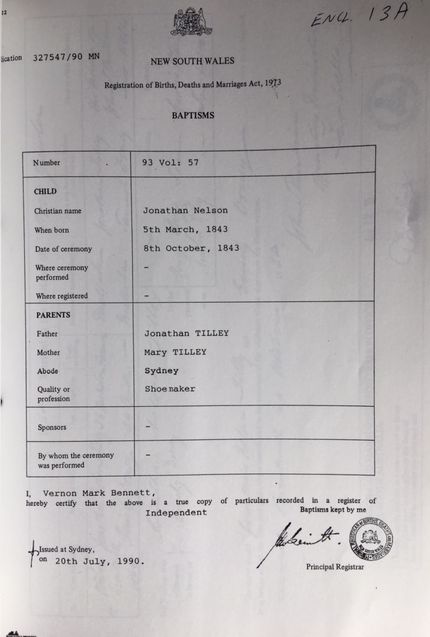
15. Jonathan Nelson TILLEY [3566] (Mary RYDER8, William6, Thomas2, William1) was born on 5 Mar 1843 in Nelson, New Zealand, was baptised on 8 Oct 1843 in Sydney NSW, Australia, died on 23 Feb 1923 in Fullarton, South Australia at age 79, and was buried on 24 Feb 1923 in West Terrace Cemetery, Adelaide, South Australia. The cause of his death was Senile Decay.
General Notes:
1843 NSW Birth (Baptism) V184393 57 TILLEY JONATHAN N, JONATHAN, MARY (Image courtesy of P Tilley 2016)
(Birth Registrations records were introduced in NZ in 1848, prior registrations were recorded NSW)
1923 SA Death 460/230 TILLEY John Nelson undefined Adelaide (H)
Jonathan Nelson Tilley died at the Home for Incurables, Fisher St, Fullarton, of Senile Decay
Chronicle (Adelaide) Saturday 15 August 1903
POLICE COURT- ADELAIDE.
Monday, August 10. (Before Messrs. J. Gordon, S.M., F.J. Whitby, and W. Carter.)
William Ball was charged on the information of Henry Adams, pattern-maker, with having in December last, while being entrusted with 3/6 by Jonathan Nelson Tilley, in order that he might deliver the same to Walter Charles Lodge, secretary to the S.A. Government Railway and Tram way Service Mutual Association, converted the money to his own use. Mr. J. R. Anderson defended, and Mr. A. J. McLachlan prosecuted. The evidence showed that Ball, who was a collector for the Adelaide branch of the association, had been handed a sum of money by Tilley, which was the latter's subscription to the general fund. Accused had never accounted to the secretary for any amounts received from Tilley. A meeting of the executive of the Adelaide branch was held on July 10, and Ball was asked to be present. He was shown a statement of various amounts missing, and requested to explain his action. In answer to a question, the accused replied, 'They are all correct. Drink has been the cause of it all.' An offer by the accused to make up the deficiency in monthly instalments had been refused. Ball was committed for trial, bail being fixed at two sureties of £25 each, or one of £50.
The Express (Adelaide) Monday 26 February 1923
Funeral Notice:
TILLEY.-The FRIENDS of Mr. JOHN NELSON TILLEY are respectfully informed that his Remains were interred privately on SATURDAY AFTERNOON, at 4 p.m. in the West-terrace Cemetery. The Rev. W. T. Wiltshire officiated. E. Hennigs, Undertaker.
Chronicle (Adelaide) Saturday 1 March 1924
In Memoriam Notices:
TILLEY. -In loving memory of dear father, who passed away February 23,1923. I know you suffered pain, dear dad. It made us weep and cry, To think we could do nothing As we slowly saw you die. But some day we hope to meet you, dad, Some day, we know not when, We shall clasp your hand in that heavenly land, Never to part again. -Inserted by his loving daughter and son-in-law, Sylvia and Jack, Hoyle, Aldgate.
TILLEY.-In loving memory of our dear father, Jonathan Nelson, who departed this life February 23, 1923. His happy face, his kindly smile Are pleasant to recall; He had a kind word for everyone, And died beloved by all. -Inserted by his loving son and daughter-in-law, Harold and Jessie, Wallaroo.
Research Notes:
Genforum Request: Janette Abbot 19 Jan 2008
Hello all Anyone know about Jonathon Nelson TILLEY he likley born c 1842 no idea where.
Married Emily DONEY 1868 in South Australia (Two wells)
Married Mary WILLIAMS in SA (Nairne) 1895
Married Amelia DREW in Adelaide SA in 1901
My interst is in line from Sophia (born of the 1st marriage) and I want to know of his parents - father listed (on his marriage) as Jonathon. So Jonathon (Snr) likely born early 1800.
The line from Sophia extnds into WHITE and then LEAR. Thanks all Jan
Genforum Response: Shirley Tarburton, May 19, 2011
In reply to Janette Abbot:
You probably have the information you need by now, but I will answer any way in case it is helpful.
Jonothan Nelson Tilley was born in NSW in 1843 to Jonathan and Mary Tilley. They had a daughter, Amelia born in 1846 in NSW. Jonathan died 1879 in Port Wakefield, SA and Mary died 1885 in Nairne, SA. My mother's uncle Harold, Jonothan N. Tilley's son of his second marriage, said his grandfather was the first immigrant child born in Nelson, N.Z.
Jonathan married Emily DONEY [3569], daughter of Samuel DONEY [8114] and Johanna FOLLAND [10191], on 17 Oct 1868 in Res John Standrins, Two Wells, South Australia. Emily was born on 25 Aug 1844 in Adelaide, South Australia, died on 3 Jun 1893 in Nairne, South Australia at age 48, and was buried on 5 Jun 1893 in Nairne Cemetery, South Australia.
Marriage Notes:
1868 SA Marriage 77/138 TILLEY Jonathan Nelson DONEY Emily Port Gawler
General Notes:
1844 SA Birth DONEY Emily Samuel DONEY Johanna FOLLAND Adelaide 1/81
1893 SA Death 210/453 TILLY Emily Jonathan TILLY (H) Nairne
Nairne Cemetery:- Plot 214.
The Express and Telegraph & The Evening Journal (Adelaide) Tuesday 6 June 1893 ; South Australian Register & The Advertiser (Adelaide) Wednesday 7 June 1893 ; The South Australian Register & The Advertiser (Adelaide) Tuesday 13 June 1893
Death Notice:
TILLEY. -On the 3rd June, at Nairne, Emily, the dearly beloved wife of J. N. Tilley, of Nairne, aged 47 years, after a long illness born with Christian fortitude.
Children from this marriage were:
+ 49 F i. Sophia TILLEY [3570] was born on 19 Oct 1868 in Grace Plains, South Australia and died on 4 Jun 1945 in Adelaide, South Australia at age 76.
+ 50 F ii. Florence Amelia TILLEY [3568] was born on 12 Jul 1870 in Virginia, South Australia and died on 20 Nov 1870 in Kadina, South Australia. (Triplet)
+ 51 F iii. Lily Agnes TILLEY [3571] was born on 12 Jul 1870 in Grace Plains, South Australia and died on 19 Nov 1870 in Kadina, South Australia. (Triplet)
+ 52 F iv. Florence Amy TILLEY [3572] was born on 13 Mar 1872 in Kadina, South Australia and died on 12 Jun 1875 in Port Wakefield, South Australia at age 3.
+ 53 M v. William Albert TILLEY [3573] was born on 13 Mar 1874 in Port Wakefield, South Australia, died on 12 Jun 1943 in Broken Hill, New South Wales, Australia at age 69, and was buried on 15 Jun 1943 in Broken Hill Cemetery, New South Wales, Australia.
+ 54 F vi. Sylvia Doney TILLEY [3574] was born on 5 Jul 1876 in Port Wakefield, South Australia, died on 15 Sep 1952 in Stirling West, South Australia at age 76, and was buried on 17 Sep 1952 in Stirling East Cemetery.
+ 55 M vii. Samuel Archibald Jonathan TILLEY [3575] was born on 28 Oct 1878 in Port Wakefield, South Australia and died on 25 Jan 1967 in Woodville, Adelaide, South Australia at age 88.
+ 56 F viii. Hilda Emily TILLEY [3576] was born on 11 Apr 1881 in Blyth, South Australia and died on 12 May 1904 in Broken Hill, New South Wales, Australia at age 23.
+ 57 F ix. Emily Mable TILLEY [3577] was born on 20 Jan 1886 in Nairne, South Australia and died on 26 Apr 1886 in Nairne, South Australia.
Jonathan next married Mary Jane WILLIAMS [3578], daughter of William WILLIAMS [9023] and Ellen GILLARD [9024], on 5 Jan 1895 in Res of Groom, Nairne. Mary was born on 28 Jul 1861 in Nairne, South Australia.
Marriage Notes:
1895 SA Marriage 182/61TILLEY Jonathan Nelson WILLIAMS Mary Jane Nairne
General Notes:
1861 SA Birth WILLIAMS Mary Jane William WILLIAMS Ellen GILLARD Nairne 23/123
Children from this marriage were:
+ 58 M i. Harold Charles Nelson TILLEY [3579] was born on 1 Oct 1895 in Mt Barker, South Australia and died on 19 Jan 1989 in South Australia at age 93.
+ 59 F ii. Irene Hellen Mary TILLEY [3580] was born on 11 May 1898 in West Adelaide, South Australia and died on 10 Dec 1898 in West Adelaide, South Australia.
Jonathan next married Amelia Millicent DREW [3581], daughter of George Butt DREW [3587] and Betsy LARDER [10192], on 19 Jun 1901 in Res Mr Tilley West Adelaide. Amelia was born on 19 May 1869 in Nairne, South Australia, died on 5 Sep 1903 in Dulwich, South Australia at age 34, and was buried on 7 Sep 1903 in West Terrace Cemetery, Adelaide, South Australia.
Marriage Notes:
1901 SA Marriage 207/1284 TILLEY Jonathan Nelson HERBERT Amelia Millicent Hindmarsh
General Notes:
1869 SA Birth DREW Amelia George DREW Betsey LARDER Nairne 73/379
1903 SA Death 296/491 TILLEY Amelia Millicent Jonathan TILLEY (H) Norwood (Resided: West Adelaide)
The Advertiser (Adelaide) Monday 7 September 1903
Funeral Notice:
THE FRIENDS of Mr. JONATHAN TILLEY are respcetfulîy informed that the Remains of his late WIFE (Amelia Millicent) will be removed from his residence, Lurline-strcet, West Adelaide, on MONDAY, at 11 a.m., for interment in the
West-terrace Cemetery. E. HENNIGS, Undertaker, 119. Hindley-street.
.jpg "Amelia Catherine Winfield nee Tilley (image courtesy MyHeritage) (36 KB)
https://www.myheritage.com/names/amelia_winfield
(Click on Picture to View Full Size)")
16. Amelia Catherine TILLEY [3567] (Mary RYDER8, William6, Thomas2, William1) was born on 23 Apr 1846 in New South Wales, Australia, was baptised on 9 Aug 1846 in Parish of Sydney, County of Cumberland, Australia, and died on 13 Jul 1926 in Aldgate, South Australia at age 80.
General Notes:
1846 NSW Birth TILLY AMELIA C 154/1846 V1846154 58 JONATHAN MARY
1926 SA Death 488/166 WINFIELD Amelia Catherine Edward James Blackeby WINFIELD [H] Adelaide
Evening Journal (Adelaide, SA : 1869 - 1912) Wed 8 Dec 1880 Page 2
INDECENT ASSAULT.
John Armstrong was charged with indecently assaulting Amelia Winfield, a married woman, at the Hundred of Gregory, on November 6. Prisoner was undefended, and did not cross examine any of the witnesses, who clearly proved the offence. On being arrested he said, " Well, such things happen sometimes." He offered no defence whatever, and did not even address the Jury. A verdict of guilty was returned. His Honor, in passing sentence, said he regretted the law did not allow him to pass a heavier sentence and order it to be accompanied by the infliction of the lash. As the law stood, he was unable to pronounce a longer sentence than he was about to pass, and certainly he should not be a party to abridging it by one hour. The sentence of the Court would be two years' imprisonment with hard labour. Sentenced accordingly.
Chronicle (Adelaide) Saturday 17 July 1926
OBITUARY.
Mrs. Winfield, who died at Aldgate on Tuesday at the age of 80, was a colonist of over 70 years. She was the youngest daughter of Mr. Jonathan Tilly. In 1869 she married Mr. Edmund Winfield, who journeyed through the desert from the city to Bordertown with a team of bullocks and dray 63 years ago. Mrs. Winfield, thought of a quiet and unassuming disposition, was kind and energetic in cases of sickness or distress. Fifty-seven years ago Mr. and Mrs Winfield conducted a business at Kadina, and after five years in that town had a farm at Broughton. Subsequently Mr. Winfield was share farming with Mr. J. H. Angas, at Melrose. Thirteen years were spent in business in Adelaide and the suburbs, then 25 years at Bordertown, the last five year being spent at Aldgate. Mrs. Winfield leaves a widower, two sons - Messrs. Frank and Arthur Winfield, of Keith, and five daughters- Mesdames Milne (Border- town), J. F. Hockham (Aldgate, H. Hockhan (Ashton), Sargeant (Borrika). and F. L. Wright (North Kensington). There are 17 grandchildren and five great grandchildren.
Naracoorte Herald (SA) Tuesday 27 July 1926
DEATH OF AN OLD-TIME TATIARA RESIDENT.
The death is announced of Mrs. Amelia Catherine Winfield, who passed away at Aldgate on July 13, at the age of 80 years, and was a colonist of more than 70 years. In 1869 she married Mr. Edmund Winfield, who, 63 years ago, went through the desert from Adelaide to Bordertown with a team of bullocks, after being in business at Kadina and farming at Broughton and Melrose. They were for 13 years in business in Ade laide and the suburbs, and were afterwards in business in Bordertown for 25 years. Her last five years was spent at Aldgate. She leaves a widower, two sons, and five daughters:-Mr. Frank Winfield (Keith), Mr. Arthur Winfield (Keith), Mrs. Milne (Bordertown), Mrs. J. F. Hockham (Aldgate), Mrs. H. Hockham (Ashton), Mrs. Sergeant (Borrika), Mrs. F. L. Wright (North Kensington). There are 17 grandchildren, and five great grandchildren.
Other Records
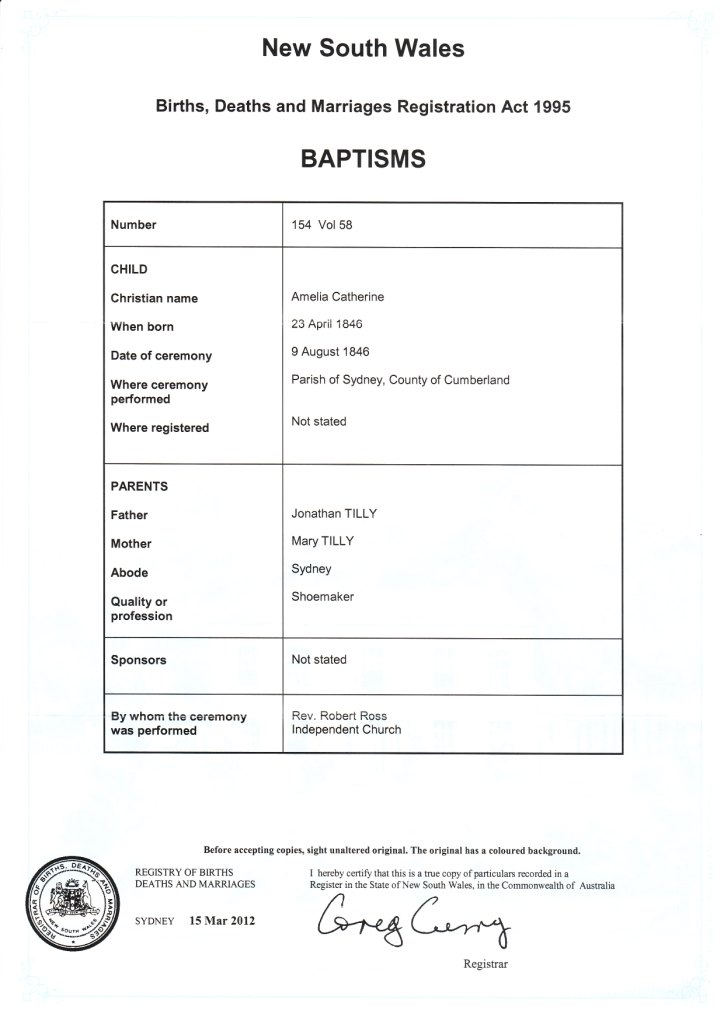
• (Image Courtesy of Deb Miller): Baptism, 1846, Sydney NSW, Australia.
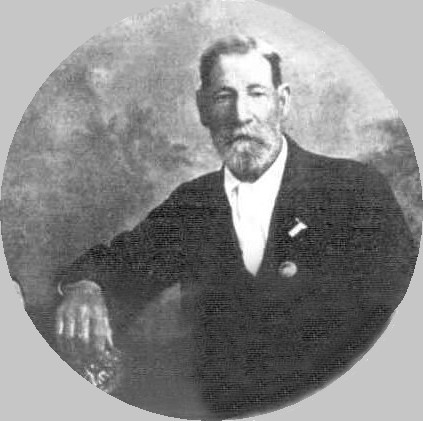
Amelia married Edmund James Blackeby WINFIELD [5653], son of James WINFIELD [8128] and Hannah BLACKEBY [8129], on 19 Jun 1869 in Res of Thomas Butcher, Kadina, South Australia. Edmund was born on 4 Feb 1849 in McGill, South Australia and died on 27 Jan 1941 in Bordertown, South Australia at age 91.
Marriage Notes:
1869 SA Marriage 79/708 WINFIELD E J B TILLEY Amelia C Daly
Chronicla (Adelaide) Saturday 21 June 1919
GOLDEN WEDDING.
WINFIELD-TILLEY.--On the 19th June, 1869, at Kadina, by the Rev. Mr. Wilson. Edmund J. H, youngest son of the late J. Winfield, of Magill, to Amelia C, youngest daughter of the late John Tilley, of Nairne. Present address, Keith.
General Notes:
1849 SA Birth WINFIELD Edmund James Blackeby James WINFIELD Hannah BLACKEBY Adelaide 2/121
1941 SA Death 633/560 WINFIELD Edmund James Blackaby Alfred Ernest MILNE [SL] Robe (Resided: Aldgate)
Border Chronicle (S.A.) Friday 2 January 1925
An old Bordertonion:
The "Register" of 23rd December, speaking of Mr Edmund Winfield now 76 years old and living at Aldgate, says :-"About 30 years ago Mr Winfield took up 15,000 acres at Wirrega in the so-called "desert", and was the first settler bold enough to tackle the proposition of farming that region. Near Brimbago Station he had 2,800 acres. He had a magnificent crop on 250 acres, which promised fully 15 bushels, until one afternoon a cyclone with rain and hailstones of abnormal size broke over the place, and in 10 minutes the whole crop was cut to pieces and driven to the ground. Mr Winfield subsequently conducted a butchering business at Kadina; also at Bordertown. He is an inventor, and fixed up the first bagger attached to the winnowing machine. He did not patent his idea, which is now in general use. He has a neat little device for attaching to the head of cattle which are "fencers". With this little attachment a slack three-wire fence will keep in or out the most notorious rogue beast. Mr Winfield has had his full share of accidents, although his present alert and active manner shows no trace of them. As a cricketer Mr Winfield holds a splendid record. About 50 years ago, at Kadina, he was picked to play against W. G. (grace's team when they visited that part of the country, but he could not get away from work. He used to win the bowling prize in almost every team in which he played, sending down a very slow ball with a deceptive spin on it. He was the champion wicketkeeper north of Clare. Once at Melrose, he played against a team containing three Adelaide Oval players, and took 17 wickets out of 20-15 being clean bowled. In the first innings he secured 9 wickets for 2 runs, and in the second 8 wickets for 7 runs. Mr Winfield attributes his present, vitality to plenty of work, never being idle, and cultivating a cheerful disposition. He is a total abstainer and a nonsmoker".
The Register (Adelaide) Wednesday 6 July 1927
BROKEN RIBS.
ALDGATE, July 5. -While Mr. Edmund Winfield (78) was loading stones into a dray at Aldgate on Monday afternoon, the horses moved off, and Mr. Winfield fell. He was conveyed to the Mount Lofty Hospital, where it was found he was suffering from four broken ribs, injuries to the back, and cuts to the body. The injured man is in a satisfactory condition.
The South Eastern Times (Millicent, SA) Friday 5 August 1927
A PIONEER'S MISFORTUNE.
Mr Edmund Winfield (78), of Aldgate, returned to his home last week from the Stirling district hospital, where he was taken a fortnight ago suffering from broken ribs and other injuries Through a stone-laden dray having capsized on him. He is making a good recovery Mr Winfeild has had more than his share of accidents during his long life, yet he played cricket regularly until last season. He neither drinks nor smokes. Educated at the late Rev. W. Mudie's school, he has at various times been a hawker, grocer, storekeeper, postmaster, butcher, dealer, milk vendor, and farmer in the north. He was the first man to start farming in the Ninety-mile Desert. Sixty-three, years ago, at Kingston, in the South-East, while he was hauling a damaged cart, it capsized on him and broke the small bone in both legs. The bullocks used ,were the property of the notorious Malachi Martin, of Salt Creek; and as no one but young Winfield could manage them, he had to shuffle along and drive the bullocks while the bones were knitting. Thirty-five years ago, while driving in Gawler Place, Adelaide, his horse bolted, and, striking a kerb, threw, Mr Winfield with great force into a galvanised-iron fence, breaking the fence, severely cutting his head, and causing serious concussion, which rendered him deaf for the rest of his life. His collarbone and ribs were also broken, and one shoulder-blade was knocked out of place. Thirteen years ago an accident through a falling tree broke the small bone of Mr Winfield's left leg. That was bandaged, and by limping on one foot he completed the season's ploughing. During the same year, through a plough accident, several of his ribs were broken. Later, when loading stock at Bordertown, he slipped from a buffer of a railway van, striking his head heavily. He was picked up, and pronounced dead, placed behind a van, and a tarpaulin was erected as an awning to keep the sun oft the "corpse" until the doctor could "view the body." When the doctor arrived, the patient declared that he was all right except for a broken wrist. As the fingers of that hand began to turn black, and the medical man would not loosen the bandages (Mr Winfield states), a friend cut them off, and Nature repaired the damage. * The injured wrist was soon as strong as the other. On another occasion, while suffering from a broken collarbone, with the left arm strapped down, Mr Winfield played cricket, batting and fielding with one hand. Last year he was thrown out of a trap in Aldgate Valley, and his right shoulder was injured. The dray which capsized on him a fortnight ago broke four ribs, and damaged his left breast, back and arms.
The Advertiser (Adelaide) Tuesday 15 November 1927
KNOCKED DOWN BY A MOTOR CAR.
Mr. Edmund Winfield (78) was knocked down by a motor car on Sunday afternoon in Aldgate Valley. He escaped with severe bruises. Mr. Winfield returned in August from the hospital, where he had been with four broken ribs and other injuries. Mr. and Mrs. Winfield were returning from a walk, and when near home they were keeping as close as possible to the blackberry bushes on the side of the road, when a motorist tried to overtake another car just as he was passing the pedestrians, who in a narrow road were in full view of the drivers of the motor cars for 100 yards or more.
The Register News-Pictorial (Adelaide) Saturday 2 February 1929
CHEQUERED CAREER OF OLD COLONIST
Intends to See Test Match on Eightieth Birthday:
Mr Edmund Winfield of Adgate, an old colonist, intends to spend his eightieth birthday on Monday at the test match. He was born at Magill in 1849 and in his time has played many parts, having been a grocer, storekeeper, postmaster, milk vendor, dealer, hawker, butcher, and farmer. His experience of accidents has been unique, for he has experienced concussion of the brain (twice), broken ribs (several times), broken leg on several occasions, collarbone and wrist broken, shoulder blade knocked out of place, back and arms injured, and was once unconscious for hours as the result of breathing foul air in a well. As a farmer he once reaped as much as 52 bushels per acre from one block, and on another, when prospects looked equally good, a terrific hailstorm arose. The hail broke through the iron roof of the house, stampeded the horses through three barbed wire fences, and cut the whole wheat crop to pieces. Mr. Winfield has played cricket for Kadina, Yacka, Melrose, Plympton, Magill, Bordertown, and Aldgate. He is now engaged in sinking a well on his block singlehanded.
Border Chronicla (Bordertown SA )Friday 8 February 1929
A Tatiara Veteran GOING STRONG AT 80 YEARS.
Mr Edmund Winfield, of Aldgate, celebrated his 80th birthday on Monday, February 4. As a hardy pioneer his experiences have been unique (states the "Advertiser"). Through them all he has been an enthusiastic cricketer and spent his 80th birthday on the Adelaide oval and keenly watched every part of the test match. Sixty-five years ago, at Kingston, in the South-East, while hauling a damaged cart, it capsized on him and broke tbe small bone in each leg; the bullocks used were the property of the notorious Malachi Martin, of Salt Creek; and, as no one but young Winfield could manage them, he bad to shuffle along and drive the bullocks while the bones were knitting. Thirty-seven years ago, while driving in Gawler place, Adelaide, his horse bolted, and, striking a kerb, threw Mr Winfield with great force into a galvanised iron fence, breaking the fence, severely cutting his head, and causing serious concussion, which rendered him deaf for the rest of his life. His collar-bone and ribs were broken, and one shoulder blade knocked out of place. Fifteen years ago an accident through a falling tree broke the small bone of Mr Winfield's left leg. This was bandaged, and by limping on one foot he completed the season's ploughing. During the same season, through a plough accident several of his ribs were broken. During very hot weather the young fellows in his employ drove some sheep several miles too fast, and on arrival at a 50-foot well they began drawing water in a great hurry, splashing the water down the well and rattling the buckets up and down. When Mr Winfield reached them they had just got one bucket jammed at the bottom of the well and could not move it. Mr Winfield fixed a rope round his body under his arms and began to descend the well. The man watching him go down soon noticed him fall forward unconscious; they hauled him out to all appearance dead. They put him in the spring dray and with two horses drove five miles through heavy sand. He showed no signs of life on reaching home, and was put in a room for dead, and arrangements were made to start a man for Bordertown to advise the doctor and the police. Just before the man started the supposed corpse called out to know where he was. On another occasion, when loading stock at Bordertown, Mr Winfield slipped from the buffer of a railway van, striking his head heavily. He was picked up and pronounced dead, placed behind a van, and a tarpaulin was erected as an awning to keep the sun off the "corpse" until the doctor could "view the body". When the doctor arrived the patient declared he was all right except for a broken wrist. As the fingers of that hand began to turn black and the medical man would not loosen the bandages (Mr Winfield states) a friend cut them off, and nature repaired damages. The injured wrist was soon as strong as the other. On another occasion, while suffering from a broken collarbone, with his left arm strapped down, Mr Winfield played cricket, bating and fielding with one hand. Three years ago, he was thrown out of a dray in Aldgate Valley and his shoulder injured. The year before last a dray, capsizing, broke four of Mr Winfield's ribs, damaged his left breast, back and arms. Since then he has been knocked down by a motor car on the main road in Aldgate Valley. In spite of his chequered experiences, Mr Winfield is still strong and vigorous. He has grubbed and cleared part of a scrub block and put it under crop this season, taking the crop off single-handed, also sinking a well by himself. He neither drinks nor smokes, and enjoys fresh, cucumbers and onions, and any amount of fruit. During the present season, besides other kinds of fruit, he has accounted for two cases of apricots. It is this diet, the old gentleman maintains, that accounts for his retaining his briskness of mind and body.
Chronicle Adelaide) Thursday 13 Feburary 1941
OBITUARY
Mr. E. J. B. Winfield One of the early links with the Tatiara district was broken by the death of Mr. Edmund J. B. Winfield who died in the Tatiara Soldiers' Memorial Hospital on January 27. Mr. Winfield, who was almost 92, was born at Magill. At the age of 20 he was married at Kadina to Miss Amelia Tilley, of Sydney. He worked at Melrose and Adelaide for some years, later returning to Bordertown. In 1895 he purchased the butchering business of the late John Langley, and after some years sold out, turning his attention again to the land. At Wirrega he developed scrub land. The following years were spent at Brimbago, Keith, and the Adelaide hills. His wife predeceased him 14 years ago. Out of a family of five daughters and four sons, there survive five daughters - Mesdames A. E. Milne, of Bordertown; J. Hockham, of Mount Barker; H. Hockham, of Ashton; A. Sargeant of Lucindale; E. Wright, of Yorketowtown - and two sons, Messrs. Arthur Winfield, of Aldgate. and Frank Winfield, of Tennant Creek.
Other Records
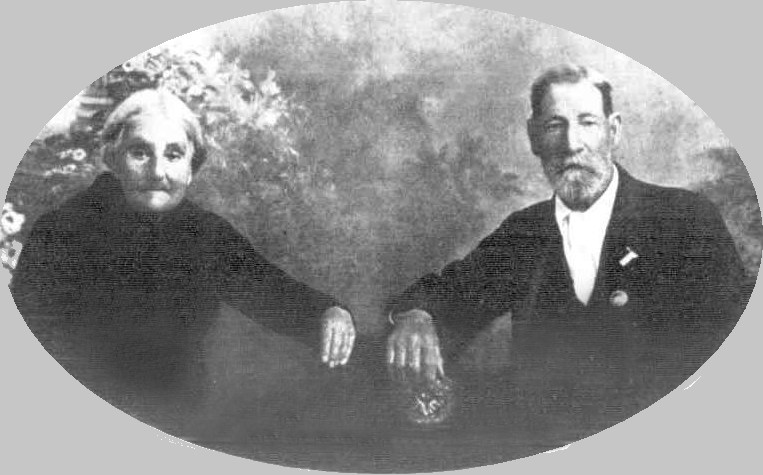
• Edmund and Amelia Winfield: Wedding Anniversary, 1925, Aldgate Valley, South Australia. Mr and Mrs Edmund Winfield of Aldgate, aged 75 and 76 years respectively, are natives of South Australia. Neither has had a day sickness except as the result of an accident, and have been married for 55 years.
Ref: Observer (Adelaide, SA : 1905 - 1931) Sat 10 Jan 1925 Page 34
Children from this marriage were:
+ 60 M i. Alfred WINFIELD [8145] was born on 19 Dec 1872 in Kadina, South Australia and died on 22 Jan 1875 in Yacka, South Australia at age 2.
+ 61 F ii. Elsie Olive WINFIELD [8130] was born on 21 Jul 1875 in Yacka, South Australia, died on 9 Jul 1948 in nr Borderdown, South Australia at age 72, and was buried in Bordertown Cemetery, South Australia.
+ 62 F iii. Jessie WINFIELD [8144] was born on 29 Jan 1878 in Yacka, South Australia and died on 12 Apr 1965 in Adelaide, South Australia at age 87.
+ 63 M iv. Arthur Ryder WINFIELD [8146] was born on 10 Sep 1879 in Willowie, South Australia and died on 9 Mar 1968 in Keith, South Australia at age 88.
+ 64 M v. Frank WINFIELD [8147] was born on 27 Sep 1881 in Gregory, nr Lake Eyre, South Australia, died on 11 Sep 1953 in Parkside, Adelaide, South Australia at age 71, and was buried on 14 Sep 1953 in Centennial Park Cemetery, Adelaide, South Australia.
+ 65 M vi. Alfred WINFIELD [8148] was born on 25 Apr 1883 in Plympton, Adelaide, South Australia and died on 25 Dec 1895 in Bordertown, South Australia at age 12.
+ 66 F vii. Adelaide WINFIELD [8149] was born on 2 Apr 1887 in Magill, Adelaide, South Australia and died on 10 Nov 1967 in Uraidla, South Australia at age 80.
+ 67 F viii. Daisy WINFIELD [8150] was born on 23 Oct 1889 in Magill, Adelaide, South Australia, died on 21 Feb 1959 in Millicent, South Australia at age 69, and was buried on 23 Feb 1959 in Millicent Cemetery, South Australia.
+ 68 F ix. Janet Evelyn WINFIELD [8151] was born on 19 Jun 1891 in Magill, Adelaide, South Australia and died on 7 Jul 1981 in South Australia at age 90.
_pg1.jpg "Page 1 of Matilda's 1860 letter to her cousin Susanna in South Australia (26741 KB)
[courtesy of State Library of South Australia]
(Click on Picture to View Full Size)")
17. Matilda RYDER [2910] (Thomas10, William6, Thomas2, William1) was born about 1839 in Hanley, Staffordshire, England.
General Notes:
Matilda married and became step-mother to two sons and one daughter.
A letter from Matilda Ryder in England to her cousin Susanna Ryder in South Australia
Home & Colonial Schools
Grays Inn Rd.
October 16th 1860
My dear cousin Susanna,
I think you are quite right when you say it is the first time you have written to me, but I hope it is not to be the last. May we be spared to write many letters to each other. I am very glad to read such good news, respecting you and Mary, as regards spiritual things. It is a joyful thought, that though we may not meet here again, we shall certainly do so some day, yes dear cousin I could not have said this a short while ago, for although I trust I have been a enquirer after Christ for some time, it is not until the past year that I have been able to call Him My Saviour and Lord and now it is such a comfort for me to know that when my earthly house of this tabernacle is dissolved, I have a building of God, a house not made with hands, eternal in the Heavens. God has been very good to our family during the past year for I trust that now we are all decided for the Lord. My dear brother was first called into the fold and I trust that we are now with him.
There has been a Great rock of Revival in London & many parts, it is still going on, though more silently. Several lay men have been raised up by God to preach the everlasting Gospel. It was through the instrumentality of one of these that my sisters and myself made our conversion. How strange are the dealings of the Lord! For years had we been privileged to hear a good and faithful minister and yet we continued far, far, from God, until we were aroused by the preaching of this layman. Now dear cousin, let us rejoice and endeavour to give our Saviour some little return for all His love to us by living for His cause. With regard to temporal God has indeed been good. I have passed all my examinations which have at present been eight in number. I was not quite so successful at the last as I had hoped to have been but I hope I shall be successful in the coming examinations which takes place at Christmas and I sincerely hope that will be the last. I was very unexpectedly appointed last year to take the Model Infant School in connection with the Boro Rd and that is the reason why I am having another year's training that I might learn the Infant System of these schools. I do not begin school till next year. Pray for me dear cousin that I may be successful.
Tom has gone to college probably for 3 or 4 years. He seems very happy and I hope He will grow to be a useful Minister of the Cross.
Emma is in hopes of entering the Training College at Christmas where I suppose she will stay two years.
Lizzie is at home she does not want to be a teacher, she likes better the unrestrained life and does not want to be so confined as we teachers are, but to those who love the work it is a pleasant confinement. I must now say Farewell, my studies prevent me writing you a longer letter. I am, Yours very affectionately, Matilda Ryder
Miss Susanna Ryder
A notation at top of letter but not in Matilda's hand.
Give my best love to Mary and tell her I will endeavour to write to her by the next mail.
Other Records
• Census: England, 6 Jun 1841, Clarkes Place, Grays Inn Lane, St Pancras, Middlesex. Matilda is recorded as daughter age 2 not born in this county.
• Census: England, 30 Mar 1851, 15 Pakenham Street, St Pancras. Matilda is recorded as Daughter age 12 Scholar.
• Census: England, 2 Apr 1871, 6 Pakenham Street, St Pancras, London. Matilda is recorded as Daughter unmarried age 32 born Skelton Staffordshire, Schoolmistress.
• Census: England, 3 Apr 1881, 7 Yerbury Street, Islington. Matilda is recorded as Wife age 42 (nee Ryder) & Father Thomas Ryder age 68 living at this address.
• Census: England, 5 Apr 1891, St John's Lodge, New Barnet, Hertfordshire. Matilda is recorded as Wife age 50.
• Census: England, 31 Mar 1901, Oak Lodge Barnet Vale Hertfordshire. Matilda is recorded as Wife age 62
• Census: England, 2 Apr 1911, Hendra, Clifford Road, New Barnet, Monken Hadley. Matilda is recorded as Wife age 72.
Matilda married John James LEWIS [2911], son of John LEWIS [8048] and Harriott [8049], in 1881 in Islington, London, Middlesex, England. John was born about 1840 in Bryanstoke St., Marylebone, London, England.
General Notes:
1881 John's marriage to Matilda Ryder is reported but the 3 Lewis children were born 1861, 1864, 1865.
1901 John is age 61 and living at Barnet Vale Hertfordshire on own means.
Other Records
• Census: England, 30 Mar 1851, 10 Collin st., Clerkenwell, Middlesex. John Jas is recorded as Son age 11.
• Census: England, 2 Apr 1871, 46 George st., Southwark. John James is recorded as Head age 31 and described as Mason
• Census: England, 3 Apr 1881, 7 Yerbury Street, Islington. John is recorded as Head age 41 born Marylebone MSX and described as Proprietor of a Traders Mercantile employing 4 Clerks.
House Servant Minnie Smith age 21
• Census: England, 5 Apr 1891, St John's Lodge, New Barnet, Hertfordshire. John is recorded as Head Age 51 and living on own means.
• Census: England, 31 Mar 1901, Oak Lodge Barnet Vale Hertfordshire. John is recorded as Head age 61 and living on own means.
• Census: England, 2 Apr 1911, Hendra, Clifford Road, New Barnet, Monken Hadley. John is recorded as Head age 71 and living on own means.
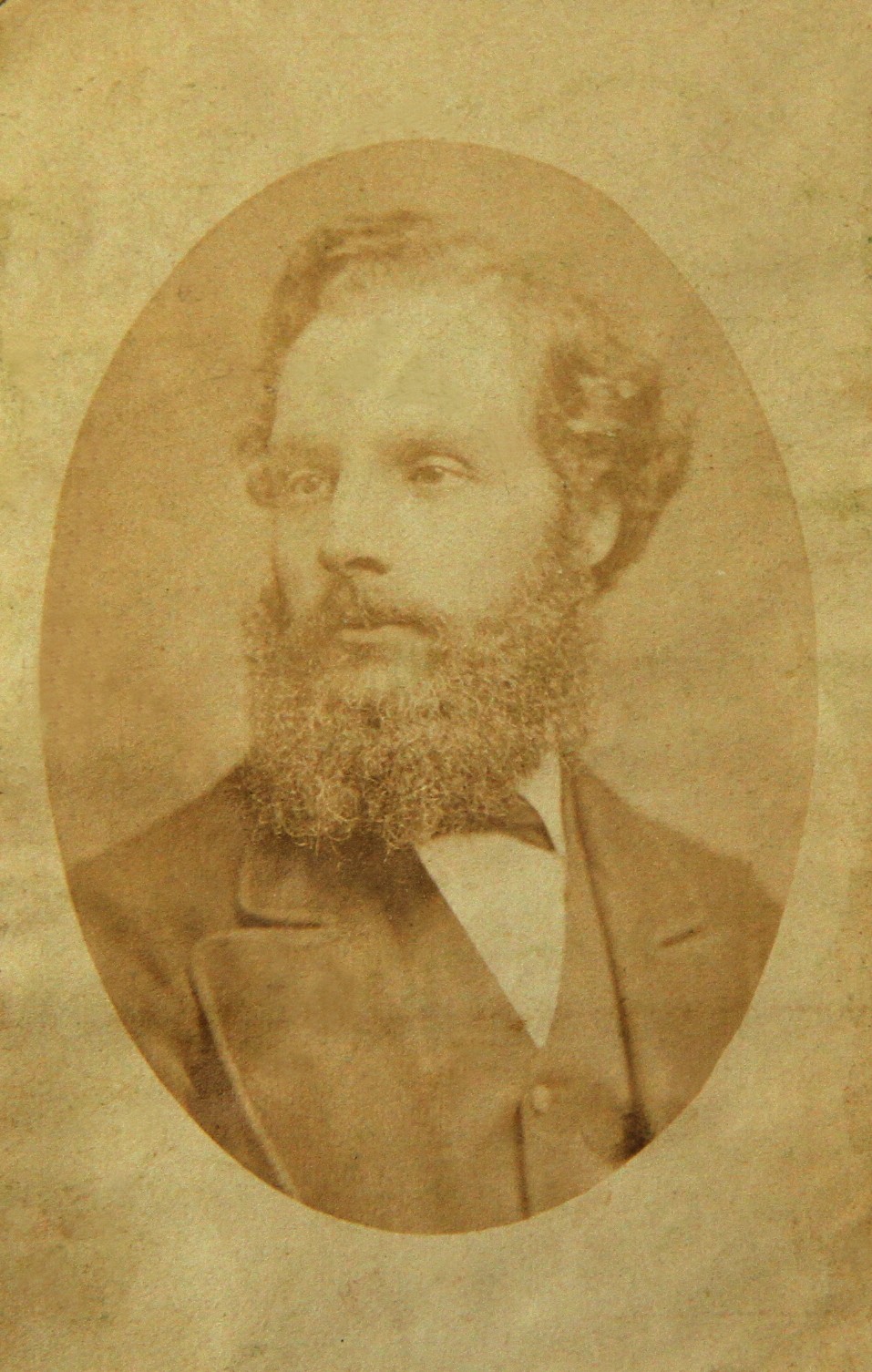
18. Rev Thomas RYDER [2917] (Thomas10, William6, Thomas2, William1) was born on 11 Jun 1840 in Wem, Shropshire, died on 7 Oct 1875 in Hartford, United States of America at age 35, and was buried on 5 Nov 1875 in General Cemetery, Nottingham, England.
General Notes:
Born 1840 Wem Shropshire Sep Qtr Vol 18
Died 1875 Hartford, USA
New York Daily Tribune, Friday, October 8, 1875
OBITUARY
The Rev. Thomas Ryder.
Hartford, Conn., Oct. 7. - The Rev. Thomas Ryder, pastor of the Strong [sic] Street Baptist Church in Nottingham, England, was found dead in his room this morning at the residence of Mrs. Harriet Beecher Stowe in this city. Mr Ryder was travelling for his health, and probably died of heart disease. From letters of introduction and other documents found with him he seems to have been a person of considerable note in England and to have met prominent people in this country. A church manual in his possession shows that his church has 481 members. He met Professor and Mrs. Stowe in the Twin Mountain House and had called to visit the family, intending to visit John B. Gough today. The funeral will take place on Saturday, the remains being held for 'instructions' from his friends in England.
Auckland Star, Volume VI, Issue 1803, 25 November 1875, Page 2
The Evening Star: WITH WHICH ARE INCORPORATED The Evening News and the Morning News, and the Echo.
THURSDAY, NOVEMBER 25, 1875
. . . Rev. Thomas Ryder, pastor of Stoneystreet Baptist Church, Nottingham, England, was found dead in his bed at the residence of Mrs Harriet Beecher Stowe. Mr Ryder was travelling for his health, and probably died of heart disease.
South Australian Register Monday 20 Dec 1875 & Saturday 1 Jan 1876
Death Notice:
RYDER. On the 6th October at the residence of Mrs. Harriet Beecher Stowe, Hartford, U.S., America, the Rev. Thomas Ryder, Pastor of the Stony-street Baptist Church, Nottingham, England, and nephew of Mr. Joseph Ryder, teacher, Noarlunga; also of Mrs. J. Tilley, sen., Port Wakefield, aged 38 years (or was it 35).
Wikipedia.org
===The schism of 1875===
A schism occurred in 1875, the causes of which are not clear, but many members of the church left and founded Woodborough Road Baptist Church. This left the Stoney Street chapel vulnerable, as the area had become commercial and industrial, and it was to survive as a chapel for only a few more years.
<http://www.hymntime.com/tch/bio/r/y/d/ryder_t.htm>
Thomas Ryder 1840-1875
Courtesy of the Cyber Hymnal™
Born: June 11, 1840, Wem, Shropshire, England.
Died: Oc-to-ber 7, 1875, Hartford, Connecticut, at the home of Harriet Beecher Stowe
Buried: General Cemetery, Nottingham, England.
A Baptist preacher and temperance speaker, Ryder pastored in Deptford, worked with the British Bible Society (1867-69), and was minister at the Stoney-Street Chapel in Nottingham (1870-75). He established 40 temperance Bands of Hope, and was well-known for his singing and song leading. In the summer of 1875, he traveled to America, hoping for change of health; he was being treated for an arterial aneurysm near his heart. Apparently, he spent most of August and September traveling, including a trip to an Indian mission school in Ontario and a stop at Niagara Falls. He met the Stowes at Twin Mountain House in New Hampshire that August the Beecher family routinely vacationed there. The Stowes invited Ryder to stay at their home while he visited John G. Gough, a leader of the American Temperance Union. Harriet Stowe discovered Ryder's body after his death, and wrote to his young widow back in England.
excerpt from Memorials of Thomas Ryder, compiled by Robert Dawson, B.A.
9th Oct 1875 - The funeral services of the late Rev. Thomas Ryder, of Nottingham, England, who died at the residence of Prof. C. E. Stowe, on Thursday, were held this afternoon in the Asylum Avenue Baptist church. The remains have been embalmed, and the face seems but little altered.
===========================================
MEMORIALS
of
THOMAS RYDER
A notation written of this page: To my dear cousin Annie Oceania From Emma Ryder
Heb VI
[a faded photograph of Thomas Ryder on next page]
===========================================
Memorials
Of
THOMAS RYDER
Pastor of the Baptist Church, Stoney Street, Nottingham,
Compiled by
ROBERT DAWSON, B.A.
====================
"Thou art a very lovely song of one that hath a pleasant voice, and can play well on an instrument."
----------------------------------
Life's more than breath and the quick round of blood;
'Tis a great Spirit and a busy heart.
We live in deeds, not years; in thoughts, not breaths;
In feelings, not in figures on a dial.
We should count time by heart-throbs. He most lives
Who thinks most, feels the noblest, acts the best.
====================
Nottingham:
Printed by J. Derry, Albert Street,
1875
To
Those who loved him in England,
And to those who
In America so kindly Blest his closing days,
These Memorials are Dedicated.
======================================
MEMORIALS.
"Needs there the praise of the love-written record,
The name and the epitaph graved on the stone?
The things we have lived for, leg them be our story,
We ourselves but remembered by what we have done.
"I need not be missed; if my life has been bearing,
As its summer and autumn move silently on,
The bloom, and the fruit, and the seed of its season,
I shall still be remembered by what I have done.
"Not myself, but the truth that in life I have spoken;
Not myself, but the seed that in life I have sown,
Shall pass on to ages - all about me forgotten,
Save the truth I have spoken, the things I have done."
THOMAS TYDER [sic] was born in the year 1840, at the little town of Wem, in Shropshire; but though country-born, his childhood's days were spent far from the fields and flowers of which he was so fond, in the crowded wilderness of London. Less than a year he breathed the pure air of the country, his father having received the appointment of head master to the large and important day school in connection with John Street Chapel, Bedford Row, of which the Rev. J. Harrington Evans was at that time the minister. His boyhood was not remarkable except for its uncontrollable buoyancy of spirits, and corresponding indifference for the serious employments of school. Only those could manage him who thoroughly understood his character and disposition; he was often a thorn in the sides of his Sunday School as an unmanageable boy. And yet, strange to say, in spite of his aversion to the routine of the class-room and the restraints of study, there was silently developing a nature, a genius, which in time would have made him one of the best and ablest teachers of the young that England has known. He made fair progress in languages and mathematics, but his favourite studies were music, drawing, and chemistry. Perhaps his most remarkable talent, and one so carefully cultivated that it contributed greatly in later years to his success as a minister, was his voice. As a child, at John Street Chapel, he was familiarly known as "the cherub of the Table-pew." When about twelve years of age he was invited to become a chorister in the Chapel royal and there can be no doubt that in after days his melodious tenor might have made his fortune. He possessed also a marvelous power of mimicry; and the display of his musical and elocutionary talents so charmed and fascinated his young associates that his company was eagerly sought after, and, but for his father's influence, and the restraining power of God, these talents would probably have led him into worldly associations.
At the age of eighteen, having been previously a pupil teacher in his father's school, he accepted the office of assistant master in a school of four hundred boys, connected with Crescent chapel, Liverpool, of which the Rev. John Kelly was the minister. Concerning the youthful teacher, Mr. White, the head master, writes:-
"Mr. Ryder came to Liverpool an entire stranger, but his disposition soon made for him a large circle of friends, whose attachment continued long after he left, and who were always glad to see him whenever he revisited the town. The cordial manner in which he commenced his duties, and the zeal and efficiency he displayed in their performance, proved that his was no eye-service, but his heart was in the work. He became very popular, winning the esteem and affection of the managers of the school, his fellow-teachers, and the scholars, many of whom look upon their association with Mr. Ryder as among the most pleasant of memories. He introduced to the people of Liverpool and Birkenhead the Tonic-Sol-Fa method of teaching singing, and conducted classes in various parts of these towns with much success. He gave several public exhibitions of his pupils' attainments, which were highly praised by the Press, and greatly enjoyed by those who attended them."
On leaving Liverpool, he took the entire charge of a school in Dean Forest, which he conducted with much ability and success. His third sphere of educational labour was an assistant mastership in the Chorlton High School, Manchester. This office he filled to the entire satisfaction of the principal; and he so gained the good-will and affection of the scholars that upon his leaving they presented him with a very handsome testimonial of their respect and esteem. So strongly did he leave the impress of his mind and character upon his pupils, that many of them, now filling important stations in society, regarded him, to the day of his death, as their best friend and adviser. There [sic] letters testify to the efficiency of his instruction, and to the moral and religious bias which, under God, he was the means of giving to their lives and characters. In Manchester also he established singing classes for the public, and so popular did these become, that it was often a difficulty to obtain and entrance after the first night of meeting. Many hundreds of persons owe to him the ability they possess of reading music at sight; and many, in their turn, have become teachers of others. This service of song in the House of the Lord."
Thomas Ryder had the unspeakable blessing of pious parents, and a home where God was honoured and loved. He was the child of many prayers and of much faithful religious training. In his boyhood he was often the subject of serious impression, but the "early dew" quickly evaperated [sic]. There was one man, indeed, who had a strong and blessed influence over the youth, the Rev. Baptist Noel, the holy man of God who at the time ministered at John Street. For him he had a profound venerations of every other minister only called forth his talent of imitation, but Mr. Noel he was never known to mimic, saying when urged to do so, "I dare not". But yet the word of truth from his lips seemed to fall as seed by the wayside, or, at best, on stony ground; no impressions of a lasting kind were made. If for a day or two a fit of seriousness was upon him, the first entertaining book, the first light-hearted companion drove it away; and it seemed impossible for this merry-souled boy to look long enough at Jesus, whose name was so familiar, to perceive how He loved him. When, at the age of eighteen, he left home for Liverpool, no decision for Christ had been made. At that time, indeed, he seems to have begun earnestly to seek for eternal Life; but, like too many, he sought in the wrong way. From a diary which he kept in short-hand it is evident that he was seeking the favour of God in the way of self-righteousness, hoping to gain it by reading his Bible, by prayer, and by leading a godly life good resolutions were formed, and for a time carried out, only to be broken, and then followed by bitter repentance. Thus he continued vainly striving after peace, while as yet his heart had not been surrendered to God. But the time was at hand when the prayers of a trustful mother and a believing father were to be answered. God had his eye upon the youth, surrounded as he was by the temptations of Liverpool life; and that God was looking lovingly and pitifully down, intent to save his soul. On August 5th 1858, Mr. Noel was advertised to preach at Birkenhead. With a heavy heart, and yet with fond remembrances of this dear minister whose appeals he had for so many years slighted, he crossed the river, and with difficulty gained admission to the crowded chapel. The angels of God are around him. As he listens to the man he had always venerated but whose words had never touched his heart, a strange and unaccountable feeling takes possession of his soul; he is arrested by the hand of Grace; Grace is taking him captive; conviction of sin is forcing its way into his heart; he feels as never before his personal need of a Saviour; that Saviour is set before him. In winning tones the gentle preacher tells of what that Saviour is, and of what He can do, urging the immediate acceptance of His offered Grace as the only way in which life's great problem can be solved, sin be forgiven, and salvation secured. Unknown to the preacher, the arrow has entered the joints of the armour in which that young soul was clothed; the old self-nature was mortally wounded; Christ was allowed to enter; and while in silent thought he recrossed the ferry and returned to his room, the angels were announcing the news that another soul was born again, another of the younger brethren brought back to the Father's house.
Henceforth the current of his life was changed. It was no easy matter, however, to give up old associations of a worldly nature; his convivial disposition at times asserted a mastery over him, and the struggle was often painful and severe. There was one friend especially from whom it was hard to part. But the grace of God triumphed. With open-hearted frankness, so characteristic a feature of his life, he informed his friend of the change he had experienced, and as he had no mind to accompany him along the new-found path, he let go his arm, bid him farewell, and set out to follow the Master. With two or three other young men, "whose hearts the Lord had touched," he met for prayer and the study of the Word of God, he became a teacher in a Sunday School, joined himself to God's people, and once or twice, with fear and trembling, gave a simple address at a prayer meeting. During the short interval which elapsed before going to Dean Forest, he several times preached in the Clerkenwell Workhouse, and in a Mission Hall connected with Mr. Noel's church. While resident in Gloucestershire, however, he began to preach on a more extended scale, and there his ministrations were so acceptable and profitable, and were so much appreciated by the people, that his minister and other friends urged him to devote his life entirely to the ministry of the Gospel. After much prayer and consultation with his father and with Mr. Noel, he sought and obtained admission into the Countess of Huntingdon's College, at Cheshunt. College life, however, while it undoubtedly aided him greatly in habits of study and in love for literature, failed in promoting his spiritual life, or in imbuing him with those high and sacred views of the Christian ministry, without which no "call" can be considered valid. This is the after days he sorrowfully admitted. After a two years' residence at Cheshunt he returned to scholastic life. His views on baptism having soon after undergone a change, chiefly through a perusal of Mr. Noel's books on that subject, he became a member of the church at Manchester under the pastoral care of the Rev. A. Maclaren. By him he was baptized; by his vigorous and heart-stirring preaching, his former desires were re-awakened; and by his advice he once more turned his attention the ministry. The following extracts from letters written at this time will show how the fire was burning on the altar, and how the Spirit of the Lord was preparing His young servant for the work to which He had destined him: -
"Where God puts me, there I'll be content to dwell and to work, whether it be India, China, England or America. I care little where, if I may be do some good, and help to make better this sinful world. But I am so sinful myself, and still lack those high and holy qualifications which ought to distinguish the ministers of Christ. Pray for me that I may become purer and holier day by day."
"I should like my God to show me my exceeding sinfulness more, that I might agonize and lie low in humility, not indeed to lie 'like slaves beneath the throne', but to rise from that humility and pierce the heavens on the wings of faith, that side by side with Christ I should be led to God, and own with joy that He was my father . . . . One thing must never be lost sight of, and that is, that God's glory is to be our highest aim; and there is no way in which we can glorify Him so much as by living lives as much as possible like that ideal Life, which came forth from His very bosom."
In the year 1864, after recovering from an illness, he wrote:
"I am much better; still I am something like John the Baptist's 'bruised reed', and there is about as much life in me as in his 'smoking flax', but as our God will neither break the one nor quench the other, my faith looks up to Him. I will wait upon the Lord that I may renew my strength. Oh, how I have longed for the blessed Sabbath, and I was well repaid when I crawled rather than walked to chapel. It was like greeting a long-lost friend; and then to see the dear form of Mr. Maclaren in the pulpit! His reading, his prayers, his words smote on my soul with a gentle, inspiring touch, and I felt keenly sensible to the glorious sermon he delivered on the 'full assurance of faith'. How I longed, while he spoke, to be on the top round of the ladder, so close to Jesus that it may really be joy and peace in believing. Our confident joy rests entirely upon the measure of our faith, as Mr. Maclaren put it - 'We must fling ourselves out of ourselves and upon God.' "
"How often we are prone to attribute to surrounding circumstances the causes of our gloom and despondency; but I have learnt the fallacy of this. For if a man is right with God he will find no difficulty in blending smiles and tears, rejoicings with sorrowing, bliss with woe and a calm, holy, and serene faith with a tempted, bruised, and weak heart. Jesus seems often to tell me that the way is easy and pleasant to arrive at all the blessings promised, and to possess all the holiness needed, by a simple, abiding, fixed, and holy trust in His love and mercy. Prayer, and the reading of the Word are the things to bring us into perfect fellowship with Christ."
An extract from a letter written in 1865 will show how earnestly he cherished the hope of being some day an ambassador for God:
"We young men have a great deal yet to learn; we must, as Paul says, 'labour for souls as those that must give account'. I do long to be instrumental in saving my fellow men from distruction [sic]. An old school-fellow of mine, named Henry Varley, is laboring at Notting Hill with abundant signs of the Grace of God. He has only been there about fifteen months, and about 150 souls have been led to Christ by him. Only think what glory is given to the Saviour by the conversion of ten men a month by the instrumentality of one man! O that I might be one-hundredth part as victorious! I sometimes think these reflections, these strivings, these yearnings, these prayers will make me a useful preacher some day."
To Mr Maclaren he owed it, under God, that the way was opened whereby his early hopes might be fulfilled, and having received an unanimous call from the Baptist Church at Padiham, in East Lancashire, he entered upon his ministry there in September, 1866. In this, his first pastoral charge, he worked with characteristic enthusiasm. In addition to the ordinary duties of a minster, he energetically devoted his spare hours to the promotion of psalmody on the Sol-Fa system, and also to the advancement of the Temperance cause. Under his fostering care, a Band of Hope sprang into existence, and became a power in the town, whilst his appeals to the magistrates prevented the renewal of licenses to several publicans and beerhouse-keepers, who had been guilty of violations of the Licensing Act. The Church at Padiham reported 77 members in his first year, 113 in his last; and when, after a four years' happy ministry, he accepted the pastorate of the General Baptist Church, at Stoney Street, Nottingham, he left behind him a warmly-attached and devoted people.
In a letter to one of his sisters, written soon after entering upon his work in East Lancashire, the following remark occurs "I pray that I may be kept humble, and be the honoured instrument of winning many souls to the Redeemer. It seems a high position for me to hold, I cannot yet understand it." If this was his feeling in taking charge of fourscore souls, what must have been his sense of responsibility when called to accept the oversight of six hundred? He needed indeed to be kept humble, and to know in his weakness the strength of Christ made perfect. The Church at Nottingham was one of the oldest and most important in the denomination; but, though numerically strong, it stood greatly in need of a vigorous ministry, and in Mr. Ryder was found a combination of qualities and talents exactly suited to the life of the church at that particular period of its history. It was soon evident that a new springtide of energy was beginning to inspire the membership, the various agencies were put into working order, and many a new scheme of usefulness was set on foot. The Pastor was the soul of every enterprise. He was a capital worker, methodical, light-hearted, energetic, a combination seldom found; the consequence was that he became the centre of many circles of activity, gathering around him workers of various kinds. Some ministers excel in one sphere of service, and some in another. Some are good students, and know how to supply the literary needs of the church; some are great preachers; some are indefatigable in pastoral visitation; some are devoted to the children; some are eager politicians for the honour of Christ; and some are earnest philanthropists. If Mr. Ryder did not excel in all these phases of ministerial life, he failed in none. Though not what would be called a great preacher, his sermons were thoughtful, clear and impressive expositions of the Word of God, at times even eloquent declarations of the truth as it is in Jesus. Pastoral visitation was not neglected; he was no stranger in the homes of his people, and there were cases of sickness in which he would take his turn in keeping watch by the bed side through the long hours of the night. But if in one thing more that another he excelled, it was surely in his care for the lambs of the flock. A children's church would have been his delight. So child-like himself, his heart was in perfect sympathy with theirs, he understands their ideas, entered into their joys and sorrows, and was at home in their society. Never too busy to attend to a child, he made himself the Pastoral-friend of the little ones, and among them will be found by and bye some of the brightest jewels that will adorn the crown he will cast at the Redeemer's feet. Nor did he forget his duties as a citizen. Mere politics were not, at least of late, attractive to one who was so deeply interested in spiritual things, yet it would be no true delineation of his life to say that he was indifferent to what he believed to be his duty as a Christian citizen. He desired to see the Church disconnected from the State, and at times took part in meetings having this end in view. He did so as a matter of conscience, believing that connection to be unscriptural, and greatly injurious to the kingdom of Christ and to the progress of truth. It is almost needless to say that the Church of England, as a Church, he held in highest honour. In practical politics beating on the social life of the community he took as active part. He was no idle spectator of Municipal and School-Board Elections. Irrespective of mere party politics, he energetically supported the cause that seemed to him most conducive to the moral purity of the town, and the social well-being of the people. He was also a busy philanthropist. The Temperance cause in Nottingham, as in Padiham, claimed much of his time. It lay very near his heart. To raise the fallen, to rescue the tempted, and to preserve the young, pure, and virtuous from ever falling into the snare of the tempter seemed to him to be work entirely in harmony with the mind that was in Christ; and knowing only too well how the customs of Society in connection with the use of strong drink were inflicting terrible injury on the Church of Christ, upon ministers, office-bearers, and members, deeply convinced, also, that there was no more fruitful cause of irreligion among the working classes, and lamenting sorely the havoc wrought among our Sunday Schools, he set himself, with all the energy of his nature, to do all in his power, by example and precept to counteract and to put down these customs. He was an active member of the Good Templar Lodge which he had been the means of establishing in connection with his congregation as a kind of life-boat for the rescue of many who, but for this, would have gone down into the depths. For twelve months he was the able and successful editor of the The Midland Temperance Record, a monthly journal which, by his literary ability, won a foremost place and obtained a large circulation. This his influence was widely felt; and though the strain was great, and hours were often snatched from sleep, for he never allowed this extra work to curtail his pastoral labours, yet he considered that in this also he was serving the cause of Christ, his motto being that of the Apostle Paul, "By all means save some."
But the Band of Hope was the joy of his heart. To such a child-like spirit as his temperance work among the young was a delight. He grudged not the time, knowing that it was seen on good ground that would bear a hundred-fold, and his note-books bear witness to the thought and labour and time devoted to his cherished purpose of seeing a Band of Hope formed in connection with every church in the town. Forty Bands of Hope were the result of his self-denying labours. Many thousands of children and young people are being trained in the principles of true Temperance; and if the coming generation should prove to be more sober, moral, and manly than the present, it will in no small measure be due to the philanthropic spirit of Thomas Ryder, the children's friend.
That such a man should become a general favourite was inevitable. Among his own people he was indeed "a man greatly beloved". The following extracts from a letter written about a couple of years after settling in Nottingham will shew [sic] the kind of feeling which existed between pastor and people:-
"Vacations are immensely pleasureable [sic], but the getting into harness again is not always easy, though when once the shoulders are used to it there is considerable delight in wearing it. I can truly say that I am never happier than when at my work, and since my return I have had much encouragement in it. I found six persons waiting for baptism, and have a list of thirteen others inquiring their way to Christ. Never could a pastor and his wife have a heartier reception than we received on our return home. Present after present has come to our hands, chiefly in the shape of flowers and fruit. On the Saturday night of our arrival a large parcel was left for M., which when uncovered proved to be a large photograph of her Bible Class, in a massive gilt frame. On the Tuesday evening following our return a crowded and enthusiastic meeting of the Band of Hope was held, and I will leave the accompanying newspaper to say what was done at that, merely adding that our drawing-room is now adorned with one of the most chaste and elegant pier-glasses you would ever wish to see. I wonder as I look from top to bottom of our house, and observe how much of its furniture is the result of personal friendship and love, whether the houses of other ministers are visited in a similar matter! When I consider all these things I am amazed at the measure of success which has been granted me in my ministerial career. May God preserve me in lowliness and humility, that so these numerous testimonies of a people's attachment may not inflate me with higher thoughts of myself than I ought to think."
During the last year of his life the affection of his people was manifested by the presentation of a most valuable American organ and other tokens of gratitude; and when a few months later it became an absolute necessity to lay aside the work he loved and to seek change of scene and rest from labour, their kindly regard for their pastor was further shown in the generous gift of nearly one hundred pounds to defray the expenses of his tour in America. "I am quite amazed," he said, "at the people's generosity, or rather at God's great goodness towards poor unworthy me."
Among the Christian public of Nottingham Mr. Ryder was a great favourite. He was always ready to lend a helping hand to any cause requiring aid, quite irrespective of denominational distinctions. From the weekly ministerial prayer-meeting he was seldom absent; and he was well known to his brethren as one on whom they could at all times rely for hearty co-operation in any work for God. It was in a great measure owing to his zeal and faithfulness that a daily meeting for prayer was commenced and maintained in the town, amid many difficulties, for a period of more than two years. Among the Temperance public of Nottingham he could not fail to be a special favourite. He was a capital platform speaker, and no public meeting or demonstr5ation on behalf of Prohibition, Sunday Closing, Good Templarism, or any other phase of the Temperance movement, would have been considered complete without his presence. When obliged, by failing health to resign his position as Editor of the Midland Temperance Record, the feeling of gratitude for his able and generous services found expression in the presentation of a testimonial, which, though he called it "a splendid gift," but feebly testified the honour and affection in which he was held. It was not, however, until his busy work was ended, not till his ministry on earth was accomplished, not till his citizenship below was exchanged for that of the city of the living God, that men understood how much they needed him, and how greatly they missed him. When the telegraph announced his death, a general feeling of consternation was experienced; words of sorrow passed from lip to lip; and when the day arrived for his funeral, Nottingham was greatly moved.
To delineate character is a difficult task; and although his character was singularly transparent, it is not possible to transfer to paper the tints of colour which gave it so great a charm in the eyes of those who knew him best. Genuine and Genial are, perhaps, the two adjectives which best express what may be called his natural character; for though in the days of boyhood he was self-willed and hard to manage by means of the ordinary rules of boy-life, yet there was in him no deceit nor duplicity of spirit. If he sinned against parents and teachers it was not on the sly: he gave them any amount of trouble, but it was open and above-board, and in his boyish judgment all fair play. Genial also he was, as the companions of those early days can testify. In later years, when the grace of God had taken possession of his soul, the genuine character became a beautiful transparency, and the genial character a wonderful charm. The 5th August, 1858, was the turning point of his life; his true character dates from that day on which he was "born again." His was a consecrated life, but in the consecration there were at least three stages, and dependent on the degree of consecration was the development of character. From the very commencement of his new life the ordinary paths of Christian service did not suffice for one to whom the Lord had entrusted not one talent but many. To Christ he had consecrated not his leisure hours, nor his Sabbath days only, but his entire life; when, therefore the suggestion was made that he should devote himself to the work of a minister of Christ, he felt it to be the call of God, and very joyfully he entered on a course of preparation for that work which was to be the crown of his brief bur blessed life. But the character of the young man, though very genuine and very genial, was not at this time the kind of character which could be said to be "after God's own heart"; the whole of his life. Its lengths were surrendered to Christ, he was resolved that as long as he lived he would be the Lord's; but its breadths had not all passed under the yoke. There were many things which did not seem to him to require that Master's yea or nay, which therefore he might keep under his own hand. His character was at this time a mixed character, the result of a partial consecration; and in the sight of Him who holdeth the stars in His right hand, who searcheth the reins and the hearts, and who along can prepare His chosen vessels for their destined service, the consecration was not yet complete; the spirit of the servant needed to be brought more fully into harmony with the will of the Master. Severest discipline was needed; humbly at the Master's feet he must lie that he might know himself, that he might know his Lord, and that he might gain those higher and more solemn views of the Christian ministry without which the ambassador of Christ must fail in his sacred and responsible mission. Nor till this discipline was complete could the Master permit him to engage in the service of His kingdom; and for awhile it seemed as if the ambition of his heart would never be realized. Like the disheartened disciple, Peter, who returned to his nets and his fishing-boat, he also went back to the more secular life of former days. But he who once stood on the shores of Tiberias, and watched through the darkness the eager spirit of that disciple as he "toiled all night and caught nothing," and who, when the morning broke, called him to His side, and having drawn forth from his wounded heart the thrice-repeated confession, "Lord, Thou knowest all things, Thou knowest that I love Thee," sent him forth with the double commission, "Feed My lambs, feed My sheep" - this same Jesus, who had already called His servant to be a fisher of men," in His own time, when the night of sorrow had done its work, sends him forth with this same two-fold commission in his hands. Re-consecrated with a deeper consecration to the service of Christ for nine brief years he made full proof of his ministry, he studied to show himself approved unto God.
But even yet the consecration was not complete, for that which God desires is something more than consecration of time, and thought, and effort, however genuine and earnest. With all his devotion to the church of which the Lord had made him overseer, and with all his untiring zeal for the salvation of the wretched and the lost around him, there was something defective still in the secret of his soul, - a missing link between himself and his God which was a source of weakness and inward failure. To him, as to every true servant and son of God, these failures, however unnoticed by man, were a cause of incessant sorrow. He was living a lifted of earnest and sincerest Christian effort, in which he was disheartened and grieved by frequent inward failures; and this unsatisfactory experience might have continued to the end, as has been the case with many disciples of Christ, had not the question been one day put to him by a Master in Israel, whether this was indeed all that Christ could do for him; - all that he was to expect in this world as the result of the suffering unto death and the intercession on high of the Son of God; all that the Holy Ghost, the Comforter, could achieve within his soul. Deep searchings of heart led to a more entire surrender of the very springs of being to the power of the indwelling Spirit of Christ; and soon the answer came to that which had become the question of his life - "I thank God through Jesus Christ, for the law of the Spirit of Life in Christ Jesus hath made me free from the law of sin and death." He saw that that which he had only hoped, with many a doubt and fear, might possibly be attained after years of self-strife, mortification, and effort, was possible for him now, he saw Jesus as never before; he saw Him as Joshua saw Him, hard by the walls of Jericho, as Captain of the host, ready to lead him on to victory, to break down the walls of every stronghold which the enemies of the Lord had fortified within his heart, and to make him more than a conqueror over every hateful foe. The Land of Promise lay before, flowing with milk and honey. How often he had viewed it, how earnestly he had desired to enter it, how weary he was of the wilderness life! Was it possible for him to enter? Others were entering, might not he? And there sounded within his soul the echo of long familiar words- "We who have believed do enter into Rest." He fell at the Great Captain's feet, he grasped the Great Captain's hand, and with the words, "Lord, I believe," he entered upon that experience of full and perfect trust in an Almighty, ever-present Saviour, which made the last few months of his life a continuous victory, an almost unbroken song of triumph. Not long before his death in the pleasant communion of an American Christian family, the conversation having turned upon the privileges and possibilities of the Christian life, the question was put by one of the circle, "Mr. Ryder, do you find that you are able to overcome temptation without failure, and to maintain the attitude of trust and communion?" He paused a moment, and then replied in a quiet, solemn tone, "Yes, by the grace of God, I do."
It was in the summer of 1874 that he entered upon this deeper, broader, higher experience of Christ as his life. By the invitation of the Honourable W. Cowper-Temple, M.P., upwards of seventy of God's children spent seven days at Broadlands, in Hampshire, in fellowship with one another, waiting, like the disciples of old, for the Baptism of the Holy Ghost. Mr. Ryder was one of the number. Among the company were Mr. and Mrs. Pearsall Smith, Revs. Theodore Monod, W.E. Boardman, G.R. Thornton, Basil Wilberforce; the Duchess of Sutherland, the Countess of Gainsborough, Miss Marsh, Prince George of Denmark, the Earl of Chichester, and Mr. Stevenson Blackwood. T [sic] Mr. Ryder, of course, was assigned the pleasant service of leading the praises of the assemblies. Writing to his wife soon after his arrival, he says, "I have not yet attained that for which I have come to Broadlands, but I am hoping and expecting, and I have faith to believe that I shall receive the Baptism of the Holy Spirit." The following extract from a letter to one his sisters, written a few days later, shows that his expectation was not disappointed.
"But the best has yet to be told. It has been a literal 'waiting on the Lord.' Nearly all our time has been taken up with a series of 'holiness and consecration,' meetings, held either under a clump of beeches in the park, or in the orangery. We have begun as early as seven in the morning, and, excepting intervals for meals, we have continued till half-past eight each night. They have been blessed times, soul feasts; so calm, so still, so sweet, I feel more and more the necessity for Christians to get right away from the world, and meet thus for prayer and fellowship, not for a brief hour, but for the whole days. Everybody is speaking today of the blessing received, and I for one am already in closer union with my dear Saviour than ever before. It is like a new life. How I wish you all could have been here!"
Thomas Ryder had now begun to walk with God; and whereas his former life was one of earnest effort to do right, and of incessant labour for the good of man and for the glory of God, the life of the last few months spent on earth superadded to all this the joy and strength and beauty of the Lord whose Spirit now dwelt fully and in ungrieved [sic] communion within his soul. And now, in the midst of weakness and pain, encompassed with bodily infirmities, and often deeply tried, he could mount up as on eagles' wings, run and not be weary, walk and not faint. The consecration was now complete, he was in the hands of his Lord. Gladly would he have labored more abundantly than before, but when the voice of the Great Commander bid him fall back to the rear, he cheerfully obeyed; one after another the engagements of his busy life were given up, until it seemed as if the moment of fullest consecration was to be the moment when he should be laid aside as a useless vessel. His only response was, "Thy will be done." And in this the depth of his consecration to the Will of God was seen more clearly than in any amount of active effort - that without a murmur he could withdraw from those scenes of happy service and much loved labour in which he had found such delight, and, curbing his ardent spirit, yield himself in entire resignation to the Will of God.
The following extract from a letter to his sister, though written some months previously, shows how the currents has done her best, she for the most part but carried back the difficulty one step farther. Life and death are inscrutable mysteries. Two trees alike in nature, in growth, in situation, will ofttimes [sic] break forth into brook in Spring, and in Autumn fade away, the only days and even weeks in advance of the other. This one is bursting with life while its companion shows no signs of escape from Winter's bondage; or this is ablaze with Autumn's golden tints while its neighbor still wears its Summer green. Curiously and wonderfully made is man; his Maker alone understands him. With Him is the number of his months. Is there not an appointed time to man upon earth? God knoweth why of these two brothers the one begins to fade at thirty, while the other is green at sixty; why, in the one case his sun goes down at noon, in the other the shadows lengthen and the slowly sinking sun lingers strangely long on the horizon. At one time it seemed likely that Mr. Ryder would outlive his companions. To a healthy and vigorous constitution were added the regular habits of a most methodical life, and all the safeguards of temperance and godliness. He enjoyed life, it was no burden to him; he was bright, busy, and sprightly as a song-bird on a summer morning. His elastic frame wearied not of his day's work, his spirit was ever gay. His head never ached, his hand never trembled, his eye was never dim. Yet, secretly, death was gaining upon life.
"It is the little rift within the lute
That by and bye will make the music mute,
And, ever-widening, slowly silence all.
The little rift within the lover's lute
Or little pitted speck in garnered fruit,
That rotting inwards, slowly moulders all."
No one could have imagined it, he knew it not himself. He knew not, as he led the sacred song beneath the beech trees of Broadlands, that "the little rift" had already started which "bye-and-bye would make the music mute."
He returned home, a fully consecrated servant and son of God, and for a couple of months made full proof of his ministry, striving to "Make all men see what was the fellowship of the mystery." Then came the summer vacation. For a few days previously he had been conscious of unusual weariness, and was glad that rest was at hand. But scarcely had his holiday begun when utter prostration came upon him, and it seemed as though a long illness were in prospect. By the advice of a London doctor he took a short sea trip to Edinburgh, and afterwards spent several weeks in the bracing climate of the Highlands.
After a somewhat extended vacation he returned home, still far from strong, and, against the desire of his medical adviser, took up again his work more loved then ever. But he soon found that the life of former days was impossible. The hand of the Lord was upon him, not as on Elijah when he girded up his loins and ran before the chariot of Ahab to the gate of Jezreel, but as on Hezekiah when He said, "Set thine house in order, for thou shalt die and not live." The trembling hand, the weary limbs, the sometimes aching breast confirmed the doctor's orders; so, one after another, the much-loved employments were dropped, and the weary pastor confined himself to the work of the church, and even much of that work had to be quietly laid aside. He did not complain, but hopefully anticipated that continued rest would relieve the over-worked system. Of his ailments he made as light as possible, and only his intimate friends were aware of the extent of his sufferings. The Winter passed away; at many a gathering his face was missed, and many an anxious question was asked, as councils and committees and even consecration meetings felt his absence. The advancing Spring, alas, brought no increase of strength, and there were times when acute neuralgic pains in the chest deprived him for the time of all energy, and enforced entire cessation from work. But when free from pain the old elasticity returned, and in conversation, and even in preaching, he was as bright and happy as ever. His heart was greatly comforted at this time, in the midst of certain trials through which he was passing, by demonstrations of affection on the part of his church; and he determined to abide at his post as long as the Lord imparted the needed strength for service. A year had passed since the Broadlands meeting, and now the time was approaching for the great Convention at Brighton. He had been unable, to his great regret, to be present at the Oxford Conference, in September 1874; being away in Scotland at the time, and all the more anxiously did he anticipate the large Convention at Brighton; but as the time drew on he felt he must give up the cherished hope. Unless in some special way the Lord should call him to go, it seemed that in his enfeebled condition home was the only place for him. But the special call came; he was asked to be one of the leaders of song. After much payer and consideration he declined. Again the call was given, under circumstances that seemed to make it almost imperative on him, if at all able, to comply. A singular feature of his illness had been that his vocal powers had never been affected, nor did the effort of singing seem in the least degree to influence the action of the heart, even though preaching was followed by sad prostration. The Brighton, therefore, he went. Many will long retain the echo of that melodious voice, clear as a bell, that in Corn Exchange, or Dome, or Music Room, led us in worship or thrilled us with the music of songs of Consecration.
Returning home after a brief season of rest, he continued for a couple of months to serve the Master with what little strength he had. "I know thy works," said the Saviour-King to one of old; 'Behold I have set before thee an open door, and no man can shut it; for thou hast little strength, and hast kept my work." In another sense there stood before this faithful servant, working on with the little strength that was left, an open door which no man could shut. Towards that open door, with weary step, he was approaching. The command of his medical adviser now became imperative that a prolonged season of rest must be taken, his opinion being that the neuralgic pains and extreme prostration were the result of an enlargement of one of the main arteries in the neighbourhood of the heart. The hand by which now all his steps were guided seemed to point beyond the western wave as the land of rest and restoration. A friend, a member of his church, Mr. R. W. Cooper, was about to cross the Atlantic; he kindly offered to bear the expenses of the passage, and, as an old resident in America, and intimately acquainted with its localities, to give his pastor the benefit of his experience and the comfort of his companionship. The arrangement was a very happy one, and the sorrow of parting from his beloved wife and his many other friends was still further alleviated by the love of his church, who present him with a handsome sum towards the expenses of his prolonged vacation.
It was on the 11th of August that the beloved pastor took farewell of his flock. Few eyes were undimmed with tears while the parting hymn was sung:
"There's a land that is fairer than day,
And by faith we can see it afar,
For the Father waits over the way,
To prepare us a dwelling place there.
In the sweet by and bye, in the sweet by and bye,
We shall meet on that beautiful shore."
The sea passage in the "City of Berlin," the finest vessel of the Inman Line, was one of the fastest on record. Eight days sufficed to cross three thousand miles of weary ocean. The effect upon the sufferer was singular; the pains, which had been very acute before starting, ceased; but throughout the passage he was subject to constantly recurring sickness. On landing in New York, however, he seemed rapidly to regain his strength, and appeared to be all the better for the bracing air of ocean. It was not, however, without some misgiving that he turned his face towards the West. On parting with his brothers-in-law, at Queenstown, he records in his journal:
"I was unable to check the starting tear, and sat down completely broken in spirit, dreading my long journey of three thousand miles. Then followed a long series of gloomy forebodings as to whether I should see any dear old faces again, or even whether I should reach New York.
"As I sat watching the sheet lighting," he writes, on the Sunday evening, "I imagined a group in the music-room at W.'s singing
'Father, save those at sea to-night;'
or,
'O hear us when we cry to Thee,
For those in peril on the sea.'
"I saw the bended forms of father, sisters, members of my flock, besides that of my dear wife, and I gained heart in my lonely musings; and I think the melancholy wholly left me when, lifting my eyes heavenward, I seemed to see beyond the stars the form of one who said, 'Fear not, for I am with thee.' Was I right about the pleadings below? - I felt sure of them, and there was no doubt about the assurance from above."
Four days were spent in New York. The heat was very great, but it did not appear seriously to affect Mr. Ryder; the pains from which he had suffered for months past had to a great extent ceased, and on the whole he greatly enjoyed the new scenes into which he was introduced by his friend. He thus describes a visit to Long Branch.
"Wednesday, August 26th. Spent the day at Long Branch, a very select and fashionable watering place for the New Yorkers. Numbers of big people have Summer residences here, all of which are styled 'cottages', notwithstanding the beauty of their design, and the spacious lawns and flower-gardens by which they are surrounded. General Grant, the President of the United States, has one, and happed to be tenanting it at the time. What did I do but summon up my most sturdy temerity and tell the driver to pull up at the President's! Instead of doing so he actually turned into the very carriage drive, and did not stop till he got to the verandah, where his majesty was sitting within a foot of the wheels. I alighted, present my card, and asked the favour of his autograph. He received me very cordially, shook me by the hand, went indoors with the book, and speedily returned, having written therein, 'U. S. Grant, Long Branch, New Jersey, Aug. 25th, 1875.' A colonel of the army was with him, to who he introduced me as Dr. Ryder, of England! He offered me a chair, and ---- a cigar ! What a shame to refuse the offer of the President of the United States; but I declined, saying, - No, thank you, sir, I do not smoke.' After about two minutes' chat I apologized for intruding upon his privacy, made my bow, and departed. This interview will form one of the pleasantest reminiscences of my American trip."
From New York Mr. Ryder went in what he called "a floating hotel" to Newport, Rhode Island, a favourite watering place of the Philadelphians, New Yorkers, and Bostonians. He thus writes:
"I am charmed with Newport. The scenery, especially at sunset, is gorgeous. All sorts of insects, such as we do not have in England, buzz and hum. Swarms of grasshoppers, with their incessant whirr, flit across your path 'humming birds and large beautiful moths are on the wing' and field crickets do a chorus of chirps as you pass them by. I had a pleasant surprise today 'while walking in the direction of Fort Adams, I was startled by the sound of a familiar voice which said, 'Why, my dear Ryder!' On looking round I saw R. P. S. getting down out of a carriage to greet me. He was with his brother Horace, his sister, and a cousin. They gave me a seat, and we drove pleasantly on to Cliff Cottage, where they have been summering. Unfortunately he had to leave for Atlantic City that night, but the introduction to his father and brother proved pleasant for me, and took away much of the loneliness I was feeling. In the evening I went to a prayer meeting, at a small Baptist church, and much enjoyed it."
At Newport he met with Mr. Wheeler, a Baptist minister, who showed him much kindness. He says:
"Mr. Wheeler insisted upon me partaking of his hospitality during the remainder of my stay in Rhode Island, so I left my hotel and came on here to a snug and happy parsonage, which I must more fully describe when I return home. On Sunday afternoon I had a delightful time at the S's Bible Class, conducted by a Quaker lady; - Subject, Redemption. Old and young were present, also white and black. I attended Mr. W's prayer meeting at night. The Sunday schools are wonderfully fitted up; they are even carpeted. I was much amused with the infant class-room; each youngster had a little arm-chair. Mr W. introduced me to several of his people; they were so cordial and hearty in their welcomes."
From Newport Mr. Ryder proceeded to Boston. A few extracts from his journal may not be uninteresting:
"Tuesday, Aug. 31, Boston, Mass. Arrived here, in this American Athens, about 11 a.m. The names of Shawmut Avenue, Boylston Road, and Belmont Square remind me that I am in the city where Dr. Lowell Mason lived. Visited dear Dr. Cullis, the George Muller of this land. He was just off to a consecration meeting, which he conducts every Tuesday afternoon. There was a large gathering, and many most helpful experiences were related. At this request I gave a short account of the Brighton Convention, after which some one led off, without announcement, 'Blest be the tie that binds, &c.' They have a way here of singing spontaneously, just as we do in prayer. Dr. Cullis is able to effect faith cures. Lord Radstock's daughter, whom we saw at Brighton, is one upon whom he laid hands about two years ago. She was bent up with a spinal complaint for some years, and could only lie upon hard boards, and had to be carried from room to room. You know how straight she is now. A lady related an experience at this afternoon's meeting even more wonderful than that.
"Wednesday, Sept. 1st. Rose early today and went over to Grove Hall, a ride in the cars of about two miles, where Dr. Cullis's 'Home for Consumptives' is. The doctor, who is an intimate friend of R. P. S. and Mr. Boardman, showed me over the establishment, and drove me back to Boston in his carriage. He is a glorious man; I love him so very much. He thinks if my faith were stronger the Lord would give me early deliverance from all my weakness and pain. I am not able to do this. It seems to me that a prayer asking for this boon might possibly be contrary to the will of God. I long to know Him more and more. On my way back I waited on three celebrities. James Russell Lowell, Oliver Wendell Holmes, and Henry Wadsworth Longfellow. I obtained each of their autographs. The interview with Longfellow was delightful; he is such a dear old man, so gentle and gracious; the English portraits of him are caricatures. Tomorrow I go to the White Mountains, in New Hampshire. I am sorry to leave Boston, but I must spend most of my time away from big cities for the sake of my health, which is slowly improving. Pain not yet wholly gone, but is not a tithe of what it was when I started, and comes at wider intervals.
The next ten days were spent in the quiet enjoyment of the society of the Twin Mountain House, amid the picturesque scenes of the White Mountains. This neighbourhood is "the invalids' resort." Upwards of fifty of the two hundred and forty guests in the House were there to recruit their broken-down health. Among them the invalid from England found a hearty welcome, and by none was he more cordially received than by Mrs. H. B. Stowe and her brother Henry Ward Beecher, who happened to be staying in the hotel.
"Imagine my surprise and delight to find Mrs. Stowe and her brother as my fellow-boarders. I lost no time in obtaining their autographs. I gained Mrs. Stowe's ear by referring to her visit to John Street Chapel, to hear Mr. Noel, an incident I well remember. I hope I shall get to know more of them . . . This morning we had prayer in one of the parlours; Mr. Beecher usually conducts. After a hymn he read and commented on 2 Cor. I v. 17 to v. 7, and invited others to take part, which Mrs. Stowe and others did. Then he offered a beautiful prayer, and we sang another hymn. This over, both Mr. B. and his sister told some interesting stories, and we all sang a number of the Jubilee Singers' Melodies. There were about forty present. Mr. Beecher hopes I will stay to lead the singing in his camp meeting next Sunday morning, but I have not quite decided whether to spend the Sunday in Montreal. I am in no hurry to quit this mountain scenery, nor the company in this house. I think, too, the air is salubrious and improving my health. I shall endeavour to ascertain the Lord's will about it and decided accordingly.
Referring to another similar occasion, he says:
"The subject was 'The gifts of the Spirit,' 1 Cor. Xii. I thought there was a good deal of doubt in Mr. Beecher's remarks about spiritual gifts of power in modern times, and as the conversation was free I instanced Moody and Sankey, George Mulle, Dorothea Trudell and others. He said he thought these gifts were sporadic, and that such phenomena of grace appears as comets. After the singing of another hymn he wanted to know a little more about the Evangelists, and Mrs. Stowe asked me if I could sing any of Sankey's songs. I gave them 'The Ninety and Nine,' and 'Jesus of Nazareth." They were quite new to the company, and all were evidently refreshed by the knowledge I imparted of what the Lord had done through those two men in England . . . .
"I have just come in from a lovely walk beneath a cloudless azure sky. I sat musing on the banks of the Ammonoosuc, as the waters rippled or rushed over the pebbles or boulders that fill up the stream, and tried to imagine what you were all doing, and whether I should return to see you, with my health vigorous. Sometimes I think I shall, sometimes not. God knows.
"Saturday, September 11th. A special train from New York and Brooklyn has arrived, bringing between twenty five and thirty of Mr. Beecher's people. They did it to give him a pleasant surprise, and also in order to have a Sunday with him. I wonder whether there is any other minister in the world whose people would charter a special train, and travel 450 miles (farther than from the Land's End to Berwick) just for a Saturday to Monday holiday with their pastor! The old man was quite overcome this afternoon with the reception he received on the piazza. About five o'clock I made the ascent of a neighbouring mountain, through a narrow pathway cut for the purpose. It is not quite 2,000 feet high, and as I made the ascent, by the help of my walking-stick, without much difficulty, and without feeling exhausted at the top, I take that to be a marked sign that my health is improving. Three weeks ago I could not have done the quart of the climbing without great pain and afterwards much lassitude. Today and yesterday I have had just slight returns of the pain in the upper part of the arm, not in the chest at all. The track was through tall pines and firs, with plenty of underwood and ferns, samples of which I send herewith. And now what shall I say of the sunset? The whole house turned out to see it. Such a sunset, they say, happens but once or twice a season. Mt. Washington and the rest were bathed in purple, the real colour as I never saw it before. It was simply gorgeous, and seen against the delicate sky-tints above, and the rich green below, it was a banquet for the visual organs of a sumptuous kind.
"Sunday, September 12th. This day has been a most delightful one to me in more senses than one - fine weather, pleasant walks, freedom from pain. Mr. Beecher asked me to lead the singing for him, which I did. About 4,000 persons were present. Mrs. Beecher and other ladies decorated the platform with wild flowers, ferns, and the beautiful red leaves of the maple, all gathered from the neighbouring woods. It was done with much taste. Mr. Beecher's sermon was at times very eloquent, and quite electric. In the afternoon, a stranger about my own age, an American, asked me to walk with him. I did so, and was well repaid. Our conversation ran upon spiritual subjects, and I found him well up in scripture truths, and evidently of a devout mind; and such was his general intelligence that our themes grew as we went, and it seemed but a few minutes when our two hours' and it seemed but a few minutes when our two hours' walk brought us back to our hotel. The evening was spent in a service of song in the spacious drawing-room. Mr. Beecher presided, and about a hundred of the guests took part. The selections were mostly from the Plymouth collection, and a volume of Sunday school songs. At Mrs. Stowe's request I varied the proceedings by an occasional solo from Sankey and the Faith hymns. After the service of song a little group, of which I was one, sat engaged in earnest conversation till half-past ten, when we retired.
"Monday, September 13th. I left Twin Mountain House this morning at eight. As Mrs. Stowe left by the same train there were many out on the piazza to see the waggonette start for the station, and I got many farewells and benedictions which otherwise I might have missed. Mr. Beecher kindly invited me to call at Brooklyn and see him before I embarked for home. Others also invited me their several homes, one to Waverley, in the heart of the Pennsylvania forests, was a very pressing invitation. I wish I had six months in this country to accomplish all the visits and see all the sights which one and another have spoken to me about. At Wells River Junction I was sorry to have to part from Mrs. Stowe, whom by this time I love dearly. She gave me a most cordial invitation to visit her home in Hartford, which I regret it will not be in my power to accept."
Those who knew Mr. Ryder will not be surprised to find from the extracts given above how quickly he won the hearts of the Americans, and they can well believe that his presence would throw a charm over the society of the Twin Mountain House, so that it was no matter of surprise that invitations were pressed upon him. Little did these kind-hearted friends imagine that the sweet singer would so soon be beyond the reach of their hospitality, or that the first of their homes which he was permitted to enter would prove to be the ante-chamber of Heaven.
Mr. Ryder's course now lay northward, in order to fulfil [sic] one of the ambitions of his life, a visit to the falls of Niagara. On the way he visited Montreal, Toronto and Brantford, where he spent four pleasant days at the house of an old friend, Mr. George Foster. He notes in his journal:
"I am in clover. The joy of being in a good old home, and such a home as this, is a blessed contrast to fashionable hotel life, and I am truly grateful to find myself here, and with such surroundings."
From Brantford he passed to Buffalo, and thence to Niagara. The following graphic description of the Falls will be read with interest:
"An hour's ride brought me to this marvel of creation. Niagara is indescribable. I came with large expectations, but they are exceeded a thousand-fold; neither letter-press descriptions, nor photographs and pictures can convey to any one the awful sublimity of the scene; it is perfectly bewildering. I was overcome with emotion at every turn. When on the brink of the cataract you are caught with a spell. I dare not have stayed more than a moment after that spell seized me. The grandeur is thrilling. The volume of waters, their terrible rush, the roaring rapids, the everlasting rainbow, the foaming below, the river emerald and white, the blinding mist, the frowning crags, the airy and fairy suspension bridges, the zigzag stairways, the perilous ascents and descents, the pouring floods, the yawning precipices, the narrow ledges beneath over-hanging rocks are simply awful to view. I have, according to my nature, ventured into every place difficult of access, and exposed myself to every peril, but the due caution and slow movement I got through all without harm or accident. My most romantic adventure was my attempt to do under the Horse-Shoe or Canadian Falls. I was clad in oil-skin from head to foot, and over my boots galoshes to give me a steadfast footing. It was like having three thousand shower baths all at once. It is easier here to realize that clouds are water, when you see the foam rise into mist and float away hundreds of feet high in the air. The rapids are almost a sublime as the cataracts, especially the whirlpool rapids, about two miles below. The whirlpool itself is a wonderful sight. The islands here and there in the midst of the rapids are exceedingly pretty. Small suspension bridges connect them with the mainland. Goat Island is the largest. The two Falls drop on either side of this island, and you can stand close enough to touch with a walking-stick the glorious cataract. To descend into the "Cave of the Winds" is considered the thing at Niagara. To effect this I had wholly to disrobe and put on first a woollen robe - something like a bathing dress - and outside that an oilskin garment, fitting every part of the body from head to foot. Thus equipped, looking half like an Egyptian mummy, and half like an inhabitant of Labrador, I, in company with a lady similarly attired, and another gentleman, followed the guide down a crazy wooden staircase to a depth of 150 feet, then along perilous rocks, with now and then a hand-rail to aid us, but more often depending upon hands and knees, to the very back of the American Falls. It was the very gem of all my wondrous sights. Imagine me with the blinding spray dashing all around my feet, shod with thick woollen cloth to prevent spray dashing all around my feet, shod with thick woolen cloth to present me falling into the torrent from off the slippery rocks, not caring to look much either down o up, and you see me in the midst of the greatest glory I have ever yet beheld. How often I have wished I could touch a rainbow, and wished in vain! Yet here it rested on me; I was actually in it, and a step or two more I was encircled by it as by a ring. The first circular rainbow I have eve seen; it was only about twenty yards in diameter. I sauntered about till two o'clock feasting on the ever-changing scene; and then till long after sun-down I stayed on Goat Island, the only remaining visitor."
In a letter written from the Falls to one of his sisters, he says:
"I am positively reluctant now to turn my face homeward. I have positively reluctant now to turn my face homeward. I have fallen quite in love with America, and wish I could prolong my stay. I shall manage a week longer if possible. My health slowly improves, but the pains do not yet leave me; once or twice this week I have had severe twinges, but I owe it all to drinking tea at Brantford; until then I had not tasted that beverage since landing at New York. I am full of hope concerning the future though I have had my seasons of despondency. The best of all is Jesus is with me, and I am happy."
Crossing Lake Ontario, Mr. Ryder returned to Toronto, where he spent four happy days under the hospitable roof of Mr. Elliott, one of the deacons of Dr. Castle's church. The doctor being away from home, he found himself almost compelled to occupy his pulpit, and he thus refers to what proved to be, though he was little aware of it, the closing service of his brief but blessed life:
"Toronto, Sunday, September 25th. I have had a glorious Sunday; the work of preaching was so easy, and I did not feel knocked up by it as of yor. Perhaps this was because I just 'talked,' for I had no sermons or even notes of sermons, having purposely left them all behind in Nottingham. My subjects were, 'Lord, what wilt Thou have me to do?' and 'Jesus of Nazareth passeth by.' The Lord wonderfully helped me. And much impression seemed to be left on the minds of the people. To the prayer-meeting many stayed, and earnest petitions for blessing on the day's services were sent up. I sang the 'Ninety and Nine,' and 'Hark, the voice of Jesus calling,' accompanying myself on a sweet melodeon that had been placed on the pulpit platform."
What the dying minister here called a "talk," those who listened to him have described as an eloquent and impressive discourse, which seemed to bring them face to face with the Saviour, and left an impression on many hearts which time will never efface. Without doubt the Spirit of Truth was using the weakness of the servant for the glory of the Master, as once more He permitted him to preach "the unsearchable riches of Christ," while waiting should be glorified with a glory of which the music and the splendours of Niagara were but faint and shadowy symbols. And now the time is come when he must set his face homeward; his moments on earth are numbered; the stages of that homeward journey are short; and the carefully kept journal records but a few more scenes of beauty, a few more pangs of pain. The sail down the Hudson, on Thursday, September 30th, was "magnificent," but when New York was reached he is obliged to confess, "I have had considerable pain the last day or two in the left and right arms." His friend, Mr. Cooper, with whom he had left England being about to return, Mr. Ryder resolved to remain a fortnight longer, and to accept pressing invitations from Mrs. Stowe and one or two other friends, which awaited him at New York. The last words of his journal, written on Friday, October 1st, are these: "My pains have been acute for several hours today, I trust I am not going to have them long, they are so exhausting and wearying." That hope was indeed fulfilled. The Great Physician was about to heal His suffering servant for evermore. During the next three days he was never for a moment free from sever neuralgic pains in the arms and chest, amount at times to agony. He hoped, no doubt, that, as aforetime, these paroxysms would speedily pass away; at length, unable to endure the suffering, he availed himself of a letter of instruction to a gentleman living in Brooklyn, and was introduced by him to a physician. An electric shock gave him one hour's complete relief, after which there was a return of the pain. A second visit, and a repetition of the treatment the following morning, appears to have produced a remarkable change for the better, for on the evening of that day, Wednesday, October 6th, he arrived at the house of Mrs. Stowe, at Hartford, Connecticut, having travelled a distance of nearly a hundred miles, and in answer to her kind enquiries concerning his health, declared himself to be quite well and free from pain. Mrs. Stowe has furnished a graphic and touching account of the hours spent beneath her roof in the following letter to Mrs. Ryder:
Hartford, October 7th, 1875.
My dear Madam, - Your dear husband left us suddenly this morning for the heavenly home.
After a cheerful evening spent by our fireside, in which he seemed quite well and happy, and delighted us by singing many charming hymns, he retired to his room, and this morning early fell tranquilly asleep in Jesus - passing, we trust, to those unspeakable joys which it hath not entered in the heart of man to conceive.
His appearance when found was that of a tranquil slumber, the expression of his face sweet and peaceful, and his attitude perfectly natural. We immediately summoned medical aid, and in the interval of the doctor's coming, my sister (Mrs. Hooker) and myself chafed his hands and feet, and did everything we could think of to restore him to life. Till the doctor came we indulged the hope that possibly he might only be in a swoon. But after a minute examination and auscultation, the doctor declared that there was no hope of restoration. He said that probably there had been a rupture of a blood-vessel, and that death had been instantaneous, and without pain, and this idea was confirmed by the serenity of his face and the tranquillity [sic] of his attitude.
I became acquainted with him this summer during a fortnight spend with him at the Twin Mountain house. He was a constant attendant of the pleasant circle which met for morning prayers, though his extreme modesty caused him to keep himself quite in the background. But after the hour of worship it was customary among us to gather informally around the piano, singing hymns, and we soon found that we had in Mr. Ryder a practical musician able to lead us all, as well as an ardent Christian, sympathetic with every religious emotion. By the hotel record we ascertained that he was an English clergyman, and after that I had many interesting conversations with him in the parlours of the Twin Mountain house, and he often delighted us with his beautiful singing.
On the last Sunday that my brother preached there was in the large tent an audience of between four and five thousand, it was a time of unusual solemnity and tenderness, and Mr. Ruder, at my brother's request, took the platform with him to lead the music. While the multitude were waiting for some one who had not arrived, your husband sang the "Ninety and Nine" in a way that thrilled every heart and hushed every one to silence. I have still before me his image as he stood on that platform, and afterwards as he leads the singing, his fate bright with feeling, singing and beating time for a choir of four thousand voices. I little thought how soon he would join the multitude whom no man can number in the songs of heaven. It was with regret that I parted from him when he and I both left the Twin Mountain house on the same train, he for Canada and I for home.
On my return home I found a letter which he had addressed to me in Florida when he first landed in the country, in which he mentioned having, as a boy, sat behind me in the pew when I visited Baptist Noel's church years ago in England, and expressing his regret that he should not meet me. It show the extreme delicacy and reticence of his nature that during the fortnight I was in the way or meeting him at the Mountains, he made no allusions to this note. I immediately replied to it, urging him before leaving the country to come and make us a visit, and make the acquaintance of my husband and the children, and we were all much delighted when we got a letter promising a visit on Tuesday of this week. On Tuesday, however, a telegram announced that he was detained in New York by illness, and shortly followed the letter that I enclose. Wednesday evening, October 6th, was the appointed time for a splendid wedding in our neighbourhood, but Mr. Stowe and myself and one married daughter, Mrs. Allen, preferred sitting by our own fireside to joining the throng, as the night was rainy. At half-past seven your husband came, and I was struck at once by his perfectly cheerful healthy appearance, giving no traces of any recent illness. I went with him immediately to his room, a study and library appropriated to my own son, now a theological student in New Haven. Shortly after he came down to tea, and as we were sitting at the table I remarked, you have not in the least the air of a sick man, "Oh," he said cheerily, "I am all right now, but the doctor has forbid me all stimulants, even a cup of tea." Fortunately we had oatmeal gruel at hand, which he seemed to relish, making a hearty meal and talking cheerfully. I then said to him, "What did the doctor tell you about yourself ?" "Oh, he told me that I must not think of resuming work yet." Then I said, "You might remain longer in this country." He answered that his passage was taken, but added, "though that might be altered." I said, "I am not satisfied with so short a visit as you propose. Why not stay with us over Sunday?" He said he was anxious to meet Mr. Gough, and that Thursday was the only day he could be at home. I said "Well, my dear Sir, I think instead of going to see Mr. Gough you had better be back with your doctor." This was after he had told me how very ill he had been on Sunday and Monday. "Oh," he replied, "the doctor says I may travel - that it's better for me to travel than to remain in New York."
After tea he talked quite a while with my husband about England and men and things there with great animation and interest. Between eight and nine my daughters returned from the wedding, and he appeared interested and amused to hear the details of it. They were saying what a crush and crowd there was, an how brilliant everything was, and one of the said, "It's almost a pity, Mr. Ryder, you had not arrived a little sooner; perhaps you might have enjoyed the sight." He replied cheerfully, "If you had no other attendant I should have been happy to have gone with you."
After this I asked him if his voice had been at all affected by his illness, and he answered readily, "Oh, no, it never affects my voice in the least," "Oh, then" said I, "you must let us hear some of your beautiful hymns."
He went to the piano readily and sang in excellent voice the "Ninety and Nine," and then those other hymns I have marked in his book, "Hymns of Consecration and Faith." As he was singing the last, "Almost Persuaded," his voice faltered, and at the end of the second verse he turned round and said, "Why, Mrs. Stowe, there's something about those words that affects me so that I cannot sing."
In the morning, at about half-past seven, I sent up the servant with hot water, and she soon returned saying that she had rapped and called and got no response. After various vain efforts to get a response we opened the door and found him as I have described.
I have no heart to think of your loss, but my conversations with your husband showed that he was living in a state of constant preparation, so that the coming of the Master was always a joy to him.
The book of devout exercises lay open on his table - he had evidently read the passage for the day. I cannot say anything to lessen the grief of losing such a friend and husband as he must have been.
The joy of his Lord is his for those he has left remains the loss and the sorrow.
We cannot but rejoice, since he must depart from a foreign land, that his way was guided to us, and that our house has been consecrated by his last visit. We feel that the angels have visited our dwelling, and we rejoice that his last experiences were among friends - cheerful and gladsome and that he was spared mental and physical anguish in his last hour.
While the Bible gives no exact knowledge of the where and how our departed friends are, it does say two things that are full of comfort. First, that they are as the angels of God; and, second, that God's angels are sent forth to minister to those who shall be heirs of salvation. Here is a reasonable divine warrant for feeling that our dear friends still care for and help us in their glorified state.
My conversation with your husband showed that he had made a peculiar advance in Christian life, that he had habitually the submission and perfect faith of a little child. It is then to be hoped and believed that when by his labours here his bodily frame had become so shattered that he could no longer minister to those he loved and cared for, it pleased the Father to appoint him a higher ministry. His beloved ones and his church, I trust, will feel that in that way of simple trust whereby he drew near to the Saviour they may draw near to Him, and enjoy that communion of saints which the church teaches, and which death cannot hinder. All that is mortal of our dear friend is now resting in the little Baptist church in our vicinity awaiting the order of his friends.
There will be a concourse of friends and brethren to pay the last tribute to his memory on Saturday. After this I will write you again, but I send this immediately, knowing by my own experience in sorrow how dear to you must be every detail of one so justly beloved.
And so the days of his mourning were ended. He had reached, it would seem, "the House Beautiful," from its inmates he had received a cordial welcome. They discoursed together till late at night, and after they had committed themselves to their Lord for protection they betook themselves to rest. The pilgrim they laid in an upper chamber, whose windows opened towards the sun-rising; the name of the chamber was PEACE, where he slept till break of day and then he awake and sang -
"Where am I now? Is this the love and care
Of Jesus for the men that pilgrims are?
Thus to provide! That I should be forgiven,
And wake to find myself at home in Heaven."
None heard the song of the sleeper; it was his bright and beautiful spirit, beautiful with the beauty of the Lord his God, that sang as it plumed itself for its flight beyond the stars. Those who stole in so silently lest they should wake the sleeper, heard not the voice of his song, he had reached the pearly gates. In vain they tried to wake those over which the Angel of Death had kissed.
"O blessed Pilgrim! we see thy face
As an Angel's face might seem,
For, lying pale in that shadowy place,
Thou dreamiest a golden dream.
The things that are hid from waking eyes
Shine clear to the veiled sight;
From the chamber dim where the pilgrim lies
We can watch the fountains of light.
The journey is over, the fight is fought,
He had seen the home of his love,
And the smile on the dreamer's face is caught
From the land of smiles above."
F U N E R A L S E R V I C E S .
---------
"Give dust to dust! and here we leave
The earthly seed to die;
That so this mortal may receive
Its immortality.
"Spirit to spirits purified:
And his hath soared on high,
Hath joined the members glorified,
The brethren in the sky.
"Keep us in fellowship of soul
With the dear saint that's gone;
Make us in worship, service, love,
Like those before the throne."
The circumstances of Mr. Ryder's death were so singular, so strangely sorrowful, that it was no cause of surprise that both in England and America the deepest sympathy should have been called forth. In Hartford the brief announcement of the daily papers that an English minister, the guest of Mrs. Stowe, had in so sudden a manner been summoned from earth, excited a feeling of kindly sorrow throughout the whole town. The ministers and members of the Baptist churches vied with one another in their efforts to prove their regard, while perfect strangers hastened to testify their respectful regret at so sad an event. The whole city was strangely moved by an indescribable feeling of sympathy with the sorrow of those who had lost a pastor, a friend, a brother, a husband, albeit three thousand miles of sea intervened. Or, may be, it was the silent conviction that into their town had come an angel unawares, who, tarrying for a night, had returned at break of day to his native Heaven, that so moved the hearts of our New England brethren as to lead them to deal more kindly and nobly with the dead than even with a citizen of their own. The following letter, from the pen of Mrs. H.B. Stowe, narrates the story of the enthusiastic sorrow with which those kindly appreciative strangers took leave of the unknown servant of God who had come to Hartford that from Hartford he might pass to Heaven:-
" Hartford, Oct 9th, 1875 "
"Dear Friends, - I have just returned from the Baptist church, where we have been mingling our prayers and our sorrows with yours so far away.
"The Baptist brethren in Hartford have taken the whole charge of your dear husband's remains.
"Our first step after his death was to send for Mr. Emerson, who is pastor of a Baptist church in our vicinity, and he took charge of everything. He telegraphed to the secretary of your husband's church, whose address he ascertained from the church book; and the funeral was announced in the papers for this afternoon, Saturday, October 9th.
"I had offered to arrange the floral decorations; but when I went for that purpose, I found that Mrs. Emerson, with a number of ladies, were before me. The South Baptist church sent a beautiful cross of white flowers and lovely rose buds. One of our neighbours sent another cross of the rarest white flowers; another friend brought two palm leaves tied together with white ribbon. An English girl, living as nurse in a neighbour's family, was quite overcome with the thought of your husband's death, and came to me begging to be allowed to make a contribution of flowers. 'For,' said she, 'he is a stranger, as I am, in this country, and it seems sad that he should die away from all his friends.'
"The whole arrangement was so very beautiful that it was resolved to take a photograph to send to you. I hope it may be a good one.
"We have had telegrams from Mr. Elliott, of Boston, and Mr. R. Pearsall Smith: the latter offered to come on to the funeral, but by a letter just received I learn that the state of his health prevented. He says Mr. Ryder came in company with a Nottingham friend, a merchant: he must have left the country, as, had he been here, he certainly would have communicated with us.
"The funeral services were participated in by all the Baptist ministers except Mr. Crane, who had another funeral at the same hour. Mr. Emerson seemed to have gained a very just idea of the character of your husband - of his perfect faith and trust - his completeness and perseverance in all he undertook. He was much interested in the methods of church work indicated in his memoranda. Though it became our duty to make some investigation of his papers, enough to know what friends he had to be written to, yet it has been done with the utmost care and delicacy, and no further than has been strictly necessary for this purpose.
"All the brethren expressed in their prayers and remarks the deepest sympathy with the sorrows which we all felt must be weighing upon your hearts. Yet I cannot but hope that God has taught to you that way of simple faith by which all the sorrows of life may be met and conquered, and that the spirit of those consoling and beautiful hymns of which your husband was so fond may shed peace upon you.
"The hymn I send was read by Mr. Emerson in his address from your husband's manuscript book, as exemplifying the state which seemed habitual with your husband, and which even the little that he could gather from his brief memoranda seemed to have impressed deeply on his mind. The remains have been embalmed, and the face seems but little altered. I pray God that it may reach you thus safely. I cannot try to add words of comfort for such a sorrow, only God can wipe away all tears, and in His time He will. - Affectionately yours in Christ,
"H. B. Stowe."
HYMN READ FROM YOUR HUSBAND'S MANUSCRIPT.
"How sweet, how passing sweet,
Rest even here to see,
To rest my soul at Jesus' feet,
So near, my Lord, to Thee.
"At dawning light I lay
On Thee my every care,
For well I know thro' all the day
My burden thou wilt bear.
"Night falls with shadow deep:
With Thee I calmly rest;
Thou givest Thy beloved sleep,
Close nestled on Thy breast.
"Tho' sorrows darkening fall,
I still will rest on Thee,
For Thou dost hear the raven's call,
And Thou dost care for me."
The following extract from the Hartford Evening Post adds a few circumstances of interest:-
"The funeral services of the late Rev. Thomas Ryder, of Nottingham, England, who died at the residence of Prof. C. E. Stowe, on Thursday, were held this afternoon in the Asylum Avenue Baptist church. The remains encased in a rosewood coffin, were placed in front of the pulpit, and the coffin was almost completely covered with flowers and evergreens, including a beautiful floral cross from friends and the South Baptist church, and a basket by an English domestic at the residence of Mr. Clemens (Mark Twain). The pulpit was also richly decorated, a cross of roses with base of evergreens occupying the stand, the top of which was a mass of flowers. Falling gracefully from the stand to the floor were trailing vines, and grouped around the base of the stand were baskets and vases of flowers, forming a pleasing and tasteful combination. Mrs. Stowe and ladies in the vicinity contributed liberally to this floral tribute to the memory of the deceased.
"The services opened with the singing of the hymn commencing, "Asleep in Jesus, blessed sleep," after which Rev. Mr. Emerson, pastor of the church, who conducted the services, read appropriate scriptural selections. The hymn commencing, "How sweet the hour of closing day," was next sung, and Rev. Mr. Emerson then spoke at some length occasion - the sudden taking away of a servant of Christ in the midst of his work. While we express our grief, how much deeper must be the sorrow of that congregation far across the sea, they who knew him well and loved him. By them will be spoken words more earnest than we can express to-day. From what little we hear of him we know him to have been a faithful minister of Christ. When we look over some of his papers, we are surprised at his wonderful neatness and order in their keeping, and the system with which he conducted his great church, and by all the charitable and other subordinate organizations among his people. We have every reason to believe that he was a most devout Christian, for all his writings breathe a spirit of perfect love and faith in Christ. We can understand the grief of his dear wife over the great loss which she has sustained. He died in a strange house, in a strange city, amount strange people, scarcely three persons in town knowing him personally, yet when it was known that he had passed away, the knowledge of the man passed around among Christian people, and there were willing hands to attend to the last sad offices.
"The services closed with a fervent prayer by the Rev. Dr. Turnbull, the singing of the hymn, commencing, "Servant of God, well done!" and the Benediction.
"The remains were then taken to the North Cemetery and placed in the receiving tomb to await shipment to England."
To those who loved him the name of Hartford will ever be dear, not merely because it was there that the angels of God met him, to escort him to the presence of the King, but by reason of the never to be forgotten kindness of its people. It was indeed a most tender Providence that guided his dying steps to so tranquil a haven as that New England home. He might have died in the crowded street, or in the bustling hotel, or in the rattling car; to him it would have mattered not. He would have slept in Jesus anywhere. True, to those who loved him the pain of such a departure would have been great; proportionately great is their thankfulness that his last hours on earth were brightened by the sunshine of a Christian home, and that he well might feel, as he laid himself down to rest, that in the society of the house Beautiful he was, a Bunyan says, "Already the next door to Heaven." When those who in England loved him call to mind the kindness of those who loved him over the sea, they breathe Naomi's prayer, "The Lord deal kindly with you as ye have dealt with the dead!"
It was in the darkness of the early morning of October 27th, just three weeks after his death, that the body, embalmed, arrived at the old home in Nottingham. A moveable panel of the beautiful coffin revealed through a glass the face and upper portion of his quietly resting form, dressed so naturally - not in deathly shroud, but in ordinary attire, that, but for the hue of death, one might have supposed that he only slept awhile. When relatives and intimate friends had looked upon that face, and bid their last adieu, the body of the beloved pastor was transferred to the house of God which he had loved so well, in order that all who desired it might have the opportunity of taking a last look at the one whose presence had always been a joy. In the grey light of the morning of that day of sorrow crowds of mourners began to assemble, and from seven o'clock till one a long procession passed by the unconscious sleeper; the sorrowing faces and silent tears of hundreds telling how deeply he was loved, and how tenderly mourned. At two o'clock the chapel was filled with upwards of a thousand worshippers assembled to take part in the last solemn service. Upon the Communion-table rested the beautiful rose-wood coffin, covered with garlands of love and floral crowns, emblematic of the words of triumph, "Henceforth there is laid up for me a crown of righteousness, which the Lord the righteous Judge shall give me in that day.' The devotional part of the service was conducted with solemn tenderness by two of Mr. Ryder's brethren, the Rev. W. R. Stevenson, the senior Baptist minister of the town, and the Rev. W. Woods, after which the Rev. R. Dawson, Congregational minister, his special friend, delivered the following.
FUNERAL ADDRESS.
The holy joy of a great sorrow is upon all our hearts today. Long may it abide there. Long may we continue to dwell in the bright shadow which our glorified brother has cast behind him as he entered through the gates of the golden city into the presence of the King! In the somber light of this autumnal afternoon we are about to sow the seed of dishonor, of weakness and of corruption in the sure and certain hope of a resurrection by and by to glory, honour, and immortality. How shall we do this? In doubt and fear and trouble of heart? Nay, rather, but with songs of solemn gladness, and prayers of triumphant faith, and ascriptions of heartfelt praise to Him who, having overcome the sharpness of death, opened the kingdom of heaven to all believers, and has now in his great and abounding mercy, as we humbly and fervently believe, summoned into His presence, and received into His eternal joy, our brother beloved. This is a Christian funeral. Let there be a clear, and sharp, and decisive difference between such a funeral and that of one, however high in the world's esteem, however useful in its service, however noble his name on its banners of renown, who nevertheless has lived and died without faith in the Son of God, the Saviour. Let us "not sorrow as others who have no hope." Let us not think of death as a ruthless enemy, a dreaded foe. Let us rather rain courage by this day's sacred work, and by all the blessed truths which seem to shine the brightest amid the darkness of the grave - courage for the hour when we also, "alone in an unknown land," shall meet the messenger of the King sent to conduct us into His presence. The Christian does not die, he falls asleep - asleep in Jesus: his wearied worn-out body sleeps; his emancipated spirit rises on the wings of faith and love, with flight more swift than the lightning's flash, into the light of God. "Absent from the body, present with the Lord." Our brother is not dead, he sleepeth - a sleep deeper and more tranquil, a sleep more mysterious and inscrutable than ever before, a sleep from which no whisper of love, no gentle hand will ever wake him, a sleep undisturbed by dream of sorrow or by pang of pain - but still a sleep. From such a sleep there shall be a wonderful awaking; "For if we believe that Jesus died and rose again, even so them also who sleep in Jesus will God bring with Him; for the Lord Himself shall descend from Heaven with a shout, with the voice of the archangel and the trump of God, and the dead in Christ shall rise first." How he fell asleep we know not; how the shadow stole upon his slumbering eyes, and sealed them that they might not open, and how it fell upon his calmly resting form, stilling his weary heart, and soothing for ever that oft-aching breast; how that quiet repose deepened into the sleep that knows no earthly waking, we cannot tell. We only know that, four days before, the acute pain from which he had suffered for months, but which had so entirely ceased of late, returned with increased violence, that medical aid was called in, that relief had been obtained, that a day of travel ended in an evening of quiet and happy enjoyment in the society of Christian friends, that without one anxious thought or foreboding of fear he retired for the night, that he meditated for a little while upon the word of God, and that then commending himself, doubtless, into the hands of His Redeemer, he laid his head upon his pillow. He slept, but his heart was waking; he slept, but his spirit was surely conscious of the presence of angelic spirits bending o'er him; he slept, but on his ear were falling sounds of music sweeter than earth may know; he slept, but to his raptured eye a vision was drawing near, which must have filled his soul with joy unspeakable and full of glory. Gazing upon that vision, the first far off sight of Him whom not having seen he had loved, he found himself, we know not how, within the veil, an inhabitant of Paradise, a spirit made perfect for ever with the Lord. How can we better tell the story of that strange eventful night than in the words of a Christian poet:
He "fell asleep" in Christ His Lord:
He gave to Him to keep
The soul this great love had redeemed,
Then calmly went to sleep:
And as a tired bird folds its wing,
Sure of the morning light,
He laid him down in trusting faith
and did not dread the night.
He "fell asleep" in Jesu's love:
so on its mother's breast,
The little child is comforted,
When there it goes to rest:
His was a child-like confidence,
And as he closed his eyes
The whisper was within his soul,
"To-day in Paradise."
Now is the spirit with the Lord,
And soon the mouldering frame
Shall put on immortality
And rise in Jesus' Name,
A Tenement of radiant light,
Shrine for the blessed soul,
To worship in, rejoice, and serve
While the great ages roll.
It is part of our Christian Faith that the key of death is in the hand of Jesus Christ, that with Him, who once passed through its portals, is the power to open the gate of death or of life, call it which you will, though in the case of the believer it is surely the latter rather than the former, for "he that liveth and believeth in Me shall never die." We hold, therefore, that all the events of death - the time, the place, the circumstances are ordered and arranged by Him to whom, even in the days of His fresh, they who knew Him instinctively turned when the shadow of death was approaching and to whom they said, "Lord, if Thou hadst been here my brother had not died." Oh, my brethren, He is here, always here - here as the Lord of Life and Death, to determine the length of our days, to unloose the silver cord, to break the golden bowel, to close our eyes for their last sleep, to fold our spirits in His bosom, and to carry us with shepherd-like care through the valley and forth into the eternal sunshine beyond. The minutest detail of death are in the hand of Jesus, and although in the case of our brother we might at first have been inclined to say, "Not yet, Lord, not till his sun has passed its noon, and the shadows have begun to lengthen; not till his life has brown more complete, and its many threads of earnest effort have been woven into some pattern of beauty which even the duff world might admire; not while that world so needs such help as he by Thy grace was so well able to render and not when the church of which Thou hadst made him the pastor so longed for his presence, so needed his counsel, his comfort, and his care. And, Lord, let it not be there; if die he must, not there, in that far-off land among strangers, however kindly - and kindly and tenderly and reverently indeed those strangers acted - strangers no more, for their loving-kindness to him has bound them to us - but yet not there, but here, among those to whom he had been a father, and more than a father, a brother and more than a brother; in the bosom of his church let him die - not there, with none to receive his last farewell, and to whisper her last word of love as the deepening shadows closed around him, but here, where fond affection, if it could not save, might at least have claimed its own last sacred pledge of faith and love. And, Lord, not thus let him die, so lonely, so strangely, in the darkness of the night or the twilight of the morning, but by more accustomed paths, if indeed he must leave us, let him descend into the valley where time and eternity meet. Although at first, I say, we might have been inclined to wish it otherwise, yet sure we are, as we assemble today to receive and to consign to its last earthly resting-place the form we loved to look upon, that nothing could have been wiser, kinder, better for him and for us than this divine arrangement. "Precious in the sight of the Lord is the death of his saints." Death was precious to God of old, because Jesus was to die; it is precious to Him now, because Jesus has already died. It has been well said, "A saint's death is a work of divine art, accomplished by supernatural skill, and flushed with the glow of eternal beauty. No two are alike, but all are beautiful." The beauty, indeed, may not always be visible to us because of the mists that are ever rising from death's darksome river, but to those who stand in the sun-light on the further shore, and crowd the hills beyond, the beauty of the ransomed spirit emerging from the gloom must be one of the perfections of Paradise. How, then, can we do less than believe that every minor detail connected with this "work of divine art" is arranged "with supernatural skill," and is intended to promote, in the highest degree, the glory of God? Hushed, then be the murmur or regret! We weep, but not rebellious tears. We understand not the mystery of that silent solitary death. But we believe in Jesus; every unanswerable question, every strange misgiving, every yearning desire, every unfulfilled hope finds in Him its solution, its perfect satisfaction. "I am the First and the Last, I am He that liveth and was dead, and behold I am alive for evermore, and have the Keys of Death." Surely this is enough; yet if any weak, sorrowful heart should, at such a moment as this, overweighted with grief and fear, be unable to say, "Thy will be done," we would, with all tenderness, ask that mourner, "Brother, sister, whose love is greater, purer, wiser, thine or thy Saviour's?" Oh, if for one moment those silent lips could speak, re-animated by the spirit that hath been gazing on the face of the King, would it not be to utter some gentle rebuke to those, if any there be, who are dissatisfied with the plans of eternal wisdom, or are murmuring at the ways of eternal love?
And now for a moment let us turn from the death of our beloved brother to the life of which that death-sleep was the calm and beautiful conclusion. About his life, as he moved among us, there was a charm which those who knew him but slightly could not fail to feel, and which those who knew him best counted among their blessings. To some of us life can never be quite the same now that he is gone. We shall miss his cheery brotherhood, his hearty friendship, his genial sympathy, his kindly counsel. To many of you this house of prayer will never be quite the same - more solemn, perhaps, and more holy, as you think of your glorified pastor, but never again so joyous; the charm of his voice as he led you in the songs of Zion will be greatly missed. An in your houses, so often cheered by his presence, and brightened by his sympathy, will you not miss the charm of his pleasant greeting, and of that simple grace which drew the children instinctively to his knee and made them at home with him at once? And what was this charm which made him so general a favourite? Was it the charm of a kindly disposition, of a frank and generous nature? Or was it the charm of an intelligent, educated mind, able to converse on various subjects of interest? Or was it the charm of one who had seen the world, was familiar with its ways, and knew how to brighten the monotony of life? It was none of these. It was the charm of grace, the grace of God in his soul. We cannot deny that there was a natural vivacity, a buoyancy of spirit, a quick intelligence which, under any circumstances must have made him a pleasant companion to familiar friends. Yet, just as the landscape, however rich in varied scenery of hill and vale, of forest and of field, cannot charm until lit up with the sunlight of heaven, so neither could that nature have charmed, as it did, the aged and the young, the illiterate and the educated, the poor and the rich, the stranger and the intimate friend, the worldling and the Christian, had not the grace of God lit up his soul with the sunshine of heaven. We magnify the grace of God in him; it was that grace which made him so buoyant in health and so cheerful in suffering, so patient under provocation, so even-tempered in trial, so charitable towards all. It was that grace which gained for him to the hearts of men and women and little children, that the news of his death brought tears to manly eyes, and to many a childish heart the first true sorrow it had ever known. But beyond the general charm of his character, we acknowledge, with gratitude to God, his personal Christian influence. He had the spirit of Christ, and in him was fulfilled the word of the Lord when he said, "He that believeth in Me, out of him shall flow rivers of living water." Thus it was that our brother was remarkable for the active benevolence which he manifested towards the suffering, the needy, the degraded. Any cause, or scheme, or effort, which had for its object to raise the fallen, to help the widow or the fatherless, to rescue the lost from sin and shame, to save the drunkard, to preserve the young from falling into the snare of the tempter, attracted his sympathy and found in him a warm-hearted support. His influence as a Christian man and as a Christian minister was strongly felt in all those institutions of the town which have these ends in view.
It is impossible here to omit a reference to his work as honorary secretary to the Nottingham and Nottinghamshire Band of Hope Union. It was his wonderful sympathy with children in their sorrows, and sufferings, and perils arising from the drinking customs of society, that led him, soon after he came to Nottingham, to form a Bank of Hope in connection with his own congregation. Its hundreds of steadfast members attest the singular wisdom of his plans, the sympathy of his child-like nature, and the Christ-like earnestness with which he sought to guard the lambs and to keep them from the paths of the destroyer. But the influence of his Chistian zeal in this direction could not be confined to his own people. There was a blessed contagion about his character, and, affecting others with a similar earnestness, he rested not until the purpose of his heart was in a great measure accomplished, for he lived to see no less than forty Bands of Hope, almost all of them the result of his personal influence, established in this town and district. In all of these his presence was a sunbeam and a song, his name was a pleasant sound in children's ears; by them he was revered and loved; and by no society outside his own church will he be so deeply missed as by the Bank of Hope Union. The fact, also, that two years ago he was elected by a large majority to the honourable office of Grand Chaplain of the Independent Order of Good Templars, having a constituency in this country of 4,000 lodges, proves how widely his influence exerted by his Christian character; there were times when he felt it his duty as one whom God had appointed, not man, to conserve the morality and religious welfare of the community, to appear before them to remind them of their responsibility as Christian rulers, and to encourage and uphold them in every attempt to diminish the facilities for vice, and to preserve the town from demoralization. It is not too much to say that Nottingham felt his presence, was the better for his earnest labours, and has lost in his death one of its best and noblest citizens.
It remains now but to speak of that more secret and more sacred life, of which the rest was but the development and the natural result. Those who had the privilege of listening to his voice as their pastor, and of receiving the Word of Life from his lips, know well how deep were the springs of truth within his soul, from which the streams of living water rose that refreshed their hearts week by week, and day by day. Of his intense attachment to the truths of the Gospel of the Grace of God I need not speak, nor of his firm belief in the God-given remedy for the disease of sin, the atoning sacrifice of Christ, and the regenerating power of the Holy Spirit. Ye are witnesses of the loving earnestness with which he urged upon his hearers the importance of a change of heart, and pleaded with them on behalf of a neglected Saviour; and those of you who knew him best can testify that his love for souls was nothing less than the other aspect of his love for Christ. Into such sympathy with Himself had the Master brought the servant that he could truly say, "The zeal of Thine house hath eater me up." In your homes, by your sick-beds, in your hours of sorrow, as much as in his public ministry, you saw revealed the hidden depths of his spiritual life. He was a man of God, the Word of God was in his heart and on his lips, and the Spirit of God dwelling in him made him a gentle comforter of those in trouble, a wise counselor of those in difficulty, and a safe spiritual guide of anxious souls. Not a little of his power as a servant of Christ was manifested through the melodious voice with which God had endowed him, and which he had so wisely and carefully cultivated. Through the tones of that voice the depth of his spiritual nature not seldom revealed itself. His soul was musical; his heart made melody; and there were times when, bidding his soul and all that was within him praise the Lord, his very frame singing, with sympathetic souls around him, that tenderly solemn hymn, "Almost persuaded," he stopped almost suddenly, and said, with faltering voice, "There's something about those words that affects me so that I cannot sing." At the great Christian Convention at Brighton, and else-where, he was the means, through the spiritual power put forth in song, of leading multitudes to long for, to seek, and to attain such fellowship with Christ as seemed almost like heaven begun below. Here I may be permitted to give my personal testimony to the strength, the sweetness, and the purity of my brother's hidden life. I knew him as I have known no other man. I know that of late, at least, during the last two years of his life he walked with God; his yearnings after holiness were very great; his desire to be "conformed to the image of the heavenly" had become the habit of his soul. Constrained by the love of Christ, he had yielded himself more entirely to His will than ever before, and believing that the grace of Jesus and the power of His spirit were all-sufficient to save him from the power of every conscious sin, that it was indeed the will of God that he should be holy, and that it was possible for him to be filled with the Holy Ghost, he doubted not the promises, but claiming them by faith he entered that land of spiritual rest, flowing with milk and honey, where victory over the world, the flesh, and the devil was the continual joy of his life. He had this testimony before he died that he pleased God, and he was able, long before the shadow of death began to fall upon his path, to declare that grace reigned within his soul, that Christ was triumphing there. We thank God for that brief life of five and thirty years. We praise Him devoutly for the five short years in which we have known him as pastor, friend, and brother. The holy influences of a Christian life can never die, even as one day's sunshine affects the earth through all succeeding ages. There are young men and maidens, old men and little children, who will thank God through all eternity for the life that by its sacred teachings and bright example led them to walk in the King's highway of holiness. Let us follow him so far as he followed Christ, let us tread the same ever brightening pathway, and ere long we too shall see, as he sees now, the King in His beauty. We shall be "changed into the same image;" we shall behold the glory of the Lord. One sacred duty remains. It is for you, brethren and sisters, the flock bereaved of so beloved a pastor, to see to it that the work of the past five years is not allowed to die - that the seed he sowed with such careful hand is watched and tended with prayerful interest, and that the affairs of the church are so well and wisely managed, at that, supposing him still to be the angel of this church, no shadow may fall upon his glorified spirit. And this also you will regard as a sacred trust and solemn duty, to care with affectionate sympathy and loving tenderness for her who through all these years of his pastoral life has been his dearest comforter, and your truest and warmest friend.
"And now unto Him that loved us, and washed us from our sins in His own blood and hath made us kings and priests unto God, even His Father, to Him be glory and dominion for ever and ever. Amen."
The service in the chapel was brought to a conclusion by the solemn strains of the "Dear March." The procession to the Cemetery was then formed as follows:-
CHOIR OF STONEY STREET CHAPEL.
THE CHURCH AND CONGREGATION.
The ceremony at the grave was not of long duration, the Rev. R. Dawson will conducting, and an impressive and earnest address was delivered by the Rev. E. J. Silverton, the proceedings altogether being of a most affecting description. After the coffin had been lowered into its final resting place - covered, as already stated, with wreaths and garlands of flowers - when the chief mourners had left the place, some hundreds of persons pressed forward in order to have a last look at the coffin which contained the remains of one who had endeared himself to their hearts; and the most acute grief was shown by many who felt that they had lost the best earthly friend they had ever known.
The following hymn, written by Mr. Ryder, and sung by him, to a tune of his own composing, at the Brighton Convention, was also sung at the grave. It sweetly describes the life of his later days, and may appropriately close these memorials:-
"Buried with Christ," and raised with him too:
What is there left for me to do?
Simply to cease from struggling and strife,
Simply to "walk in newness of life." Glory be to God!
"Risen with Christ," my glorious Head,
Holiness now the pathway I tread,
Beautiful thought, while walking therein:
"He that is dead is freed from sin." Glory be to God!
"Living with Christ, who "dieth no more,"
Following Christ, who goeth before;
I am from bondage utterly freed,
Reckoning self as "dead indeed." Glory be to God!
Living for Christ, my members I yield,
"Servants to God," for evermore sealed,
"Not under law," I'm now "under grace,"
Sin is dethroned, and Christ takes its place. Glory be to God!
Growing in grace, no more shall be named
Things of which now I'm truly ashamed,
"Fruit unto holiness" will I bear,
Life evermore, the end I shall share. Glory be to God!
__________________________________________
Printed by J. Derry, Albert Street, Nottingham.
MINISTERS AND CLERGYMEN.
The Rev. R. Dawson, B. A., the Rev. John Stevenson, M.A., the Rev. W. R. Stevenson, M.A., the Rev. T. Goadby (President of Chilwell College), the Rev. W. Woods, the Rev. E.J. Silverton, the Rev. F.G. Buckingham, the Rev. Watson Dyson (Baptists); the Rev. G.R. Thornton (Rector of St. Nicholas), the Rev. E. Davies (Rector of Wilford), the Rev. G. Edgcome (Rector of St. Peter's); the Rev. F. S. Williams, the Rev. F. Binns, the Rev. R. C. Hutchings, the Rev. C. W. Butler (Congregationalists); the Rev. J. Medicraft, the Rev. T. G. Hartley, the Rev. T. M. Rees, the Rev. A. Hilditch, the Rev. J. Barfoot, the Rev. G.H. Gowler (Methodists); the Rev. J. B. Dougherty (Presbyterian), and others.
THE HEARSE.
The bearers were Messrs. Towlson, Collins, Taylor, Corner, Hoe, and Reynolds.
CHIEF MOURNERS.
Mrs. Ryder, Mr. Ryder, Sen., Miss Ryder, Miss E. Ryder, Mr. Lenton, Sen., Mr. and Mrs. W. Lenton, Miss Lenton, Mr. A. Lenton, Mr. McMichael, Mr. Logan, Mr. and Mrs. H. Lenton, Mr. and Mrs. R. W. Cooper, Mr. Birks, and Mr. Foster.
THE SUNDAY SCHOOL AND BAND OF HOPE.
Under the care of the Rev. M. L. Gooby and teachers.
REPRESENTATIVE BODIES.
Council of Nottingham and Notts. Band of Hope Union :--Mr. Councillor Gilpin (Chairman), Mr. John Bayley, Rev. J. C. Mansel-Pleydell, B.A., Rev. J. Williams, Mr. T. K. Gordon, Mr. W. Myatt, Mr. W. Straw, Mr. Hindley, Mr. B. Smith, Mr. J. B. Gayton, Mr. W. T. Knight, Mr. J. Keble, Mr. West, Mr. A. H. Pownall, Mr. A. E. Martin, Mr. J. T. Edward, Mr. R. J. Simons, Mr. W. Howitt, Mr. J. Boss, Mr. Foriston, Mr. Brittle, Mr. Smith, Mr. J. Reid, Miss Bullivant, Miss James, Miss Robinson, Mr. J. Keeton, Mr. Batchelor, Mr. Pike, and Mr. Hodges.
Tonic-Sol-Fa College: Messrs. C. Kiekling, F.G. Rowe, and W. Copleston.
Good Templars' Grand Lodge: -- Mr. J. W. Kirton (G.W.S. of England), and Mrs. Watson.
Nottingham and Notts. District Executive of Good Templars: Mr. W. Brooks, D.D., Miss Grundy, and Mrs. W. Snowden.
Nottingham Temperance Society.
Good Templar Subordinate Lodges.
The total number of persons taking part in the procession was upwards of 2,000.
==========================================================
Research Notes:
Newspaper Refs: Inter Ocean (Chicago, Illinois), Friday, October 08, 1875; Issue 169.
MORTUARY.
Hartford, Conn., Oct. 7. - The Rev. Thomas Ryder, pastor of the Strong Street Baptist Church, Nottingham, England, was found dead in his bed this morning at the residence of Mrs. Harriet Beecher Stowe, in this city. Mr Ryder was traveling for his health and probably died of heart disease. He met Professor and Mrs. Stowe at the Twin Mountain House in August5 last, and had called to visit the family.
Milwaukee Daily Sentinel (Milwaukee, Wisconsin), Friday, October 08, 1875; pg. 4; Issue 240.
SUDDEN DEATH.
Hartford, Conn., Oct. 7 - Rev. Thomas Ryder, pastor of Strong-street Baptist Church, Nottingham, England, was found dead in his bed, this forenoon, at the residence of Mrs. Harriet Beecher Stowe, in this city. Mr. Ryder was traveling for his health, and probably died of heart-disease. He met Professor and Mrs. Stowe at Twin Mountain House, in August last, and had called to visit the family.
Independent Statesman (Concord, New Hampshire), Thursday, October 14, 1875; pg. 19; Issue 3.
CURRENT MENTION.
Rev. Thomas Ryder, pastor of the Baptist church at Nottingham, England, was found dea, yesterday morning, in the house of Harriet Beecher Stowe, at Hartford, Conn. Heart disease was the cause.
The Congregationalist (Boston, Massachusetts), Thursday, October 14, 1875; pg. 4; Issue 41.
PERSONAL.
At one of the last of Mr. Beecher's Twin Mountain sermons, the opening moments were occupied by a Rev. Thomas Ryder, a visiting Baptist clergyman from England, with the singing of Mr. Sankey's hymn, "The ninety and Nine." Having met Mr. and Mrs. Stowe at the Mountains, Mr Ryder called on them last week, in Hartford, while on his way to see John B. Gough at Worcester. He remained with the Stowes over night, and the next morning, it being Thursday, he was found dead in his bed. The supposed cause was disease of the heart. Papers upon his person indicate that he was a man of some note at home. His age was perhaps forty.
Boston Investigator (Boston, Massachusetts), Wednesday, October 20, 1875; pg. 6; Issue 26.
GENERAL INTELLIGENCE.
Sudden Death of an English Divine. - Hartford, Conn., Oct. 7. - Rev Thomas Ryder, pastor of the Baptist Church in Nottingham, England, was found dead in his bed this morning at Harriet Beecher Stowe's residence, in this city. Mr Ryder was travelling for his health, and probably died of heart disease, as he was under treatment for aneurism of an artery of the heart. From letters of introduction found on his person, and from autographs of distinguished persons in this country, which appear to have been obtained at personal interviews, he seems to have been a person of considerable rank in England. A church manual in his possession shows that his church numbers 481 members.
Leicester Chronicle and the Leicestershire Mercury (Leicester, England), Saturday, October 16, 1875; pg. 10; Issue 3454. 19th Century British Library Newspapers: Part II.
LOCAL & DISTRICT NEWS.
DEATH OF REV. THOMAS RYDER. - The death is announced of the above-named gentleman, which took place a few days ago. Early in thge summer Mr. Ryder's health broke down, and non of his medical attendants being able to discover the malady from which he suffered, he took advice from an eminent Lond physician, who assured him that nothing but a lengthened sea voyage would be any benefit to him. Acting upon this recommendation, the rev. gentleman sailed early in August last for America, intending to be away from home two or three months, and it was hoped by his friends that he would return with his health recruited. However, on Thursday night last, a telegram was received by his friends in Nottingham informing them of his death. Mr Ryder was the pastor of Stoney-street Chapel, Nottingham, and was held in high esteem by all with whom he came in contact. He was a thorough Nonconformist, and a staunch support of Liberal principles. He was well-known and greatly respected in Leicester, and his untimely decease will be a source of unfeigned sorrow to his numerous friends in Leicester and Nottingham, and in other places where he was so well-known.
Lloyd's Weekly Newspaper (London, England), Sunday, October 17, 1875; Issue 1717.
LAW & POLICE, SATURDAY.
THE GOOD TEMPLARS. - The Rev. Thomas Ryder, of Nottingham, the Grand Worthy Chief Chaplain of the Good Templars, has just died in America, whither he had gone for the good of his health.
Liverpool Mercury etc (Liverpool, England), Tuesday, October 19, 1875; Issue 8659.
MULTUM IN PARVO.
The Rev. Thomas Ryder, of Nottingham, the Grand Worthy Chief Chaplain of Good Templars, has just died in America, wither he had gone for the good of his health.
Birmingham Daily Post (Birmingham, England), Friday, October 22, 1875; Issue 5391.
GLEANINGS.
The Rev. Thomas Ryder, pastor of the Strong Street Baptist Church, Nottingham, England, was found dead in his bed on the morning of the 7th inst., at the residence of Mrs. Harriet Beecher-Stowe, Hartford, Connecticut, where he was staying on a visit.
The Bradford Observer (Bradford, England), Friday, October 22, 1875; pg. 2; Issue 3999. 19th Century British Library Newspapers: Part II.
THE MARQUIS OF RIPON AT LEEDS .
The Rev. Thomas Ryder, pastor of the Strong Street Baptist Church,Nottingham, England, was found dead in his bed on the morning of the 7th inst., at the residence of Mrs. Harriet Beecher Stowe, Hartford, Connecticut, where he was staying on a visit.
Lloyd's Weekly Newspaper (London, England), Sunday, October 24, 1875; Issue 1718.
SATURDAY'S LAW AND POLICE .
THE GOOD TEMPLARS. - The Rev. Thomas Ryder, of Nottingham, the Grand Worthy Chief Chaplain of the Good Templars, has just died in America, whither he had gone for the good of his health.
Nottinghamshire Guardian (London, England), Friday, November 05, 1875; pg. 3; Issue 1580.
FUNERAL OF THE REV. T. RYDER .
Amidst the most affecting demonstrations of grief on the part of his congregation and a large gathering of his friends, the mortal remains of the late Rev. Thomas Ryder, the revered pastor of the Baptist Church, Stoney-street, were on Friday afternoon deposited in a grave against the western wall of the General Cemetery, Nottingham. The funeral services was opened in Stoney-street Chapel about two o'clock, and not only were the environs of the edifice at the hour occupied by large crowds of people, but the interior of the chapel wore an imposing, though withal a very solemn, aspect. Every seat in the sacred building was occupied by the members of the congregation and their friends, on every hand the eye resting upon mourners clad in sombre garments befitting the occasion, and awaiting in solemn stillness the opening of the sad ceremonials. The pulpit and the stairs leading thereto were covered with heavy black cloth, on which here and there were placed devices in ferns and red and white flowers, but these had little effect in relieving the depressing surroundings of the scene. On a high table in front of the pulpit was placed in full view of the assembled worshippers the coffin containing the body of the lamented deceased. Over the table was thrown first a black cover, on which was placed a white covering, looped up at the edges by rosettes of black crape[sic]. The coffin itself was of rosewood, and by an arrangement of the lid those of the congregation or his friends who wished to gaze for the last time on the features of the late gentleman had an opportunity of doing so all day up to the commencement of the service. The coffin, which was of plain but substantial construction, was loaded with wreaths of immortelles, even the handles of it being intertwined with tokens of grief by loving hands. Amongst the congregation, who, as stated, thronged every portion of the chapel, were Rev J Barfoot, Rev John Fowler, Rev G Edgcomb, Rev - Butler, Rev W Kirkby, Rev J Medicraft, Rev H C Hutchings, Rev - Hilditch, Rev J Stevenson, Rev J Wild (Ilkeston), Rev J Foster (Derby), Rev Alfred Lenton (Oundle), Rev E J Silverton, Rev T S Hartley, Rev Mr Craven, Councillor Simpson, Messrs J J Hayman, R W Needham, J W Smith - Ryder. sen (Gray's Inn-road, London), - Lenton, J H Ellis, &c. The Chief mourners were Mr and Mrs William Lenton, Mr MacMichael, Mr Logan, Mr and Mrs Henry Lenton; there being in the family pew of the deceased Mrs Ryder (wife of the late Rev Thomas Ryder), Mr Ryder (brother), Misses T Ryder and E Ryder (sisters), Mr Lenton (father-in-law), and Mr T Parker. The bearers of the coffin were Messrs H Towlson, W Collins, S Taylor, - Corner, J Roe, and - Reynolds. It may be mentioned here that the undertakers were Messrs Farmer and Spatcher, South-parade. The proceedings opened by prayer, offered up by the Rev W R Stevenson, of Broad-street Chapel, who occupied the pulpit. The supplication was appropriate, and fervently responded to. The hymn commencing "Ye that put on the heavenly crown" was then sung, after which the major portion of the 90th Psalm was read. Then followed the reading of the 20th chapter of the Acts of the Apostles, and during the affecting passages relating St. Paul's interview with the elders at Miletus, the pent-up feelings of the congregation gave way, and many a handkerchief was seen before a head bowed down with grief. At the 25th verse, where St. Paul tells his hearers that they "shall see my face no more," the reader of the Sacred Word was overcome with emotion, and painful was the pause that followed. St. Paul's first Epistle to bhe Thessalonians was then selected from for reading, and silence reigned while from the 13th verse to the end of the 14th chapter was read to the congregation. The hymn opening with the words, "Servant of God, well done!" was next sung or rather whispered in a melancholy measure, that spoke too eloquently of the thoghts of the singers. The Rev. W. Woods, of George-street Chapel, then prayed on behalf of the bereaved wife of the deceased, and while the simple but touching words sounded throughout the building, the sobs of the sorely afflicted congregation were loud and deep. The minister prayed to God that His love and gentleness might be ever round her, that she might not only be conscious that she was not alone, but that He might stretch over her His covering wing, and leave her not for a moment furing the whole of her life. The hymn beginning "Captain and Saviour of the hosts" was next sung, after which the Rev. Mrs. Dawson, (St. Ann's Well-road), delivered a deeply affecting address. He spoke of the holy joy and great sorrow which had been in their hearts that day. Long might it abode there; long might they continue to dwell in the bright shadow which their glorified brother had cast behind him as he entered through the gates of the golden city into the presence of his Maker. In the sombre light of that autumnal afternoon they were going to sow the seeds of dishonour and corruption, but they had the certain hope of a resurrection and a glorious immortality. How should they do that? By fear or trouble of heart? No; rather with songs of solemn gladness and prayers of triumphant faith. That was a Christian funeral. Let there be a clear, sharp, decisive difference between that and the funeral of one, however hight in the world, however useful in his service, however noble, who notwithstanding, had died without faith in the Son of God. Let them not sorrow as others who had no hope; let them not think death a rutghless enemy, but let them rather gain courage through the blessed thruths which seemed to shine brightest in the darkness of the grave. Their brother was not dead. He slept a sleep deeper and more tranquil, a sleep more mysterious and inscrutable than ever before. A sleep from which no whisper of love, no gentle hand would ever awake him, a sleep undisturbed by pain or sorrow, but still a sleep from which there should be a wonderful awaking. (The loud lamentations of the congregation were here very painful, and it was with evident difficulty that the preacher proceeded.) How their brother fell asleep they knew not. How the shadow fell upon his eyes and upon his calmly resting form there they knew not; how that quiet repose deepened into the sleep from which there was no earthly wakening they could not tell. They only knew that four days before his death the acute pain from which he suffered for some months before had returned, when medical aid was called in. One evening, after meditating for a little while over the Word of God, he retired and laid his head upon the pillow. He slept, but his heart was weakening; he slept, but his spirit was surly conscious of the presence of angelic spirits bending o'er him; he slept, but on his ears were falling sounds of music sweeter than that of earth; he slept, but he must have felt his Redeemer gazing upon him through His glory; he slept, but he found himself an inhabitant of the far-off land, a spirit made perfect for ever with the Lord. Let him die, but not so far from the Church that so longed for his presence, not among strangers, however kind, but among those to whom he had been a father and brother. In the bosom of his Church let him die, not there with no one to receive his last farewell, and whisper her last word of love as the deepening shadows closed around him, but here where fond affection might at least have claimed the sc red pledge of love, and not so lonely, so silently, so strangely in the darkness of the night, or in the twilight of the morning. The preacher, after painting eloquent lessons from the death of the deceased, proceeded to invoke the Divine blessing on his partner, and to speak of the great work achieved by the departed minister, not only amongst his own flock, but in the town of Nottingham, where his death had caused a great blank. The ministger then offered up a solemn prayer, which brought the sad proceedings in the chapel to a close. While the "Dead March from Saul" pealed forth its plaintive notes from the organ, the procession, which was to accompany the body of the grave, commenced to form, and it is estimated that fully 2,000 persons took part in it. the streets in the neighbourhood of the chapel were blocked for some distance by large crowds of people, and far as the eye could reach, the windows of the various factories in the vicinity were occupied by workers anxious to catch a glimpse of the mournful work on hand. A little after four o'clock the procession walked slowly away to the General Cemetery in the following order:
Members of the Church Choir,
Members of the Congregation,
Bearers and Officers of the Church,
THE HEARSE and Carriages of the Mourners,
Sunday School,
Stoney-street Band of Hope,
Band of Hope Council,
Executive Council of the Independent Order of Good Templars,
Representatives of the Tonic Sol-Fa College of London,
Members of the Temperance Society,
The Public.
The mournful cortege, which was watched with interest throughout its solemn progress, passed through Stoney-street, Carlten-street, Pelham-street, Long-row, and Derby-road, to the Cemetery. At the gates of the necropolis a large concourse of spectators had gathered, and all along the walks of the burial-groung by which the hearse had to pass was a deep line of people who, by their quiet decorum testified to their motive for being present. Around the open grave which, as stated, is against the west wall of the Cemetery, a body of police were necessary to keep the crowd from passing too near the suggestive opening in the ground. The procession, as well as the circumstances would permit, took up a semicircular position round the grave, and the coffin having been borne to the side of the burial-place, a service remarkable alike for its quiet solemnity and its deeply-pathetic character, was performed. A hymn, composed by, and sung to a tune, the creation of him about to be lowered into the earth, commencing "Buried with Christ and raised with Him too," was feelingly sung by the mourners, of whom it may truly be said -
A tear bedewed each eye.
The Rev. E. J. Silverton addressed the sorrowing assemblage in words full of appropriateness to the occasion, and then, amid the heartrending sobs, we had almost said cries, of the bereaved relatives, the coffin was lowered into the earth, and down upon it were showered wreath after wreath of immortelles, so that in a brief space the simple instription "Thomas Ryder, died October 7th, 1875," was soon lost to view. The multitude then sang impressively the well-known hymn beginning "There's a land that is fairer than day," and as the shades of night fell fast over the scene, old men and somen, young men and maidens and little children with streaming eyes approached the grave to look on the last earthly tenement of the late and much lamented Rev. Thomas Ryder.
Image of partial newspaper report in picture galleryy - likely dated Saturday 6 November 1875 - commences: "Yesterday the remains of the late Rev. Thomas Ryder . . . . "
Nottinghamshire Guardian (London, England), Friday, December 24, 1875; pg. 5; Issue 1587.
Local and District News .
THE RYDER MEMORIAL CONCERT. - On Saturday afternoon last, the Nottingham and Notts. Band of Hope Union gave a concert in the large hall of the Mechanics' Institute, in aid of the "Ryder Memorial Fund." The name of the late Rev. Thomas Ryder must be well known to the majority of our readers, as his death in Hartford, Connecticut, whither he had gone to seek health, at the early age of thirty-five, is deeply lamented by all those with whom he was associated. For four years, Mrs "Ryder was honorary secretary to the Nottingham Band of Hope. His name, however, in connection with the Bank of Hope and in kindred institutions, is known almost everywhere where temperance hymns and songs are sung. The concert on Saturday evening last was partly sacred and partly secular, and made up chiefly from Mr. Ryder's own compositions, in one or two cases from unpublished manuscripts. The attendance was good, but the hall was not crowded. The choir was stated to be nearly 500 strong, and its members, down to the most youthful ones, bore in their dress appropriate emblems of mourning. The Choir was under the direction of Mr. W. Copleston, and Mr. Henry Kent, organist of Stoney-street Chapel, officiated at the organ. The first part of the programme was appropriately solemn, opening with the "Dead March," played on the organ by Mr. Kent. The choir then sang the hymns "Yes, it is good," "Father, I know," and "Jesus, my God," the music of each being the composition of Mr Ryder. The senior members next sang the hymns "The Work of Grace," and "One Sweetly Solemn Thought," also the composition of Mr. Ryder. The next three pieces, taken from "Sacred Songs and Solos," were stated to be the last three pieces sung by the Rev. T. Ryder the day before his death. These three pieces, which under the circumstances, must have carried with them many melancholy associations, were a quartett, entitled "Knocking," sung by the Misses M. Price and N. Lake, and Messrs. Reid and Johnstone; a sacred song, sung by Mt. Copleston and quartett "Almost Persuaded," sung by Miss Timms, Mrs Kent, and Messrs E. Kent and H. Goodman. The remainder of the first part of the programme comprised the anthem "Lord, Thou hast been our dwelling-place," sung by the senior members of the choir, and the hymns "Resurrection Life." "Still, still with Thee," "How firm a foundation" and "The sweet by and by," sung by choir. Between the first and second parts of the programme a solo on the organ was played by Mr Kent. It will be unnecessary to allude to the efforts of the choir in the second part of the programme, suffice it to say that the pieces were fairly sung. In the majority of cases the selections were, as in the preceding part of the programme, the composition of Mr Ryder. Mention, however, may be made of "The Lay of the Robin," sung very prettily by three little girls, and the temperance song "I am a Little Soldier," sung by a little boy in a very creditable manner. A glee entitled "Sinclair Lithgan," with a very catching and comical chorus, caused merriment among the audience. Mr. Kent gave a solo in this part of the programme. Some of the heartiest applause of the evening was bestowed on a little Miss Hawkesley, a little temperance devotee in the Band of Hope army, who could scarcely have seen more than seven or eight summers, and who gave a recitation entitled the "Band of Hope Child's Prayer." The grace, tact, and clear conception of this little lady were irresistible in their effect, and it would be difficult to conceive anything prettier in its way. In answer to an amused and very hearty recall she essayed another recitation. But the verses were many and at length memory proved treacherous, and the little lady availed herself of the arms of her prompter to resume her seat amid a hearty round of applause. The remaining solos were sung by Miss Price and Master Herbert Kinder. The words and music of the first and the words of the second, being by Mr. Ryder. A lengthy programme was brought to a close by the hymn "Ere I sleep," also by Mr. Ryder. During the evening Mr. Copleston, on behalf of the committee, announced that a memoir of the late Rev T. Ryder was in course of completion, and would be published on the 1st January next.
Evening Journal (Adelaide) Wednesday 15 December 1875
DEATH
RYDER.-On the 6th October, at the residence of Mrs. Harriet Beecher Stowe, Hartford, Conn., U.S., of disease of the pericardium, the Rev. Thomas Ryder, Pastor of the Stony-street Baptist Church, Nottingham, England, and nephew of Mr. Joseph Ryder, teacher, Noarlunga, aged 38 years.
South Australian Register Monday 20 Dec 1875
Evening Journal (Adelaide) Monday 20 December 1975
DEATH
RYDER.- On the 6th October, at the residence of Mrs. Harriet Beecher Stowe, Hartford, U.S., America, the Rev. Thomas Ryder, Pastor of the Stony-street Baptist Church, Nottingham, England, and nephew of Mr. Joseph Ryder, teacher, Noarlunga; also of Mrs. J. Tilley, sen., Port Wakefield, aged 38 years.
The South Australian Advertiser (Adelaide) Saturday 1 January 1876
DEATH
RYDER.-On the 6th October, at the residence of Mrs. Harriet Beecher Stowe, Hartford, Conn., U.S., of disease of the pericardium, the Rev. Thomas Ryder, Pastor of the Stony-street Baptist Church, Nottingham, England, and nephew of Mr. Joseph Ryder, teacher, Noarlunga, aged 38 years.
Other Records
• Census: England, 6 Jun 1841, Clarkes Place, Grays Inn Lane, St Pancras, Middlesex. Thomas is recorded as son age 1 not born in this County
• Census: England, 30 Mar 1851, 15 Pakenham Street, St Pancras. Thomas is recorded as Son age 10 born Shropshire, Scholar
• Census: England, 7 Apr 1861, Church Gate, Countess of Huntington College. Thomas is recorded as unmarried age 20y born Wem Shropshire and described as a Student of Divinity.
• Census: England, 2 Apr 1871, 10 Colville St, Nottingham, England. Thomas is recorded as Head Married age 30y born Wem, Shropshire and described as a Baptist Minister. He has a wife, Mary, age 25y born Oundle and a Domestic Servant, Lucy Ann Billing age 16y.
Thomas married Mary Ann LENTON [5045], daughter of William LENTON [5059] and Mary [5060], in 1866 in Oundle, Northants., England. Mary was born about 1846 in Oundle, Northants., England.
Marriage Notes:
Third Quarter Oundle Northamptonshire, 3b, 313.
General Notes:
Born Q2 1846 XV 313
Following her husband Thomas Ryder's death in 1875, Mary Ann Ryder nee Lenton returned to her father's home. She married again and had five children.
(Reported in a letter written by Emma Ryder in England dated 1901, to William Charles Ryder in Adelaide.)
Other Records
• Census: England, 30 Mar 1851, West St., Oundle, Northants. Mary is recorded as Dau age 5y born Oundle at School
• Census: England, 7 Apr 1861, Market Place, Oundle, Northants. Mary Ann is recorded age 15y, born Oundle, and described as Bootmakers dau.
• Census: England, 2 Apr 1871, 10 Colville St, Nottingham, England. Mary is recorded as Wife age 25y born Oundle.
• Census: England, 3 Apr 1881, St Peters, Oundle, Northants. Mary is recorded as Mrs Ryder Dau Widow age 35y and described as Annuitant. (appears to be living with here parents in Oundle following her husband's death 1875.)
19. Emma RYDER [2915] (Thomas10, William6, Thomas2, William1) was born about 1842 in Islington, London, Middlesex, England and died on 27 Aug 1908 in Berkshire, England aged about 66.
General Notes: 28 Milman Road, Reading, Berks
Nov.1st 1901
My Dear Cousin,
I was astonished after so many years silence, again to hear from you, and your letter was a bit tantalizing, in as much as it contained no news of yourself and surroundings. Well I will be better than you, and tell you what I can about our branch of the Ryder family. My eldest sister Matilda lives at Barnet, she has two step sons both married, and a step daughter who teaches in the Barnet Board School, and lives at home. My brother you know has been dead many years, his widow married again and has five children by her second husband. My brother had none. My younger sister Lizzie lives at Stroud Green, she has five children, the youngest is 19 yrs old. None of them at present are engaged or married. I gave up school teaching nearly three years ago and am now living on an annuity purchased with my savings and a government pension of 25 pounds a year. Eleven years ago my Aunt Hatton was left quite destitute on the death of her husband, and I took her to live with me for I could not bear the thought of Fathers sister coming to the workhouse.She is now nearly 92 years of age and though feeble has a good appetite and seems likely to live yet for some time. I have found the care of her a great care and burden and it prevents my going from home, for she is too old to be left alone. It seems strange she should live so many years beyond the ordinary span of life, while those we would love to keep a bit longer are taken from us. Aunt says she thinks you in Australia have all forgotten that she is your Fathers sister and your aunt. When you write again it would give her much pleasure, if you only sent her a few lines. She would like to know the date of your Fathers death, his age at that time and the nature of his last illness. I was glad to get your letter, for though I hear from some of my cousins of the Tilley family, I do not hear at all from any one of your family. I was glad to see that you had a son and that he was old enough to criticize your composition. You know you are the only one who can keep the Ryder name from dying out. I shall be glad to know all about your wife and family, their names, ages, what they are doing etc. Please too tell me about your sisters and their families. I can remember your Father and Mother, and your two oldest sisters. I was a little girl when they stayed at our house, before starting for Australia. I wonder how many years ago it is. I am now 59 years old, so I should think it is more than fifty years ago. I expect you saw the Duke and Duchess of York when in Australia. I think you gave them a real royal welcome. They are expected in Portsmouth today and are to have an ovation in London tomorrow. The King and Queen have sailed out into the channel to meet them, taking their little children to meet them. How glad they will be to meet them again. This dreadful South African war still drags on its weary length. My sympathy is largely with the Boers and though I think we should insist on the British being treated fairly, yet I think we have no right to take their land from them. Now I must stop - cousinly love to all my cousins known and unknown. I expect a good long letter mind. A Merry Christmas and a Happy New Year.
Your affectionate cousin,
Emma Ryder.
28 Milman Road Reading, Berks.
July 10th 1903
My Dear Cousin,
[I was charmed with] your long and very interesting letter.
I am sure your dear Father if he were still here would be glad, to know that the boy he thought so much of had grown into such an important and useful man. I sent your letters to my two sisters to read, and also read to some of my reading friends. Your descriptions were so graphic and your mode of life so different (from ours) that these things gave a peculiar charm. Especially is this the case with your account of the news of the cousins. I should think your wife must have been very glad to see you return safely. I am glad you have a good wife, and certainly your long courtship gave you plenty of time to know each other. (Church & Sunday School are good places in which to seek a wife.) Your old pastor Rev. Silas Mead has recently (returned ? to Australia ?) and his place at H. . . . . College has been (taken) by my . . . . Reading. Rev Forbes . . . . . . . . sorry to lose him.
I like your account of your boys. Could you not get the Cecil Rhodes Scholarship for Norman and let him come to Oxford University? I am not surprised to hear that Geoffrey is musical. Some musical talent has also been in the Ryder family for years. I am expecting a great future for both your lads, especially so if they while young give their heart to their savior. Among my cousins I hear from several in Mrs Tilley's family, but none in yours but yourself, Mrs Perry and her missionary daughter, Mrs Cooke, Mrs Winfield and her daughter Mrs Milne all write to me.
Aunt Hatton still lives. She is bed ridden for a year and seven months and suffers . . . . . . . . .
In matters of State education you are far before us.
Give my kind regards to your wife and the boys. I expect some days your adventurous spirit will bring you to see the native land of your father.
I am, Yours sincerely, Emma Ryder
England & Wales National Probate Calendar
RYDER Emma of 28 Milman-road Reading Berkshire spinster died 27 August 1908 at Hendra Clifford-road New Barnet Hertfordshire Probate London 11 September to Matilda Lewis (wife of John James Lewis) and Elizabeth Parker (wife of George Parker). Effects L458. 9s. 5d. [New Barnet = northern outskirts of London]
Other Records
• Census: England, 30 Mar 1851, 15 Pakenham Street, St Pancras. Emma is recorded as Daughter age 9 Scholar
• Census: England, 7 Apr 1861, 64 High Street, Norwood, Middlesex. Emma is recorded as Servant for Charles & Caroline Tamplin age 20 born Norwood Middlesex and described as House Maid.
• Census: England, 2 Apr 1871, 6 Pakenham Street, St Pancras, London. Emma is recorded as Daughter unmarried age 29 Schoolmistress.
• Census: England, 3 Apr 1881, 2 Shepton Villas, Reading (St Giles) Berkshire. Emma is recorded as Board age 39 unmarried and described as a Public Elementary Teacher
• Census: England, 5 Apr 1891, 28 Milman Road, St Giles. Emma is recorded as Head Single age 49 born St Pancras London and described as a Certified Schoolmistress. A visitor is recorded staying Anne Rivers Single age 46 born ?Upham Kent and described as a Certified Schoolmistress.
• Census: England, 31 Mar 1901, 28 Milman Road, St Giles, Reading. Emma is recorded as Head, Single age 59 and described as Retired School Mistress (Aunt Ann Hatton living with her).
• Probate: London, 11 Sep 1908, Hendra Clifford-road New Barnet Hertfordshire. RYDER Emma of 28 Milman-road Reading Berkshire spinster died 27 August 1908 at Hendra Clifford-road New Barnet Hertfordshire Probate London 11 September to Matilda Lewis (wife of John James Lewis) and Elizabeth Parker (wife of George Parker).
Effects L458. 9s. 5d.
20. Elizabeth RYDER [2916] (Thomas10, William6, Thomas2, William1) was born about 1845 in Clerkenwell, London, England. She was usually called Lizzie.
General Notes:
The South Australian Advertiser (Adelaide) Thursday 11 February 1875
Evening Journal (Adelaide) Thursday 11 February 1875
Marriage Notice:
PARKER-RYDER.-On the 7th November, at John-street Chapel, Bedford-row, London, by the Rev. E. Medley, B.A., assisted by the Rev. Thomas Ryder, of Nottingham, brother of the bride, Mr. George Parker, of Ampton-street, to Lizzie, youngest daughter of Mr. Thomas Ryder, of the North London Schools, and niece of Mr. Joseph Ryder, teacher, of Noarlunga.
Other Records
• Census: England, 30 Mar 1851, 15 Pakenham Street, St Pancras. Elizabeth is recorded as Daughter age 6 Scholar (sub-registration district Grays Inn Lane).
• Census: England, 2 Apr 1871, 6 Pakenham Street, St Pancras, London. Elizabeth is recorded as Daughter age 26 unmarried Schoolmistress
• Census: England, 5 Apr 1881, 38 Citizen Rd, Islington, London. Elizabeth is recorded as Wife age 36 born Clerkenwell.
• Census: England, 5 Apr 1891, 38 Citizen Rd, Islington, London. Elizabeth is recorded as Wife age 46 born Clerkenwell.
• Census: England, 31 Mar 1901, 48 Lorne Rd., Hornsey, London. Elizabeth is recorded as Wife age 56 born Clerkenwell.
• Census: England, 2 Apr 1911, 10 Albert Rd., Stroud Green N, London. Elizabeth is recorded as Wife age 66y born Clerkenwell.
Lizzie married George PARKER [3653] on 7 Nov 1874 in John-street Chapel, Bedford-row, Holborn, London, Middlesex, England. George was born in 1851 in St Pancras, London, England.
Other Records
• Resided: Marriage, 7 Nov 1874, Ampton St., London.
• Census: England, 5 Apr 1881, 38 Citizen Rd, Islington, London. George is recorded as Head age 30 Married born St Pancras recorded as Wholesale Fancy Stationer employing 3 Men and 2 Boys. Also living at the address is Caroline Abbey age 15 born Lambeth and described as General Servant .
• Census: England, 5 Apr 1891, 38 Citizen Rd, Islington, London. George is recorded as Head age 40 born St Pancras and described as Commercial Traveller.
• Census: England, 31 Mar 1901, 48 Lorne Rd., Hornsey, London. George is recorded as Head age 50 born St Pancras and described as Commercial Traveller Fancy Good, Worker.
• Census: England, 2 Apr 1911, 10 Albert Rd., Stroud Green N, London. George is recorded as Head age 60y married 36y born St Pancras, London and described as Traveller in Fancy Stationery.
Children from this marriage were:
+ 69 F i. Jessie Matilda PARKER [3654] was born on 23 Oct 1875 in Islington, Middlesex, England and died on 3 May 1959 in England at age 83.
+ 70 F ii. Rose Emily PARKER [3655] was born on 30 May 1877 in Islington, Middlesex, England and died on 6 May 1945 in England at age 67.
+ 71 M iii. Thomas Ryder PARKER [3657] was born on 21 Aug 1878 in Islington, Middlesex, England and died on 28 Dec 1959 in Hove, Sussex, England at age 81.
+ 72 F iv. Elizabeth Emma PARKER [3656] was born on 22 Aug 1880 in Islington, Middlesex, England.
+ 73 F v. Ethel Mary PARKER [3658] was born on 7 Aug 1882 in Islington, Middlesex, England and died in 1974 in Elstree, Hertfordshire, England at age 92.
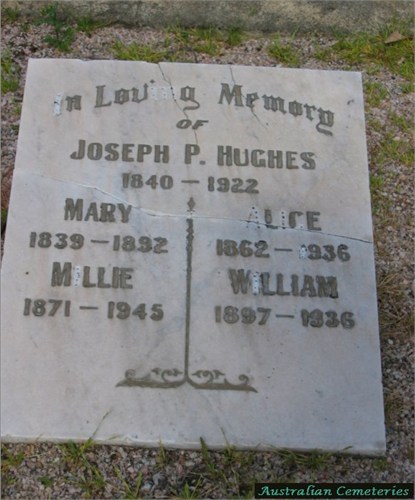
21. Mary RYDER [267] (Joseph12, William6, Thomas2, William1) was born on 13 Sep 1839 in Windsor, Berks, England, died on 16 Apr 1892 in North Adelaide, South Australia at age 52, and was buried on 19 Apr 1892 in Walkerville Cemetery, Adelaide.
General Notes:
1839 UK Birth Windsor, Berks, England
1892 SA Death 202/37 HUGHES Mary Joseph Prentice HUGHES (H), Adelaide
South Australian Register & The Advertiser Monday 18 April 1892
Death Notice:
HUGHES.-On the l6th April, at Childers-street, North Adelaide, Mary, the dearly beloved wife of Joseph P. Hughes, aged 62 years 6 months.
Funeral Notice:
THE FRIENDS of Mr. JOSEPH P. HUGHES are respectfully informed that the Remains of his late WIFE (Mary) will be removed from his residence, Childer street, North Adelaide, on TUESDAY Morning, the 19th inst. at 11 o'clock for interment in the Walkerville Cemetery. Members of the Alliance Tent, I.O.R., please notice the above. P. LeCornue Undertakers 64 O'Connell street North Adelaide.
Other Records
• Census: England, 6 Jun 1841, Victoria St, New Windsor, BRK. Mary is recorded as age 2 born in Berkshire
• Newspaper: Death Notice, 1892, North Adelaide, South Australia. Image courtesy Trove

• Internet Research: I.O.R., 2016. History:
The Independent Order of Rechabites was founded in 1835 at Salford in Lancashire, England to promote temperance and thrift. (http://www.australianrechabites.org.au/)

Mary married Joseph Prentice HUGHES [266], son of George Robert HUGHES [236] and Charlotte Isabella PRENTICE [238], on 10 Jul 1861 in Res. Joseph Ryder, Nairne, South Australia. Joseph was born on 8 May 1840 in Boston Spa, Yorkshire, England, was baptised on 7 Jun 1840 in Boston Spa, Yorkshire, England, died on 29 Oct 1922 in Childer Street, North Adelaide, South Australia at age 82, and was buried on 30 Oct 1922 in Walkerville Cemetery, South Australia.
Marriage Notes:
1861 SA Marriage 47/220 HUGHES Joseph Prentice RYDER Mary, Nairne
General Notes:
1840 UK Birth Boston Spa, Yorks
1922 SA Death 457/566 HUGHES Joseph Prentice, Adelaide
Cemetery: Walkerville Wesleyan; HUGHES Joseph Prentice 82y 1922; born 1840, of North Adelaide; Plot 131
Joseph arrived in the Colony of South Australia as an infant with his parents on the Diadem in 1840.
Resided: Adelaide, Nairne and North Adelaide.
Joseph Prentice Hughes and Mary Ryder met and married in Nairne 1861. Their first child was born at Nairne in 1862, their second child was born in Adelaide in 1863, and from 1865 the remainder of their children were born in North Adelaide or nearby.
In 1897 Joseph married Alice Anne Rowe.
Joseph owned a grocer shop on the corner of O'Connell and Childer Streets, North Adelaide, and they resided at 50 Childer Street. He stabled his horse/s in the triangular section of the parklands between Prospect and Main North Roads. In his latter years Joseph wore a patch over one eye.
Evening Journal (Adelaide) Thursday 30 May 1895
Police Courts:
ADELAIDE: THURSDAY MAY 30
(Before Messrs J.M. Gordon, S.M. J. Abbott, J. Eitzes, and F.W. Wood)
Peter McPhee, alias Rogers, a well-dressed young man, was charged on the information of Joseph P. Hughes, of North Adelaide, with the larceny, on September 19, 1894, of a bay filly, valued at £8. Mr. J. R. Anderson defended. The evidence of the informant was that he had identified a bay mare in the Police Station yard as his. She had been on September 18 grazing on the North Parklands, and he had missed her on the following day.
The Journal (Adelaide) Monday 30 October 1922
Funeral Notice:
HUGHES - the Friends of the late Mr. Joseph P. Hughes are respectfully informed that his Remains will be Removed from his late Residence, Childer street, North Adelaide, this day at 4 p.m., for the Walkerville Cemetery.
P. Le Cornu, Undertaker, 68 O'Connel street, North Adelaide. 'Phone 813, Prospect road, 'Phone 5108.
Chronicle (Adelaide) Saturday 4 November 1922 and Observer (Adelaide Saturday 4 November 1922
Death Notice:
HUGHES. --On the 29th October, at his residence, Childers-street, North Adelaide, Joseph Prentice, beloved husband of Alice A. Hughes, in his 83rd year.
Australian Christian Commonwealth (SA) Friday 24 November 1922
In Memoriam:
JOSEPH PRENTICE HUGHES was born at Boston, England, in the year 1840. His. parents brought him to South Australia in the same year and took up their residence at Nairne where they remained until 1862. When his parents landed here there were only four or five preaching places in South Australia, and the population of the whole of Australia was not more than 100,000, so that Mr. Hughes was a link with the very early days of the Colony. It was while at Nairne at the age of 16 years that he decided, for Christ. In 1862 he came to Adelaide and for a short period was connected with the Pirie Street church. A year later he came to North Adelaide and joined Archer Street and has remained a faithful member ever since. He was interested in the young people and was superintendent of the Sunday school at Enfield and Walkerville. He was for many years a teacher at Archer Street. Mr. Hughes was a man whom everybody respected because of his strong, manly personality and deep religious convictions. His large family of sons and daughters are well known in Church circles and are a credit to him. He may be described as "one of the old school," whose numbers - as far as Archer Street is concerned - are being rapidly depleted by the angel of death. We may surpass the old school in knowledge, skill and learnings but it is very doubtful if we equal them in commonsense, piety, religious conviction and spiritual power. Mr. Hughes passed away on Sunday, October 29, and was laid to rest in the Walkerville cemetery. The Rev. S. Forsyth conducted an In Memoriam service the following Sunday morning at Archer Street.
Research Notes:
Image courtesy of J Miller & I Aston
Other Records
• Birth: 1840, Boston Spa, Yorkshire, England. Born 8 May 1840
.jpg "(455 KB)
(Click on Picture to View Full Size)")
• Baptism: 1840, Boston Chapelry, Yorkshire, England. Baptised 7 Jun 1840
• Baptism: 1840, Boston Spa, Yorkshire, England. courtesy Family Search
• South Australian Directory: Storeman, 1873, Archer-street, North Adelaide.
• Boothby's South Australian Directory: Storeman, 1876, Jeffcott-street, North Adelaide.
• Boothby's South Australian Directory: Storeman, 1877, Jeffcott-street, North Adelaide.
• Boothby's South Australian Directory: Storekeeper, 1885, Childer-street, North Adelaide.
• Boothby's South Australian Directory: Storekeeper, 1886, Childer-street, North Adelaide.
• Boothby's South Australian Directory: Storekeeper, 1890, 67 Gover-street, North Adelaide.
• Boothby's South Australian Directory: Storekeeper, 1905, 50 Childer-street, North Adelaide.
.jpg "(1938 KB)
(Click on Picture to View Full Size)")
• Photograph: Joseph, Dorothy, Kathleen, 1920, North Adelaide, South Australia.
• Death: Headstone, 1922, Walkerville Cemetery, Adelaide.
• Will: 1922, Adelaide, South Australia.
Children from this marriage were:
+ 74 M i. Edwin Joseph HUGHES [253] was born on 30 Apr 1862 in Nairne, South Australia and died on 11 Aug 1862 in Coxs Creek, Nr Nairne, South Australia.
+ 75 M ii. Joseph Ryder HUGHES [254] was born on 27 Dec 1863 in Adelaide, South Australia, died on 30 Jun 1932 in Lower Mitcham, Adelaide, South Australia at age 68, and was buried on 2 Jul 1932 in Walkerville Cemetery, Adelaide.
+ 76 F iii. Mary Hill HUGHES [250] was born on 5 Sep 1865 in North Adelaide, South Australia, died on 7 Jan 1931 in Beetaloo Valley, South Australia at age 65, and was buried on 7 Jan 1931 in Whyalla Cemetery, South Australia.
+ 77 M iv. Robert George HUGHES [255] was born on 24 Jun 1867 in North Adelaide, South Australia, died on 13 Oct 1931 in Victoria Park, Perth, Western Australia at age 64, and was buried on 14 Oct 1931 in Karrakatta Cemetery, Perth, Western Australia.
+ 78 M v. James David HUGHES [256] was born on 5 Nov 1869 in North Adelaide, South Australia, died on 18 Mar 1870 in North Adelaide, South Australia, and was buried on 19 Mar 1870 in Walkerville Cemetery, Adelaide.
+ 79 F vi. Amelia Hannah HUGHES [257] was born on 29 Mar 1871 in North Adelaide, South Australia, died on 19 Nov 1945 in A Private Hospital, South Australia at age 74, and was buried on 21 Nov 1945 in Walkerville Cemetery, South Australia.
+ 80 M vii. Ernest Laurence HUGHES [258] was born on 5 Feb 1873 in North Adelaide, South Australia, died on 4 Aug 1938 in Adelaide, South Australia at age 65, and was buried on 6 Aug 1938 in Dudley Park Cemetery, Adelaide, South Australia.
+ 81 M viii. Arthur Walter HUGHES [259] was born on 10 Jul 1875 in North Adelaide, South Australia, died on 20 Jul 1876 in North Adelaide, South Australia at age 1, and was buried on 21 Jul 1876 in Walkerville Cemetery, Adelaide.
+ 82 M ix. Percy Septimus HUGHES [198] was born on 14 Aug 1877 in North Adelaide, South Australia, died on 31 Oct 1945 in Hampstead, Adelaide, South Australia at age 68, and was buried on 2 Nov 1945 in Walkerville Wesley Methodist Cemetery, South Australia.
+ 83 F x. Louisa Maud HUGHES [260] was born on 7 Jul 1879 in North Adelaide, South Australia, died on 2 Jan 1966 in Magill, Adelaide, South Australia at age 86, and was buried on 4 Jan 1966 in Evergreen Memorial Cemetery, Enfield, South Australia.
+ 84 M xi. Frank Gilbert HUGHES [261] was born on 18 Nov 1880 in North Adelaide, South Australia, died on 29 Oct 1957 in Cannington, Westerna Australia at age 76, and was cremated in Karrakatta Cemetery, Perth, Western Australia.
+ 85 M xii. Arthur Sidney HUGHES [262] was born on 25 Mar 1883 in Prospect, Adelaide, South Australia, died on 21 Dec 1940 in Private Hospital, Adelaide, South Australia at age 57, and was buried on 23 Dec 1940 in North Brighton Cemetery, South Australia.
+ 86 M xiii. Frederick John HUGHES [263] was born on 20 Dec 1884 in North Adelaide, South Australia, died on 9 Jan 1958 in Prospect, Adelaide, South Australia at age 73, and was buried in Dudley Park Cemetery, Adelaide, South Australia.
22. Susanna RYDER [920] (Joseph12, William6, Thomas2, William1) was born in Mar 1841 in Windsor, Bucks, England, died on 21 Feb 1918 in Wool Bay, South Australia at age 76, and was buried in Stansbury Cemetery, South Australia.
General Notes:
1867 SA Marriage 70/304 DUNN Alfred RYDER Susanna Nairne
1918 SA Death 416/559 DUNN Susanna Alfred DUNN [DH] Daly (Resided: Oaklands, Wool Bay)
Cemetery: Stansbury DUNN Susanna 76y 1918; wife of Alfred
The Register (Adelaide) Friday 8 March 1918
Death Notice:
DUNN.-On the 21st February, Susanna, widow of the late Alfred Dunn, beloved mother of Herbert and Frank, Melbourne; Mrs. W. A. Anderson, Gilgandra, NSW; Mrs. G. N. Thompson; Castlemaine, Victoria; and Mrs. J. A. Anderson, Yorketown; aged 76 years.
Although all Susanna's children were born in SA she and Alfred lived in Melbourne for a number of years; at least one child, their youngest son Frank Garfield Dunn lived his life in Melbourne, and their youngest daughter, Lilian and husband,George Thompson, lived at Elphinstine near Castlemaine.
Other Records
• Census: England, 6 Jun 1841, Victoria St, New Windsor, BRK. Susanna is recorded as Susannah age 2m born Berkshire.
• Resided: Minnie's marriage venue, 1897, Buckley-street, Essendon, Melbourne.
Susanna married Alfred Henry DUNN [930], son of Samuel DUNN [1017] and Joan DUFTY [4793], on 30 Jan 1867 in Res of Joseph Ryder, Nairne, South Australia. Alfred was born about 1845 and died on 7 Jul 1904 in Melbourne Hosp., Flemington, Melbourne, Australia aged about 59.
Marriage Notes:
South Australian Register Friday 1 February 1867
Marriage Notice:
DUNN-RYDER.-On the 30th January, by the Rev. Charles H. Goldsmith, at the residencc of the bride's father, Alfred, eldest son of Samuel Dunn, Esq., of North Tauton, Devonshire, England, to Susanna, second daughter of Mr. Joseph Ryder, of Nairne. No cards.
The South Australian Advertiser Saturday 2 February 1867
Marriage Notice:
DUNN-RYDER -On the 30th January, at the residence of the bride's father, by the Rev. C. H. Goldsmith, Alfred, eldest son of Samuel Dunn, Esq., of North Tawton, Devonshire, England, to Susanna, second daughter of Mr. Joseph Ryder, of Nairne. No cards.
South Australian Register Tuesday 26 February 1867
Marriage Notice:
DUNN-RYDER - On the 30th January, by the Rev. Charles H. Goldsmith, at the residence of the bride's father, Alfred, eldest son of Samuel Dunn, Esq., of North Tauton, Devonshire, England, to Susanna, second daughter of Mr. Joseph Ryder, of Nairne. No cards.
General Notes:
Occupation: Miller, Clerk
The Argus (Melbourne) Saturday 9 July 1904
Death Notice:
DUNN.On the 7th July, at the Melbourne Hospital (suddenly) Alfred Henry, dearly beloved husband of Susanna Dunn, of 69 Waltham-street, Flemington, aged 59 years.
Children from this marriage were:
+ 87 F i. (Not Recorded) DUNN [1009] was born on 15 Sep 1867 in Nairne, South Australia and died on 15 Sep 1867 in Nairne, South Australia.
+ 88 F ii. (Not Recorded) DUNN [1010] was born on 2 Jun 1868 in Nairne, South Australia and died on 2 Jun 1868 in Nairne, South Australia.
+ 89 M iii. Alfred Herbert DUNN [1011] was born on 10 May 1869 in Nairne, South Australia, died on 5 Aug 1954 in Coburg, Victoria, Australia at age 85, and was buried on 6 Aug 1954 in Fawkner Memorial Cemetery, Victoria, Australia.
+ 90 F iv. Minnie Gertrude DUNN [1012] was born on 8 Oct 1870 in Nairne, South Australia and died on 4 Feb 1958 in Gilgandra, NSW, Australia at age 87.
+ 91 F v. Elsie Amelia DUNN [1013] was born on 16 Sep 1872 in Nairne, South Australia, died on 5 Oct 1939 in Yorketown, South Australia at age 67, and was buried in Stansbury Cemetery, South Australia.
+ 92 F vi. Lilian Mary DUNN [1014] was born on 4 Nov 1874 in Nairne, South Australia and died in 1969 in Victoria, Australia at age 95.
+ 93 M vii. Willie Samuel DUNN [1015] was born on 6 Mar 1876 in Nairne, South Australia, died on 17 Feb 1897 in Lincoln rd, Essendon, Melbourne, Australia at age 20, and was buried on 19 Feb 1897 in Melbourne General Cemetery.
+ 94 M viii. DUNN [4873] was born on 19 Sep 1880 in Nairne, South Australia. (Stillborn)
+ 95 M ix. Frank Garfield DUNN [1016] was born on 13 Dec 1881 in Nairne, South Australia and died in 1961 in Footscray, Victoria, Australia at age 80.
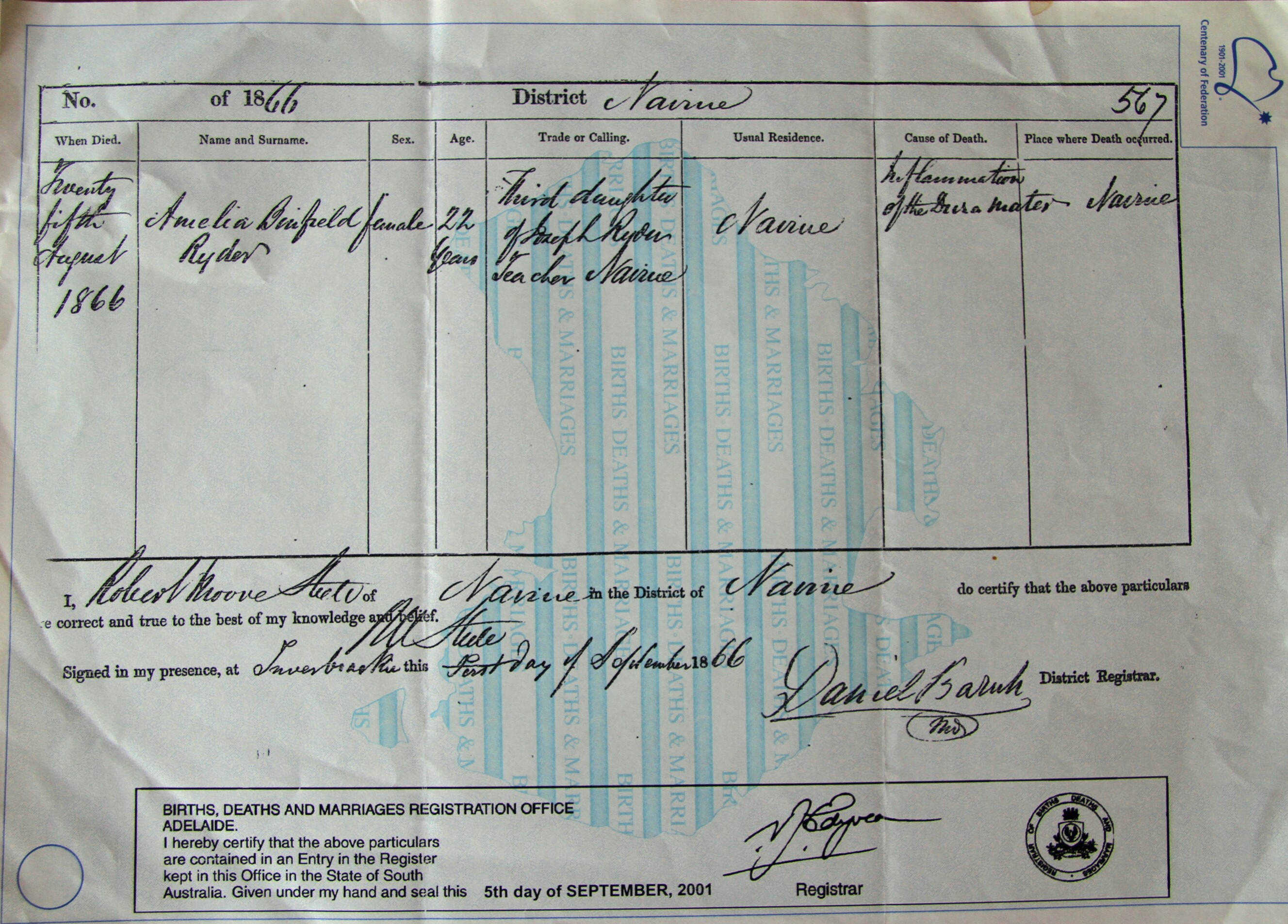
23. Amelia Binfield RYDER [921] (Joseph12, William6, Thomas2, William1) was born on 14 Apr 1844 in Windsor, Bucks, England, was baptised on 9 Mar 1845 in High St, formerly Mount St, Ind or Cong, Lancaster, and died on 25 Aug 1866 in Nairne, South Australia at age 22. The cause of her death was Inflammation of the Dura Mater.
General Notes:
Name: Amelia Binfield Ryder
Birth Date: 14 Apr 1844
Baptism Date: 9 Mar 1845
Baptism Place: High Street Formerly Mount Street-Independent OR Clancasteronal,Lancaster,Lancashire,England
Father: Joseph Ryder
Mother: Mary
FHL Film Number: 0560883 (RG4 129, 76-7)
1866 SA Death 24/567 RYDER Amelia Binfield, Joseph RYDER (F) Nairne (Register records symbol S = Supplementary, additional, unusual information included on registration)
The South Australian Register Tues 28 Aug 1866
Death Notice:
RYDER.-On the 25th August, at Nairne, after eight week's severe suffering, borne with Christian fortitude, Amelia Binfield, third beloved daughter of Joseph and Mary Ryder, aged 22 years. She rests in Jesus.

24. Joseph Hill RYDER [922] (Joseph12, William6, Thomas2, William1) was born on 30 Nov 1846 in Lancaster, England, was baptised on 30 May 1847 in High St, formerly Mount St, Ind or Cong, Lancaster, died on 13 Dec 1862 in nr Nairne, South Australia at age 16, and was buried on 15 Dec 1862 in Nairne Cemetery, South Australia.
General Notes:
Name: Joseph Hill Ryder
Gender:
Birth Date: 30 Nov 1846
Baptism Date: 30 May 1847
Baptism Place: High Street Formerly Mount Street-Independent OR Clancasteronal,Lancaster,Lancashire,England
Father: Joseph Ryder
Mother: Mary
FHL Film Number: 0560883 (RG4 129, 76-7)
1862 14/355 RYDER Joseph Nairne
from Joseph Ryder Snr's Journal
...Little Joe was killed by a careering horse and cart driven by an intoxicated driver, near the old Mill, Nairne on Saturday night 13 Dec 1862. Joe had given notice to his Master that night and his final wages found in his pocket. The fatal wound was a fracture at base of the skull. The driver was committed for trial for manslaughter and sentenced to 1yr hard labour in the Stockade, but after a month his health broke down and JR signed a petition to the Governor for accused to serve remaining time in Adelaide Gaol....
South Australian Register Wednesday 17 December 1862
THE LATE FATAL ACCIDENT AT NAIRNE.-
CORONER'S INQUEST.
[From our Special Correspondent.]
An inquest was held on Monday, 15th December, at 10 a.m., at the Millers' Arms, Nairne, touching the death of Joseph Ryder, jun., before Dr. Esau, J.P., Acting Coroner; Mr. J. R. Toll, foreman; and 16 other inhabitants of Nairne as Jurymen. After being sworn, they proceeded to the residence of the deceased's parents to view the body. On asssembling the first witness called was
Amelia W. Ryder, who deposed as follows: - On Saturday night last past, on coming out of Mr. Parsons's shop, I saw my brother and asked him to go home with us. He did so. Margaret and Robert Gordon were with us. On getting near the old mill we heard a cart coming, and I said, "Oh, this is Mr. Harding's cart; surely he's drunk." I had scarcely said that when I with Maggie Gordon went on one side of the road and the boys on the other. After the cart passed I turned to look, and saw my brother down. I ran and placed his head in my lap. I sent Robert Gordon for Dr. Weld. My brother never spoke. I heard a noise in his throat for a few seconds. I did not hear him breathe. I then placed my hand under his head and found it broken and bleeding. This happened about a quarter to 9 o'clock p.m. Mrs. Thomas was the first person who arrived, then Dr. Weld. My reason for saying I thought Harding was drunk was because the cart was coming at such a furious rate. The cart appeared to come down the middle of the road, and then turned sharp round to the off side towards the loose stones. I do not know the difference between trotting and galloping; but I know he was coming furiously, the stones striking fire as he passed along. It being starlight I recognised Mr. Harding as the driver. He drove on after the occurrence. Margaret Gordon, sworn, said- I came up from Nairne on Saturday evening last past, about half past 8 o'clock, with the last witness.- my brother Robert and the deceased, myself, and Miss Ryder on one side, the boys in the middle of the road. Near the old mill we, heard a cart coming furiously down the road towards Nairne. Miss Ryder and the deceased both said, "Oh, there's Mr. Harding; he must be drunk." The boys went towards the south side. The cart came past round the corner and turned sharp off towards the side the boys had gone. We looked round after the cart had passed and then saw the deceased on the ground. We went to him. My brother ran for Dr. Weld, and I ran to Mr. Whitehead's house for assistance. I only heard the cart coming and stood still until it passed. I recognised Mr. Harding in the cart which was of a yellow colour. I knew it was going at a furious rate because it passed us like a shot, the stones striking fire. Mr. Harding was driving a great deal faster than men usually drive. Robert Gordon, sworn- Between 8 and 9 o'clock on Saturday night last past myself, the two last witnesses, and deceased were walking home from Nairne. When opposite the old mill we heard a cart coming furiously down the road; the girls ran on one side and Joe and I on the other. We got on the new metal, which is on the side the telegraph-posts are. I was nearer the telegraph posts than Joseph; he was on the edge of the metal nearest to the beaten track. The cart was coming very sharp round the corner, and knocked the deceased over. When I first heard the cart coming I ran to the telegraph-posts and then ran on to the road again. The deceased did not follow me, but I think he was talking to the girls. Not being aware that deceased was knocked down, I said, "Come along, Joe." His head was towards Nairne on the metal near the beaten track. From his appearance I believe it was Mr. Harding in the cart. I thought he was cantering, but I would not be sure. The horse was going at a rapid rate.
Elizabeth Case examined - I recollect last Saturday evening. About half-past 8 or a quarter to 9 I saw Mr. Harding drive a cart very fast at the corner turning into his yard. I am certain it was Mr. Harding. He was going very fast, and turned very quick into his yard.
Elizabeth Hains, on being sworn, said- On Saturday night last past about 9 o'clock I heard a cart coming down the road very fast. I ran out to see, because I thought it was running away. I saw it was Mr. Harding driving, so I went in again. I live on the same side as the old mill, towards Byethorne. He was going very fast down the middle of the road.
Henry Lethlean, sworn- About a quarter to 9 on Saturday night last I saw Mr. Harding come home, I was talking to his wife. I said, "Harding is coming." He passed by me, and went into his yard. I went and assisted him to take his horse out of his cart. He was in liquor, but I think quite capable of driving his horse. He was driving in his usual way-about six or seven miles an hour. I saw him pull up and turn the comer. I heard of the accident immediately after.
Samuel Doney, examined, said- On Saturday night, about half-past 8, I was standing between Mr. Humphries's and Mrs. Barrett's. I saw Mr. Harding and his horse and cart come down the road, and go to his own house. I am positively sure he was not going more than 6½ miles per hour. This was after the accident. The cart is an old one, and rattles much more than a cart generally does.
Dr. O. Weld, J.P., sworn- Shortly before 9 o'clock last Saturday night I was called by a person to see Joseph Ryder, jun. I immediately went and found him lying on the ground in the road, his head, resting on his sister's lap. I raised his head and found his skull fractured. I picked him up and carried him to Mr. Whitehead's residence. His heart was beating at the time, but stopped about three minutes after I took him in. Considerable blood was flowing from his left ear. I detected a fracture extending from his left ear midway across the back of his head sufficient to cause death. I left as soon as the heart ceased to beat. His head was towards the old mill and his feet towards Adelaide. He was lying about the middle of the road, From the nature of the fracture it must have been occasioned by a blunt instrument, such as a cart-wheel. The blood came from the left ear in large quantities. There was no abrasion of the skin on the scalp.
George Pope, sworn - On Saturday night last I was at Mr. Harding's between 8 and 9. I heard some one at the back door, and in a few minutes Mr. Harding came in. Mrs. Harding went to him. He said, "l am returned again drunk as usual." By the way he was talking he appeared much intoxicated. I had no conversation with him myself. Thomas Donoghue, jun., examined said- On Saturday night last, between 7 and 8, Mr. Harding called at my shop in Little Hampton. He came in and we had a little chat. I asked him if he was going home. He said "Yes." I then asked him to give me a ride. He said "Yes; get up. "I went with him to Blakiston. I had not seen him drunk. I could not say he was intoxicated. He knew what he was saying. In coming down the hill near Mr. Gray's, at Blakiston, the horse increased his pace and appeared to get master of the driver, as he had a great difficulty to pull him up. The horse broke into a gallop. I was alarmed at the time. John Plunkett, police-constable, sworn, said- About a quarter to 9 on Saturday evening last past, having ascertained the particulars of the accident, I went to Mr. Harding's house. I saw him in the bakehouse. Told him that a child had been driven over by a cart a little way up the road. Told him I thought he was the person who had done it and I should take him prisoner as a charge of manslaughter was likely to arise against him. I cautioned him in the usual way.
He then said he knew nothing about it. He was more than fresh, but he was not dead drunk. Yesterday (Sunday) after he was sober, he said he was not aware he had run over anyone, but if he had he was very sorry for it. The hat I produce I got from his house, and the cart outside belongs to him. This being the whole of the evidence, the Coroner lucidly recapitulated the evidence, and instructed the Jury on the law of the case; after which the room was cleared, and in about half an hour the Jury unanimously returned a verdict that the deceased came by his death by the furious and reckless driving of Charles Harding. The Coroner, at the express desire of the Jurymen, complimented Miss Gordon and her brother, and more especially so Miss Ryder, the sister of the deceased, for the straightforward and clear manner they gave their evidence. The funeral took place at 5 p.m., the sympathies of the people for the bereaved parents and relatives being such as to draw a large assemblage of persons to witness the ceremony, and many were as deeply impressed as though the deceased had been one of their own. Not the least affecting scene was a large muster of his youthful companions from the Wesleyan Sunday-school, to which he belonged, to many of whom he had so endeared himself by his amiable and unassuming disposition and manners as to cause them to feel they had not only lost a companion but a brother.
The South Australian Advertiser, Wednesday 17 Dec 1862
CORONER'S INQUEST.
On Monday, the 15th December, an inquest was held at the Millers' Arms, Nairne, before Dr. Esau, J.P., on the body of Joseph Ryder, jun., a youth about 16 years of age, who met with, his death on Saturday night, about 9 o'clock, from an accident occasioned by a person driving a horse and spring cart. A Jury of 17 having been sworn, John Toll, Esq was chosen Foreman. The Jury viewed the body, which was lying at the residence of deceased's father, and reassembled at the Millers' Arms to hear the evidence.
Amelia Ryder, sister of deceased, was the first witness called, who stated- My age was 18 last February. I remember last Saturday night; myself and Miss Gordon, Robert Gordon, and my brother Joseph, were coming home from Mr. Milway's shop. I gave Joseph, my brother, 6 lbs. of sugar to carry home. We were coming up the middle of the road, and when nearly opposite the old mill, we heard a cart coming up at a furious rate towards Nairne. Myself and Margaret Gordon went on one side of the road, and Bobby Gordon and my brother Joseph went to the other side. I said "it is Harding; he must be drunk." He turned the corner quick. I looked and saw my brother down. Robert Gordon went for the doctor, and Miss Gordon to Mr. Whitehead for assistance. I sat down by him and lifted his head in my lap. I heard a noise in his throat. He never spoke. This noise in his throat lasted for about " a second. I put my hand under his head and felt it bleeding. The accident took place at about a quarter to 9 p.m. on Saturday last, December 13. Dr. Weld came and took him up.
By a Juryman- I thought Mr. Harding was drunk because he was coming at a furious rate down in the middle of the road and took a sharp turn round the corner. It was not very dark. I don't know whether he was trotting or galloping. He was coming at a furious rate. Found my brother lying on his back, his head lying across the road. Recognised the driver, Mr. Harding. I know him. Harding went on and never stopped to see what had occurred. I could swear it was Harding. He did not stop at all. I noticed the light cart, mid hat (hat produced). It was the same sort of hat as this.. Fire was flying from the wheels of the cart.
Elizabeth Gordon called- I was coming up from Nairne with Amelia Ryder, Joseph Ryder, and my brother (Robert Gordon) coming from Mr. Milway's store about half-past 8 p.m., walking slowly, nearly in the middle of the road. When near the old mill heard a cart coming furiously down the road towards Nairne. Amelia and Joseph Ryder said "it's Mr. Harding, he must be drunk." The boys went on one side of the road towards the south and myself and Miss Ryder on the north side of the road. Mr. Harding came quickly round the comer of the road, turned sharp off where the boys were; after a few seconds Miss Ryder and myself saw Joseph Ryder fall. Went to him; Miss Ryder took his head in her lap. I went to Mr. Whitehead for assistance. Robert Gordon went for Dr. Weld. It was starlight. Dr. Weld came and said he was dead.
By a Juryman- I was four or five yards from the cart when this took place. I heard the cart coming. I recognised Mr. Harding. I could swear it was Mr. Harding. The body the Jurymen have viewed is that of Joseph Ryder. By the Jury-Harding was driving very much faster than men do in general.
Robert Gordon, sworn, said- I am 12 years old. I recollect coming home from Nairne on last Saturday night, between 8 and 9 o'clock, with Joseph Ryder, Amelia Ryder, and my sister. Coming near the old mill I heard a cart come up furiously; my sister and Amelia Ryder went on one side, and I and Joseph Ryder went on the other side; we both got on the newly metalled side of the road, close to the telegraph post, where the metal had been put on - on the side of the road where it is worn down a little; I was further on than Joseph was. Joseph was on the edge of the beaten road. Mr. Harding's cart was coming round the corner very sharp, and knocked Joseph down. I immediately ran for Dr. Weld.
By the Jury- When the cart struck Joseph Ryder I was little ahead. I ran to the telegraph post. We were passing, not stopping. The girls called out there was a cart coming. When I heard it I ran to the telegraph post, turned round, and went back. The cart had passed, and knocked Joseph down. Joseph was lying with his head towards Nairne, just on the edge of the metal worn down.
By a Juryman- Mr. Harding was coming nearest the telegraph posts, on the edge of the metal worn down. He was on the wrong side. I believe it was Mr. Harding from his appearance.
By another Juryman- I believe Mr. Harding was cantering. He was going at a mad pace. The cart was yellow. I went for the doctor. I did not see anyone else in the cart.
Elizabeth Case sworn- About half past 8 or 9 o'clock on Saturday night last, saw Mr. Harding driving his cart very fast just as he was driving into his own yard. Certain it was Mr. Harding. No one was with him in tbe cart. He turned very quick. Had a rein in each hand. I was standing at the corner of the Millers' Arms. A friend was with me, remarking, he was driving very fast He was pulling from one side of the road to the other.
Elizabeth Hains- On Saturday night last I was inside my house, and heard a cart coming down very fast. I went out of my house, as I thought a horse was running away. I saw Mr. Harding, who was driving towards Nairne. I live just past the old mill going towards Byethornbs from Nairne. He was driving fast. The reason I came out of my house was because I thought some horses were running away.
Henry Letts Lean sworn- Saw Mr. Harding come home last Saturday night between 8 and 9 o'clock. Helped to take the horse out of the cart. I spoke to Mrs Harding before Mr Harding came home. As I stood there I said, Harding is coming. He was a little in liquor, but quite capable of driving a horse.
By a Juryman- When I saw him he was not driving more than six miles an hour. I was standing at the entrance of Mr. Ryder's schoolroom. Mr Harding never mentioned to me about the accident.
Samuel Doney- I was standing on Saturday night, between 8 and 9, between the Millers' Arms and Mr. Humphries. I save Sir. Harding's horse and cart heading down the road. Saw him go home to his own house in his cart, sitting on the proper side of the cart, on the proper seat the driver aught to sit. To the best of my knowledge he was not going more than six and a half miles an hour. I saw him at home after the accident happened. The cart is an old one, and rattles very much. Octavius Weld, M.D., sworn- On Saturday, shortly before 9 o'clock, a person came for me to see Joseph Ryder, jun. I immediately went, and found him lying on the ground in the road, his head resting on his sister's lap. I raised his head, and found his skull fractured. I picked him up and carried him to Mr. Whitehead's residence. His heart was beating at the time, and stopped about three minutes later. I took him in. A considerable quantity of blood was flowing from his left ear, and I detected a fracture extending from his left ear midway across the back of his head sufficient to cause death. I left as soon as the heart ceased beating, about ten minutes to 9. His head was towards the old mill.
By the Jury- Was the wound such as would be caused by a cart wheel?
Witness- It was caused by a blunt instrument, not by a sharp instrument.
George Pope- I was at Mr. Hardings on Saturday night, between 8 and 9 o'clock. I heard some one at the back door. In a few minutes Mr. Harding came, and Mrs. Harding came into the back of the house. He said to his wife, " I have returned again as drunk as usual". He was speaking to Mrs. Harding. He appeared intoxicated. I had no conversation with him myself.
Thomas Donoghue, jun.- On Saturday last, between 7 and 8 o'clock in the evening, Mr. Harding called at my shop in Little Hampton, and we had a little chat. I asked him if he was going home. He said he was. I asked him to give me a ride home to Blakiston, which he did. He was not drunk; he spoke as though he was not drunk. In going down the hill, by Mr. Gray's, the horse increased his speed, and galloped I believe. I do not know whether Harding got any more drink at my father's. I did not see him do so.
John A. Flunket, police constable- About half-past 8 on Saturday night last I heard that an accident had happened. A boy had been run over. I was told it was done by Mr. Harding. I went to Harding's house, and saw him in the back place where the bake house is. I told him that a boy had been run over on the Mount Barker road, and it was thought he was the party that had driven over him, and I must take him prisoner. As I thought a charge of man slaughter might arise, I duly cautioned him at the same time. He appeared to know nothing of it. He was intoxicated. He appeared not lo be in a hurry. I put the twitches on him, as I wanted to make haste to get other evidence, and pulled him out of the chop. He wanted to know what I was taking him for. I then told him again and cautioned him. I had a slight struggle in the street. After he was sober he did not know anything about it, and expressed sorrow for having done so. This is his hat; I took it from his place, likewise his cart outside. I picked up some sugar mixed with blood where the accident happened. The Jury here went and looked at the cart, and after careful examination returned to the room.
Joseph Ryder, father of the youth, stated- I saw the body of a young lad at Mr. Whitehead's on Saturday night last. That body was that of my son, and to all appearance dead. He is now lying at my house. This concluded the evidence, and the Coroner then summed up, going through all the depositions taken. The Court was cleared, and the Jury considered for about half an hour, and then returned the following verdict:-
"That the deceased, Joseph Ryder, the younger, came to his death on Saturday, the 15th of December, 1862, through the furious and reckless driving of Charles Harding. Mr. J.R. Toll, Foreman." The prisoner was then committed for trial at the next Criminal Sittings of the Supreme Court. Bail allowed. The inquest lasted nearly seven hours.
South Australian Register Thursday 18 December 1862
Death Notice:
RYDER. On the 13th December, at Nairne, from fracture of the skull, Joseph Hill, eldest son of Mr. Joseph Ryder, licensed teacher, Nairne, deeply lamented
Other Records
• Occupation: Telegraph Office, Abt 1861, Nairne, South Australia. Little Joe's Master, Mr Christen, a Chemist and Stationer at Nairne.
.jpg "George & Annie Padman (nee Ryder) (934 KB)
Courtesey of Waterhouse-Padman Tree
(Click on Picture to View Full Size)")
25. Annie Oceana RYDER [923] (Joseph12, William6, Thomas2, William1) was born on 5 Oct 1849 in Onboard Asiatic Nr Tenneriffe (Long 6.5W, Lat. 0.35N), died on 10 Feb 1927 in Glenelg, Adelaide, South Australia at age 77, and was buried on 11 Feb 1927 in St Jude's Cemetery, Brighton, South Australia.
General Notes:
1849 Annie was born on board the Asiatic nr Tenneriffe, position, Long 6.5W, Lat. 0.35N.
1927 SA Death 493/184 PADMAN Annie Oceana George Waterhouse PADMAN [DH] Adelaide
Cemetery: St Judes Anglican Church Cemetery (Brighton) PADMAN Annie Oceania 77 y 1927; wife of George Waterhouse.
The Register Friday 11 February 1927
Death Notice:
PADMAN-On the 10th February, at Glenelg, Mrs. G. W. Padman, beloved mother of Mrs. W. Page (Glenelg), Mrs. W. Raston (W.A.), Mrs. N. Weston. (Chicago, U.S.A.), and Mrs B. Scott (Glenelg), and loved sister of Mrs. D. W. Moyse, aged 77 years.
The West Australian (Perth, WA : 1879 - 1954) Thu 17 Feb 1927
Death Notice:
PADMAN. - On February 11, 1927, at Glenelg, South Australia, Annie, widow of the late George Waterhouse Padman and loved mother of Mrs. W. J. Page, Glenelg, South Australia, Mrs. W. A. Raston, Tammin, Western Australia; Mrs. N. J. Weston, Chicago, U.S.A. age 77.
Glenelg Guardian (SA : 1914 - 1936) Thursday 17 February 1927
OBITUARY.
Mrs. A. O. Padman- An old and highly respected resident of Glenelg, Mrs. Annie Oceana Padman, passed away at a rest home at Glenelg on Thursday afternoon,--after a short illness. The deceased lady, who was 77 years of age, was born at sea while her parents were on voyage to Australia from England. She was a daughter of the late Mr. and Mrs. J. Ryder. Her father'was a schoolmaster, and for 20 years was stationed at Nairne, and subsequently in many of the northern towns of the State, his last school being at Morphett Vale. At that place Miss Ryder married Mr. George Waterhouse Padman 50 years ago. Mr. Padman conducted a general store in Jetty Road, Glenelg, and after his death 37 years ago the late Mr. J. W. Lane, "who for years was in his employ, took over the business which is now conducted by Mr. Lane's family. Mr. Padman was one of the founders and the first trustee of the Moseley Street Methodist church, and Mrs. Padman took an active interest in church affairs until increasing years made it impossible for her to continue. She also took an active interest in the W.C.T.U., and was a member of the Liberal Union. Kindergarten schools also had her ardent support, and she was given the honour, of opening the Moseley Street kindergarten which was founded by her daughter, Mrs. Weston. Mrs. Padman possessed a kindly nature which endeared her to a large circle of friends. Three daughters survive -Mrs. W. J. Page (Glenelg), Mrs. Norman Weston (Chicago, U.S.A.), Mrs. W. A. Raston (Tammin, W.A.). There is also an adopted daughter (Mrs. B. Scott of Glenelg), whom she cared for from a baby of four months, and seven grand children. Her surviving sister is Mrs. D. W. Hoyse[sic] Moyse.
Research Notes:
image courtesy Padman family Tree
Other Records
• Boothbys South Australian Directory: 1895, Milton-street, Glenelg.
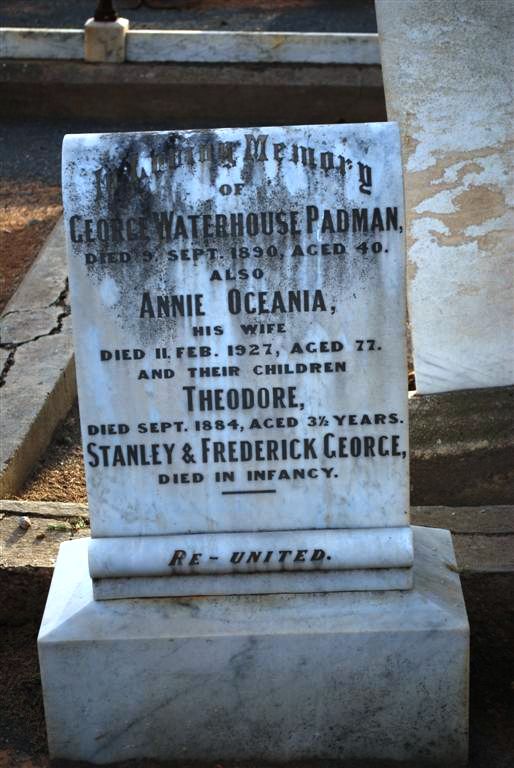
Annie married George Waterhouse PADMAN [924], son of Thomas PADMAN [1639] and Mary Ann WATERHOUSE [1640], on 16 Apr 1878 in Res of Joseph Ryder, Morphett Vale, South Australia. George was born on 2 May 1851 in Adelaide, South Australia, died on 9 Sep 1890 in Kent Town, Adelaide, South Australia at age 39, and was buried in St Jude's Cemetery, Brighton, South Australia. The cause of his death was Leukaemia.
Marriage Notes:
1878 SA Marriage 115/245 PADMAN George W RYDER Annie O, Willunga
South Australian Register Thursday 16 May 1878
Marriage Notice:
PADMAN- RYDER- On the 16th of April at the residence of the bride's father, by the Rev. G. W. Patchell, M.A., George Waterhouse, son of Thomas Padman, Esq. of Kent Town, to Annie Oceana, daughter of Mr. Joseph Ryder, public teacher, of Morphett Vale.
General Notes:
1851 SA Birth PADMAN George Waterhouse Thomas PADMAN Mary Ann WATERHOUSE Adelaide 3/205
1890 SA Death 188/369 PADMAN George Waterhouse Herbert PADMAN (B) Norwood
Cemetery: St Judes Anglican Church Cemetery (Brighton) PADMAN George Waterhouse 40 y 1890; husband of Annie Oceania
South Australian Register (Adelaide, SA : 1839 - 1900) Tuesday 2 June 1885
ASSIGNMENTS
. . . George Waterhouse Padman, trading as Padman Brothers, Glenelg, storekeeper.
Adelaide Observer (SA : 1843 - 1904) Saturday 6 June 1885
Insolvencies:
. . . George Waterhouse Padman, trading as Padman Brothers, Glenelg, storekeeper. . .
South Australian Register (Adelaide, SA : 1839 - 1900) Monday 9 August 1886
POLICE COURTS.
Adelaide : Saturday, August 7.
[Before Mr. S. Beddome. P.M.]
Frank Poole, Walter Codling, and Harry Bright., youths, were charged by George Waterhouse Padman with stealing a whip, valued 10s. 6d. On the evening of August 5 prosecutor left a whip in his trap in the yard adjoining the Draper Memorial Church, Gilbert-street, and on his coming out of Church he found that the whip had been removed. Subsequently several boys were seen about the neighbourhood with whips in their possession, and on Friday Bright and Codling each handed a whip to Detective Lawton, who was informed by Poole, 'We heard yon were looking for us, and we thought we had better bring the whips to the Detective Office.' Defendants pleaded guilty, and were each sentenced to twenty-four hours' solitary confinement. James Gumley, a youth, appeared to answer a charge of having stolen & whip, valued 63. 6d., the property of Robert Brady. It appeared from the evidence that the whip was obtained in the same way and from a trap at the same place as the one in the previous case. Sentenced to a like imprisonment.
Evening Journal (Adelaide, SA : 1869 - 1912) Wed 10 Sep 1890
Death Notice:
PADMAN.-On the 9th September, at Norwood, George WaterhousePadman, of Glenelg, the beloved husband of Annie O. Padman, and second son of Thomas Padman, of Norwood,aged 39 years.
Evening Journal (Adelaide, SA : 1869 - 1912) Mon 9 Sep 1895
In Memoriam:
PADMAN.-George Waterhouse Padman, of Glenelg, who died on the 8th September, 1880, aged 40 years. "He asked life of Thee, and Thou gave it him, even length of days for ever and ever."
Research Notes:
Information from Google re Geo Waterhouse Padman.
Other Records
• Boothbys South Australian Directory: Storekeeper, 1876, Jetty rd, Glenelg.
• Boothbys South Australian Directory: Storekeeper, 1877, Jetty rd, Glenelg.
• Boothbys South Australian Directory: Storekeeper, 1878, Jetty rd, Glenelg.
• Boothbys South Australian Directory: Storekeeper, 1879, Jetty rd, Glenelg.
• Boothbys South Australian Directory: Storekeeper, 1880, Jetty rd, Glenelg.
• Boothbys South Australian Directory: Storekeeper, 1881, Jetty rd, Glenelg.
• Boothbys South Australian Directory: Storekeeper, 1882, Jetty rd, Glenelg.
• Boothbys South Australian Directory: Storekeeper, 1889, Jetty rd, Glenelg.
• Boothbys South Australian Directory: Storekeeper, 1890, Jetty rd, Glenelg.
Children from this marriage were:
+ 96 F i. Winifred Mary PADMAN [945] was born on 17 Jan 1879 in Glenelg, Adelaide, South Australia, died on 21 Apr 1963 at age 84, and was buried in St Jude's Cemetery, Brighton, South Australia.
+ 97 F ii. Madeline PADMAN [946] was born on 20 Mar 1880 in Glenelg, Adelaide, South Australia and died on 9 Jul 1960 in Perth, Western Australia at age 80.
+ 98 M iii. George Theodore PADMAN [947] was born on 18 May 1881 in Glenelg, Adelaide, South Australia, died on 5 Sep 1884 in Glenelg, Adelaide, South Australia at age 3, and was buried in St Jude's Anglican Church Cemetery, Brighton, South Australia.
+ 99 M iv. Stanley PADMAN [948] was born on 12 May 1882 in Glenelg, Adelaide, South Australia, died on 10 Jul 1882 in Glenelg, Adelaide, South Australia, and was buried in St Jude's Anglican Church Cemetery, Brighton, South Australia.
+ 100 M v. Frederick George PADMAN [949] was born on 29 Sep 1884 in Glenelg, Adelaide, South Australia, died on 20 Apr 1885 in Glenelg, Adelaide, South Australia, and was buried in St Jude's Anglican Church Cemetery, Brighton, South Australia.
+ 101 F vi. Theodora Ryder PADMAN [950] was born on 19 Nov 1888 in Glenelg, Adelaide, South Australia and died on 2 Jul 1972 in Evanston, Illinois, USA at age 83.
26. Matilda RYDER [925] (Joseph12, William6, Thomas2, William1) was born on 4 Jun 1852 in Adelaide, South Australia and died on 21 Sep 1853 in Hay Valley, Nairne South Australia at age 1.
General Notes:
1852 SA Birth 4/38 RYDER Matilda, Joseph RYDER, Mary HILL, Adelaide
No death is recorded for Matilda Ryder in SA Death records.
Leith Ryder of WA has a death date of 21 Sep 1853 at Hay Valley - (which I have adopted as at 2013).
Joseph Ryder mentions the birth of this child (in his autobiography) while he was away at the Diggings.
The IGI records two entries: Emma Ryder & Emma Matilda Ryder born 1852 South Australia; death 1853 South Australia.
27. Eliza Smillie RYDER [926] (Joseph12, William6, Thomas2, William1) was born on 25 Jan 1855 in Adelaide, South Australia and died on 15 Jan 1917 in Perth, Western Australia at age 61.
General Notes:
1855 SA Birth 5/108 RYDER Eliza Smillie Joseph RYDER Mary (not recorded), Adelaide
1897 Removed to WA (according to 1917 Obit)
1917 WA Death Perth
The Register (Adelaide) Wednesday 17 & Thursday 18 Jan 1917
Death Notice:
HOCKING.- At her residence, Perth, W.A., Eliza Smillie, wife of H. Hocking, late of Nantawarra, S.A., and beloved sister of Mrs. Dunn, Mrs. G. W. Padman, and Mrs. D. W. Moyse.
The West Australian Friday 19 Jan 1917
Obituary:
The Late Mrs. H. Hocking. -The funeral of the late Mrs. Eliza Smillie Hocking, wife of Mr. Herbert Hocking, 82 Palmerston-street, Perth, took place on Wednesday afternoon, and was largely attended by persons representing the professional, business, and other interests of the community. The deceased, aged 62 years, was born in South Australia, and had resided in this State for the past 20 years. Her husband and grown-up family of five daughters and three sons survive her. After a service held at the house the cortege moved from her late residence, and proceeded by road to the Congregational portion of the Karrakatta Cemetery, where the remains, enclosed in a polished jarrah casket, with silvered mountings, were in interred. The Rev. S. H. Cox, assisted by the Revs. W. A. Potts and G. Wright conducted the burial service. The chief mourners were Mr. H. Hocking (husband), Mesdames G. Manning and V. Bentley, Miss Doris Hocking (daughters), Messrs. Herbert R. and Norman W. E. Hocking (sons) Mrs. M. Hocking (daughter-in-law), Messrs. Geo. Uppill, G. Manning. and V. Bentley (sons-in-law), W. C. Ryder (brother), Mrs. Raston (niece), and Mr. Raston (nephew). The pall-bearers were Messrs. W. M. Gray, J. Fairfax Conigrave, J. J. East, J. Schoe, I. Blackman, C. A. Hall, J. D. Manning, and C. E. Connop. A large number of wreaths was laid on the grave, and numerous letters, telegrams, and messages of sympathy were received by the family. The funeral arrangements were carried out by Messrs. C. H. Smith.
Other Records
• Resided: 1916, North Perth, West Australia.
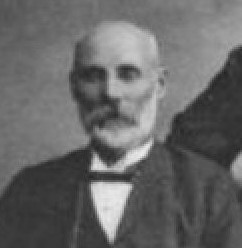
Eliza married Herbert HOCKING [931], son of Nicholas J.R. HOCKING [377] and Sarah SHORE [3787], on 15 Apr 1876 in Res of Joseph Ryder, Noarlunga, South Australia. Herbert was born on 26 Mar 1850 in Adelaide, South Australia, died on 26 Jun 1932 in Perth, Western Australia at age 82, and was buried in Congregational Cemetery, Karrakatta.
Marriage Notes:
1876 SA Marriage 107/256 HOCKING Herbert RYDER Eliza Smillie, Morphett Vale
South Australian Register Wednesday 19 and Friday 21 Apr 1876
Marriage Notice:
HOCKING-RYDER-On the 15th April at the residence of the bride's father, by the Rev. James Haslam, Herbert Hocking, of Adelaide, to Eliza Smillie, daughter of Mr. Joseph Ryder, of Noarlunga.
General Notes:
1850 SA Birth HOCKING Herbert Nicholas HOCKING Sarah SHORE Adelaide 3/47
1932 W.A. Death Reg 1370
1994 Hocking became a suburb in Wanneroo
The People of Perth by C.T. Stannage (Perth 1894)
There were several Hocking families in goldrush Perth. A Herbert Hocking was president of the Stock Exchange, (and an E.W. Hocking was a Perth City councillor).
The Daily News (Perth) Wednesday 19 Mar 1930
MANY HAPPY RETURNS
Eighty Years Old Today Mr. Herbert Hocking
Many happy returns of the day to Mr. Herbert Hocking, who is 80 years old today! "Yes, I suppose I look very well for my age, and I feel better now than I have been for years," remarked Mr. Hocking when congratulations were extended to him this morning. There is no danger of the name of Hocking dying out in Western Australia, because in addition to his eight children, all of whom are settled on the land, four sons being farmers in the Katanning district, Mr. Hocking has 31 grand-children. "That's interesting, in view of the cry for population in Australia," he observed with a chuckle. Mr. Hocking was born in Rundle street, Adelaide, on March 19, 1850. The Sir John Barleycorn Hotel now stands on the site of his old home. Thirty five years ago he came to Western Australia, having been preceded by his brothers, Percy and Sydney, who had purchased the 'Western Argus' news paper at Kalgoorlie. They afterwards started the 'Kalgoorlie Miner,' and Mr. Hocking was appointed Perth representative. He has occupied the position for about 30 years, and for very many years has been installed in an office at Lombard Chambers, St. George's Terrace. He is a well-known figure in many walks of public life. For 33 years Mr. Hocking has been a member of the Perth Stock Exchange, and 27 years ago was instrumental in the establishment of the Wanneroo Roads Board, and has been a member of the board since its inauguration. For 20 years he was chairman. Mr. Hocking was not long in Perth before he was appointed to a seat on the Perth Hospital Board, which he occupied for four years. In his capacity of justice of the peace he filled the position of coroner on numerous occasions. He was appointed a member of the council for the School for the Blind, and, has been identified with the institution for 33 years, and for the past 18 years has carried out the duties of honorary secretary. For a number of years Mr. Hocking was a member of the now defunct Caves Board, of which the late Sir Winthrop Hackett was chairman. Mr. Hocking has been a member of W.A. Auxiliary of the British and Foreign Bible Society for 33 years, and now that the president, the late Archbishop Riley, has passed away, Mr. Hocking is the senior vice president of the society. Along with the late Mr. Charles Moore, Mr. Percy Harrison, Mr. J. Bickford, and others, Mr. Hocking was a member of the original committee which established the Children's Hospital, and for several years acted as treasurer. He is still a trustee of the hospital and recalled the fact that when treasurer he had £2400 locked away at fixed deposit in the Bank of Western Australia. For 25 years Mr. Hocking has been a deacon of Trinity Congregational Church, and has also been treasurer of the Congregational Union, of which organisation he is a past-chairman.
EARLY EXPERIENCE
Speaking of his early experiences in Western Australia, Mr. Hocking mentioned that in connection with Stock Exchange business it was quite a common sight 30 years ago, in the boom days to see stock and share brokers operating freely on the footpath in St. George's Terrace after the business sessions at the Stock Exchange, members of which institution then met each morning and afternoon in a room in the suite of offices now occupied by Messrs. Stone. James and Co. When the Stock Exchange list was posted outside, the "kerbstone operators," as they were called, got busy, and many large and important sales of stocks and shares took place on the footpath. "On the Stock Exchange we feel the pulse of the financial situation quicker than anyone else," observed Mr. Hocking when remarking on the fact that during recent months there had been a genuine tightening up so far as money was concerned. Banks today, he said, would not dream of standing behind a man in any deal whatever that savored of a speculation. "I think the period through which Australia is now passing will last for some time," said Mr. Hocking, who pointed to the fact that the last sales of wheat in London realised only 38s 6d a quarter, which was the lowest price he could remember for a long time.
ONCE A FARMER
Mr. Hocking was once a farmer himself. That was about 40 years ago, before he came to Western Australia. He was located at Nantawarra, near Balaclava, in the Port Wakefield district, in South Australia, and still remembers the fact that he received only 1s 9d a bushel for his crop one season. As a youth he spent much of his time overlanding with stock and working on sheep stations around Bordertown, in South Australia. Many years ago at Bordertown he recalls having met Adam Lindsay Gordon, who was a great friend of Messrs. John and George Ridoch, who owned Nalang sheep station, on which Mr. Hocking was employed. When Mr. Hocking first knew Bordertown the only buildings it contained were a police station, a store, a "pub," and a blacksmith's shop. Today it is one of Australia's finest inland towns. Mr. Hocking has been twice married. His first wife was Miss Ryder, of Nairn, South Australia, and daughter of his old school master. The present Mrs. Hocking was Miss Voysey, and is a Devonshire girl.
The West Australian Monday 29 Aug 1932
FUNERAL
The Late Mr. Herbert Hocking.
On August 26 there passed away, at his late residence, Nantawarra, 82 Palmerston-street, Perth one of the best known and highly respected citizen of the State, in the person of Mr. Herbert Hocking. Deceased had an interesting and useful career, and was a conspicuous figure in the business life of the city. He was a respected member of the Stock Exchange, and an industrious worker in the interests of the blind, having held the office of hon. secretary for a number of years. Although a busy man, he found time to devote to other civic duties, being a justice of the peace, an active member of the Wanneroo Road Board, Masonic lodges, the Children's Hospital, and an old adherent of Trinity Congregational Church, where he was one of the senior deacons and trustees. News of his death at the age of 82 years was received with sincere regret. A sorrowing widow and a grown-up family remain to mourn their loss. The cortege, a lengthy one, with the hearse a mass of floral emblems, moved, at the conclusion of a short service, to the Congregational Cemetery, Karrakatta. where it was met by a large and representative assemblage. The Rev. K. Richards officiated at the residence and the graveside. The chief mourners were Mrs G. M. Hocking (widow), Herbert, Arthur and Norman (sons), Mesdames Geo. Uphill, Geo. Manning, R. W. East. V. L. Bentley, and H. Roberts (daughters), Messrs. Geo. Manning. V. L. Bentley, and H. Roberts (sons-in-law). Mrs. H. Repton (granddaughter), Mr. H. Repton (grandson-in-law), Mr. Ernest W. Hocking (brother). The pall-bearers were Rev. Theo. Bryant (representing Congregational Church Union), A. Hawkes, L. Ballarini (Blind Institute), F. Helsham (Deacons Trinity Church), P. O. Carter (Perpetual Trustees and Agency Company), E. Ashby (Justices' Association). B. W. Frankish (W.M. Royal Stuart Temperance Lodge). Those present to pay their last respects were Rev. Geo. Tulloch (vice-president British and Foreign Bible Society). V. Hammersley. Mr. R. S. Sampson, M.L.A, (Road Board Association). A J. Mellor, N. V. Bremner. A. G. Bird. C. A. Saw (Perth Stock Exchange). W. Ashton (S.W.), G. Cowie (J.W.), A. Palmer, B. Andrews, E. Walker. J. Shaw. S. Devenish, Debnam, Anderson (Royal Stuart Temperance lodge), V. R. Abbott. W. Nicholson (Trustee Trinity Church), S. B. Alexander. E. F. Bickford (hon. trustees British and Foreign Bible Society), H. J. Minors (Children's Hospital). J. R. Gee, R. C. Yeldon (Victoria Institute and Industrial School for the Blind), A. 13 Sharland. F. J. Everett, G. Ide, H. Stockman, J. Wansbrough, J. D. Manning, C. Poole, J. C. Show, M. Wilkinson, M. Curry, M. Shephard. F. G. Hughes , J. S. White, T. Gammon, A. Stewart, I Blackman, V. R. Abbott, J. Wingrove, A. Haig, D. J. Keane, A. Bentley, W. D. Robinson, W. H. Shields, A. F. Devenish, E. Ashby, B. Kaston, R. G. Durstan, S. A. Caporn, J. and S. Caporn, J. Connaughton, F. G. Mainwaring, H. A. White, S. and W. Nottage, Rev. W. J. Cowley, P Sheridan, W. Seddon, M. White, A. Backshall, S. Cockman. A. Wood, W. Tapping, J. Forrester, G. Tapping, W. V. Esley, A. B, Flint, A. B. Nott. W. E. Tremlett, H. Cooke, G. A. Debman, S Thompson, J. Slather, T. B. Durham, H. S. Yeates, A. G. O'Keefe. E. J. Cockman, H. Gover, J Bastow, G. E. Letch, A. H. Ilearnden, C. A. Watkins, R. S. Smith, T. C. Armstrong, Mesdames Wood, Thompson, Hillman, Bestwick, Durham, Sparks, Wingrove, Haig, Armstrong, and Miss Stainer. Donors of floral tributes comprised the following: - His loving wife, eight affectionate children, Ernest and Elizabeth Hocking, May and family, Meryl, Kathleen, Keith and Alfred, John, Maggie and May, S. E. Hocking (wife and family) Mollie, Nonnie, Shirley, Stuart and Gwenyth, Mr. T. H. Bath, Hazel and Hope, Dorothy, Doreen, Jeannie and Ren., Harold, Doreen, and Pan, Miss V. Plant, Mr. and Mrs. W. E. Trembert, Mrs. Elliott, Mr. H. and Miss E. Bentley, Mr and Mrs. G. Bell, Mr. and Mrs. J. Wingrove, Mrs Wyatt, O. Gough. Mr. and Mrs. R. Bentley, Mr. and Mrs. Wing, Mr. and Mrs. C. Poole, Mrs. and Clare Kruth, Mrs. Dot Perry and family, Lyla and Sis Thomas, D. J. Carmichael, J. R. and M. H. Crellin. Mrs. Sparks and family, president and members Children's Hospital, Stock Exchange of Perth, his friends of Lombard Chambers, Hocking and Company, Kalgoorlie, chairman and members of the Wanneroo Road Board, Council and Workers Western Australian Institute and Industrial School for the Blind, Worshipful Master, Officers and Bethren[sic] Royal Stuart Lodge. Many telegrams, letters, cards and personal expressions of condolence were received by the bereaved family. The funeral arrangements were conducted by Messrs C. H. Smith and Co.
The Advertiser (Adelaide) Thursday 17 August 1933
PUBLIC NOTICES SOUTH AUSTRALIA.
IN THE SUPREME COURT.
TESTAMENTARY CAUSES JURISDICTION. HERBERT HOCKING DECEASED. NOTICE IS HEREBY GIVEN that after the expiration of eight days APPLICATION will be made in the Registry of the Supreme Court of South Australia in its Testamentary Causes Jurisdiction for the SEALING of an EXEMPLIFICATION dated the 21st day of July 1933 of the PROBATE of the WILL of HERBERT HOCKING late of 82 Palmerston street Perth in the State of Western Australia agent deceased granted by the Supreme Court at Perth PAVY, HARRY & PAVY, 44 Grenfell street, Adelaide. Solicitors for BAGOTS EXECUTOR & TRUSTEE COMPANY LIMITED Attorneys for The Perpetual Executors Trustees & Agency Co. (W.A.) Limited and Herbert Ryder Hocking the executors named in the said will.
The West Australian (Perth) Wednesday 22 August 1934
IN THE SUPREME COURT OF WESTERN AUSTRALIA.
PROBATE JURISDICTION.
In the Matter of the Will of HERBERT HOCK ING, late of 82 Palmerston-st, Perth, in the State of Western Australia, agent, deceased. Notice is hereby given that the accounts and plan of distribution in the above estate have this day been filed in my office and all persons having any claim on the said estate or being other wise interested therein are hereby required to come in before me at my said office on or before the 8tb day of September, 1934, at 10.30 o'clock in the forenoon and inspect the same and if they shall think fit object thereto, otherwise if the said accounts be not objected to the same will be examined by me and passed according to law. Dated the 21st day of August, 1934. T. F. DAVIES. Master.
SHAW & SHAW, National Mutual Buildings, 81 St. George's-ter., Perth, Solicitors for the Executors. The Perpetual Executors Trustees and Agency Company (W.A.) Limited, and Herbert Ryder Hocking.
Children from this marriage were:
+ 102 F i. Rosa HOCKING [4080] was born on 26 Mar 1877 in Adelaide, South Australia and died in 1877.
+ 103 F ii. Gertrude Shaw HOCKING [3712] was born on 22 Mar 1878 in Adelaide, South Australia, died on 8 Nov 1958 in Tammin, Western Australia at age 80, and was buried in Tammin Cemetery, Western Australia.
+ 104 M iii. Herbert Ryder HOCKING [3713] was born on 27 Mar 1880 in Adelaide, South Australia, died on 14 Apr 1964 at age 84, and was buried in Tammin Cemetery, Western Australia.
+ 105 M iv. Arthur Stanley HOCKING [3725] was born on 3 May 1882 in Adelaide, South Australia, died on 2 Mar 1957 at age 74, and was buried in Tammin Cemetery, Western Australia.
+ 106 M v. Norman Willie Ernest HOCKING [3728] was born on 7 Aug 1884 in Adelaide, South Australia, died on 24 Mar 1959 in Perth, Western Australia at age 74, and was buried in Karrakatta Cemetery, Perth, Western Australia.
+ 107 F vi. Myrtle Mary HOCKING [3737] was born on 7 Feb 1886 in Adelaide, South Australia and died on 26 Mar 1972 in Perth, Western Australia at age 86.
+ 108 F vii. Hazel Amelia HOCKING [3744] was born on 15 Sep 1888 in Nantawarra, South Australia, died on 31 Oct 1953 in Bunbury District Hospital, Bunbury, Western Australia at age 65, and was cremated on 3 Nov 1953 in Karrakatta Cemetery, Perth, Western Australia.
+ 109 F viii. Elsie Emma HOCKING [3750] was born on 23 Jul 1891 in Nantawarra, South Australia, died on 8 Jun 1939 in Perth, Western Australia at age 47, and was cremated on 10 Jun 1939 in Crematorium Chapel Karrakatta, W.A.
+ 110 F ix. Doris May HOCKING [2883] was born on 9 May 1898 in Perth, Western Australia, died on 10 Aug 1937 in Perth, Western Australia at age 39, and was buried on 11 Aug 1937 in Congregational Cemetery, Karrakatta.
28. Emma Matilda RYDER [927] (Joseph12, William6, Thomas2, William1) was born on 2 Feb 1857 in Vallies, Near Nairne, South Australia and died on 28 Mar 1858 in Nairne, South Australia at age 1.
General Notes:
1857 SA Birth 10/286 RYDER Emma Matilda, Joseph RYDER Mary HILL, Nairne
1858 SA Death 7/272 RYDER Emma Matilda, Nairne

29. William Charles RYDER [928] (Joseph12, William6, Thomas2, William1) was born on 21 Oct 1858 in Nairne, South Australia, died on 21 Aug 1923 in 2 Norbert St., East Perth, Western Australia at age 64, and was buried on 22 Aug 1923 in Karrakatta Cemetery, Perth, Western Australia.
General Notes:
1858 SA Birth 14/453 RYDER William Charles Joseph RYDER Mary HILL, Nairne
1923 WA Death RYDER WILLIAM C Male PERTH 967
Perth WA Cemetery: Karrakatta - Congregational - Section AA - Gravesite: 0270
William lived in Western Australia for 19 years (as per Death Cert)
State Records of South Australia:
Surname: RYDER
Given name(s): William Charles
Born: 21-10-1858 Nairne SA
Previous occupation: musician
Joined: 1-6-1884
Marital status: married
Notes: resigned 11-9-1902
Sources: GRG5/23, PG 1884
POLICE SERVICE RECORD - State Records GRG 5/23
WILLIAM CHARLES RYDER
Joined: 1/6/1884
Married:
Previous Occupation - Musician
Examinations passed - Corporals 21/3/1899
DATE OF APPOINTMENT RANK STATION OR PROMOTION
1/6/1884 3rd Class Mounted Constable ADELAIDE
15/4/1885 3rd Class Mounted Constable MARRYATVILLE
1/2/1886 Bottom of 3rd Class MARRYATVILLE
1/11/1886 Bottom of 3rd Class ADELAIDE
1/11/1887 Bottom of 3rd Class WOODSIDE
1/10/1891 2nd Class Mounted Constable WOODSIDE
1/7/1891 2nd Class Mounted Constable MT BARKER
1/7/1892 Re-instated 689/1892
15/4/1894 Re-instated ADELAIDE
9/4/1894 Re-instated QUORN
4/3/1897 Re-instated CALTOWIE
11/9/1902 Resigned
PUNISHMENT AND REPRIMANDS GRG 5/18 1828-1923
20/6/1885 Leaving Barracks without Permission
Punishment - Cautioned
31/1/1886 Neglect of Duty and Absent from Station without Leave
Punishment - Fined 3 Days Pay and Reduced to Bottom of 3rd Class
24/4/1886 Late for Duty
Punishment - Fined 2/6d.
30/9/1887 Absent without Leave
Punishment - Fined 2/6d.
Extract from [Police]Station Journal - Quorn 1895-1900
Friday 14th June 1895
M.Cs (mounted constables) WELLS, RYDER AND F.C. (first class constable) HARNETT on Town and Station duty at 10a.m. Prisoner Reilley was discharged from custody at 1pm. William Dempsey, Farmer of the Hundred of Pichi Richi reported that a second hand riding bridle with plated buckles and an iron bit, value 5/- his property, had been stolen from a fence at the back of the Town Hall, Quorn between 8p.m. of 13th and 8a.m. of 14th inst. M.C. Ryder making enquiries re same, obtained no trace of it.
The Daily News Wednesday 10 Sep 1913
LICENCE TRANSFERRED
William Hornsby Crooks, licensee of the City Bottling Works, 158, Lord street, Perth, applied to-day to Mr. Roe, P.M., for a transfer of his one gallon licence to William Charles Ryder, of 2 Norbert-street, East Perth. The application was granted.
The West Australian Thursday 11 Sep 1913
NEWS AND NOTES
Licence Transfer. As chairman of the Perth Licensing Bench. Mr. A.S. Roe, P.M., yesterday granted a transfer of the gallon licence in respect of the City Bottling Works, 158 Lord-street, from William Hornaby Crooks to William Charles Ryder.
The Daily News (WA) Tuesday 21 August 1923
Funeral Notice:
RYDER. -The Friends of the late WILLIAM CHARLES RYDER, beloved husband of Mrs. Ann Ryder, of 2 Norbert street, East Perth, father of Norman, Geoffrey, Marjory, and Joyce, are respectfully invited to follow his remains to the place of interment, the Congregational Cemetery, Karrakatta. The Funeral is appointed to leave his late residence, 2 Norbert-street, East Perth, at 3 o'clock TOMORROW (Wednesday) AFTERNOON, per road. Friends wishing to attend the Funeral may proceed by the 3.45 p.m. train leaving C.H. Smith and Co., Undertakers, 281 Newcastle-St., Perth. Tel. A 1231.
The West Australian (Perth) Wednesday 22 August 1923
Death Notice:
RYDER. On Angust 21, at his residence, East Perth, William Charles, beloved husband of Ann Ryder, and father of Norman C. and Geoffrey K., Marjorie and Joyce, aged 64 years 10 months.
The West Australian Wednesday 22 August 1923
Funeral Notices:
RYDER. The Friends of the late William Charles Ryder, beloved husband of Mrs. Ann Ryder, of 2 Norbert-street. East Perth, father of Norman, Geoffrey, Marjorie and Joyce, are respectfully invited to follow his remains to the place of interment, the Congregational Cemetery, Karrakatta. The Funeral is appointed to leave his late residence, 2 Norbert-street, East Perth, at 3 o'clock THIS (Wednesday) AFTERNOON, per road. Friends -wishing to attend the Funeral may proceed by the 3.45 p.m. train leaving Perth. C.H. Smith and Co, Undertakers, 281 Newcastle-street, Perth. Tel. A1231.
ABERCORN LODGE 26, W.A.C. RYDER.- The Brethren of the above Lodge are requested to follow the remains of late Wor. Brother Wm. Charles Ryder, to the place of interment, the Congregational Cemetery. Karrakatta. Brethren wishing to attend may proceed by 3.45 p.m. train leaving Perth TO-DAY (Wednesday). J.H. O'Shannessy, W.M. C.H. Ram, Secretary.
LODGE DIAMOND JUBILEE, No. 23, W.A.C. RYDER. - Members of the above Lodge, and the Craft in general, are respectfully invited to follow the remains of their late Tyler, Wor. Bro. W.C. Ryder, to the place of interment, the Congregational Cemetery, Karrakatta. The Funeral is appointed to leave his late residence. 2 Norbert-street, at 3 p.m. TO-DAY (Wednesday). Brethren wishing to attend the Funeral may proceed by the 3.45 p.m. train from Perth. T.H. Edwards. Master. J. Cruickshank, Secretary.
DIAMOND JUBILEE LODGE No. 23, WM.C. RYDER. - Members of the above Lodge and the Craft in general, are respectfully requested to follow the remains of our late Worshipful Brother William Charles Ryder, to the place of interment, the Congregational Cemetery, Karrakatta. The Funeral is appointed to leave his late residence, 2 Norbert street, East Perth, at 3 o'clock THIS (Wednesday) AFTERNOON, per road. Those wishing to attend the Funeral may proceed by the 3.45 p.m. train leaving Perth. T.H. Edwards, W.M.M. Cruickshank, Secretary.
ROYAL STUART TEMPERANCE LODGE, No. 78. WAC. RYDER. - Brethren of the above Lodge, and the Craft in general, are respectfully requested to follow the remains of our late Worshipful Brother, William Charles Ryder (father of our Worshipful Master, Worshipful Brother G.K. Ryder, and of Brother W.C. Ryder. Wellington Lodge No. 4) to the place of interment, the Congregational Cemetery. Karrakatta. The Cortege will leave his late residence, 2 Norbert-street, East Perth, at 3 o'clock THIS (Wednesday) AFTERNOON, per road. Those desirous of attending the Funeral may proceed by the 3.45 p.m. train leaving Perth. W.H. Whitford, Secretary.
UNITY LODGE No. 11. W. C. RYDER. - Members of the above Lodge and the Order in general, are respectfully requested to follow the remains of our late Worshipful Brother, William Charles Ryder, to the place of interment, the Congregational Cemetery. Karrakatta. The Funeral is ap- pointed to leave his late residence. 2 Norbert Street. East Perth, at 3 o'clock THIS (Wednesday) AFTERNOON. per road. Those wishing to attend the Funeral may proceed by the 3.45 p.m. train leaving Perth. R.H.G. Clark. W.M. H.R. Bristow, Secretary.
MT LAWLEY NORTH PERTH BRANCH R.S.L. RYDER.- Members of the above Branch are respectfully requested to follow the remains of our comrade (G. K. Ryder's) late father. W. C. Ryder, to its last resting place, the Congregational Cemetery, Karakatta. The Cortege will leave his late residence 2 Norbert-street, East Perth, at 3 o'clock THIS (Wednesday) AFTERNOON. Members will please proceed by 3.45 p.m. train leaving Perth, M.E. Zeffert, President, C. Bader. Secretary.
The Daily News Monday 27 August 1923
Obituary:
THE LATE MR. WILLIAM C. RYDER.
The funeral of the late Mr, William Charles Ryder took place on Wednesday afternoon, and was well attended. Deceased, aged 64 years, was born at Nairne, South Australia, and had resided in this State 10 years. A widow and family of two daughters and two sons survive him. He was a prominent figure in Christian and Masonic circles, having been an enthusiastic worker of Trinity Church, and a member of several lodges. His quiet, manly qualities made for him many friends. The cortege moved from his late residence, after a short service, during which deceased's, favorite hymn, "Now the Laborer's Task is O'er,'' was sung, and proceeded to the Congregational Cemetery, Karrakatta, where the remains were laid to rest, the Rev. G. A. W. Legge officiating. Supporting the pall were Wor. Bro. A.R. Connell (Knight Templars), Wor. Bro. H. Hodgson (Duke of Albany), Bros. J.M. Palmer, G. Chiffins (Royal Stuart), Bro. T.H. Edwards (Diamond Jubilee), Bros. F. Sedgley (Abercorn), H. Mann, M.L.A., and Mr. C.E. Nicholls (Trinity Church). The chief mourners were: Mrs. A. Ryder (widow), Norman and Geoffrey (sons), Marjorie and Joyce (daughters), and H. Hocking (brother-in-law). Among those present were Colonel Strickland (Grand Scribe, Royal Arch Chapter), Lieut. S.J. Chipper (First Principal, Military Chap.), Bros. J.C. Shaw, Nankervill, Cherry, Webster, Blakemore, Green (two), Andrews, Whitford, Walker, Buzza, Daly, King, Venables, Gunter, Jones, Morris, Cowie, Ashton (Royal Stuart Lodge), J.T. Pect (St. John's Lodge), F. Daniels, A.J. Parker, Wor. Bro. O'Shannessy (Abercorn), Bristow (sect.), Button (chaplain), Marshall, McInn (Unity Lodge), Wor. Bro. Robinson (King Edward Lodge), Wor. Bro. Fettbar (Diamond Jubilee), W. Clapp (Lodge Australia), H.S. Bickford, M. Ogston (Claremont-Cottesloe Lodge), G. Ashton (Grand Chaplain, S.C.), Richardson (Unity), J. May (Foresters', S.A.), Captain M. Davies (Naval and Military Club), J.H. Tozer (28th Batt. Ass.), C. Bader and A.S. Isaacs (Mt, Lawley-North Perth R.S.L.), W.M. Gray, C.A. Hall, W. Nicholls, S. Macnamara, T.E. Gammon, S.J. Wylie, J. Schoe, H. McMinn, E.E. Osborne, R.H.G. Clark, W. Sparks, A. Connop, C.H. Smith, R. Parsons, and many others. Floral tributes were received from: Mother, Norman and Geoff, Marjorie and Joyce, Herbert and Maude and family, Mrs. Sparks, Nellie, Will, Flora and Bevan, Mr T.H. Mann, M.L.A., Mrs. Mann, Jack and Mrs. Tozer, Mr. and Mrs. Geo. Chiffius, Mr. and Mrs. C. Reilly, Mr. and Mrs. W. Exley, Brethren Lodge, Royal Stuart Temperance, Lodge Abercorn, Mr. and Mrs. Bader and family, Mr. and Mrs. Ranford and family, officers, teachers and scholars, Trinity Congregational Sunday school, all at Pourabbel, Worshipful Master, officers and brethren Lodge Diamond Jubilee, Duke of Albany Lodge, and Lodge Unity. Numerous telegrams, letters and cards of sympathy were, received by the bereaved relatives. The funeral arrangements were carried out by Messrs. C.H. Smith and Co.
Sunday Times Sunday 23 September 1923
Wills of the Week:
The following is a list of probates and letters of administration for week ending September 20, 1923 William Charles Ryder, late of East Perth (died August 21, 1923), to Norman Charles Ryder, of Bunbury, and Geoffrey Kirkwood Ryder, of East Perth.
Research Notes:
Image courtesy of D Hart
Other Records
• Police Service Record: 3rd Class Mounted Constable, 1884, Adelaide, South Australia.
• Police Service Record: 3rd Class Mounted Constable, 1885, Marryatville, Adelaide, South Australia.
• Police Service Record: Bottom of 3rd Class, 1886, Marryatville, Adelaide, South Australia.
• Police Service Record: Bottom of 3rd Class, 1886, Adelaide, South Australia.
• Police Service Record: Bottom of 3rd Class, 1887, Woodside, South Australia.
.jpg "(8043 KB)
(Click on Picture to View Full Size)")
• Photograph: Young man, 1888, Hammer & Co, 184 Rundle St. Adelaide.
• Police Service Record: 2nd Class Mounted Constable, 1889, Woodside, South Australia.
• Police Service Record: 2nd Class Mounted Constable, 1891, Mt Barker, South Australia.
• Police Service Record: Re-instated - 2nd Class Mounted Constable, 1892, Mt Barker, South Australia.
• Police Service Record: Re-instated - 2nd Class Mounted Constable, 1894, Adelaide, South Australia.
• Police Service Record: Re-instated - 2nd Class Mounted Constable, 1894, Quorn, South Australia.
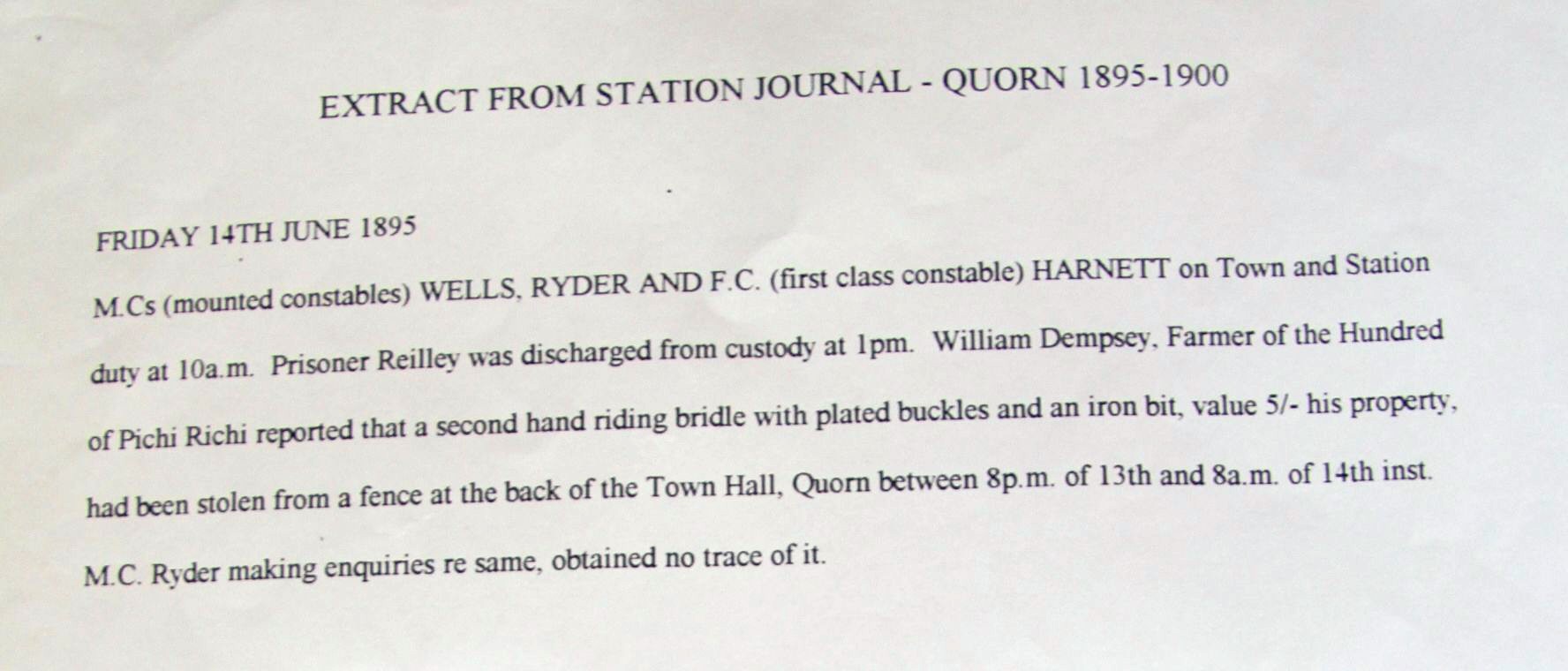
• Mounted Constable: Station Journal, 1895, Quorn, South Australia.
• Police Service Record: Re-instated - 2nd Class Mounted Constable, 1897, Caltowie, South Australia.
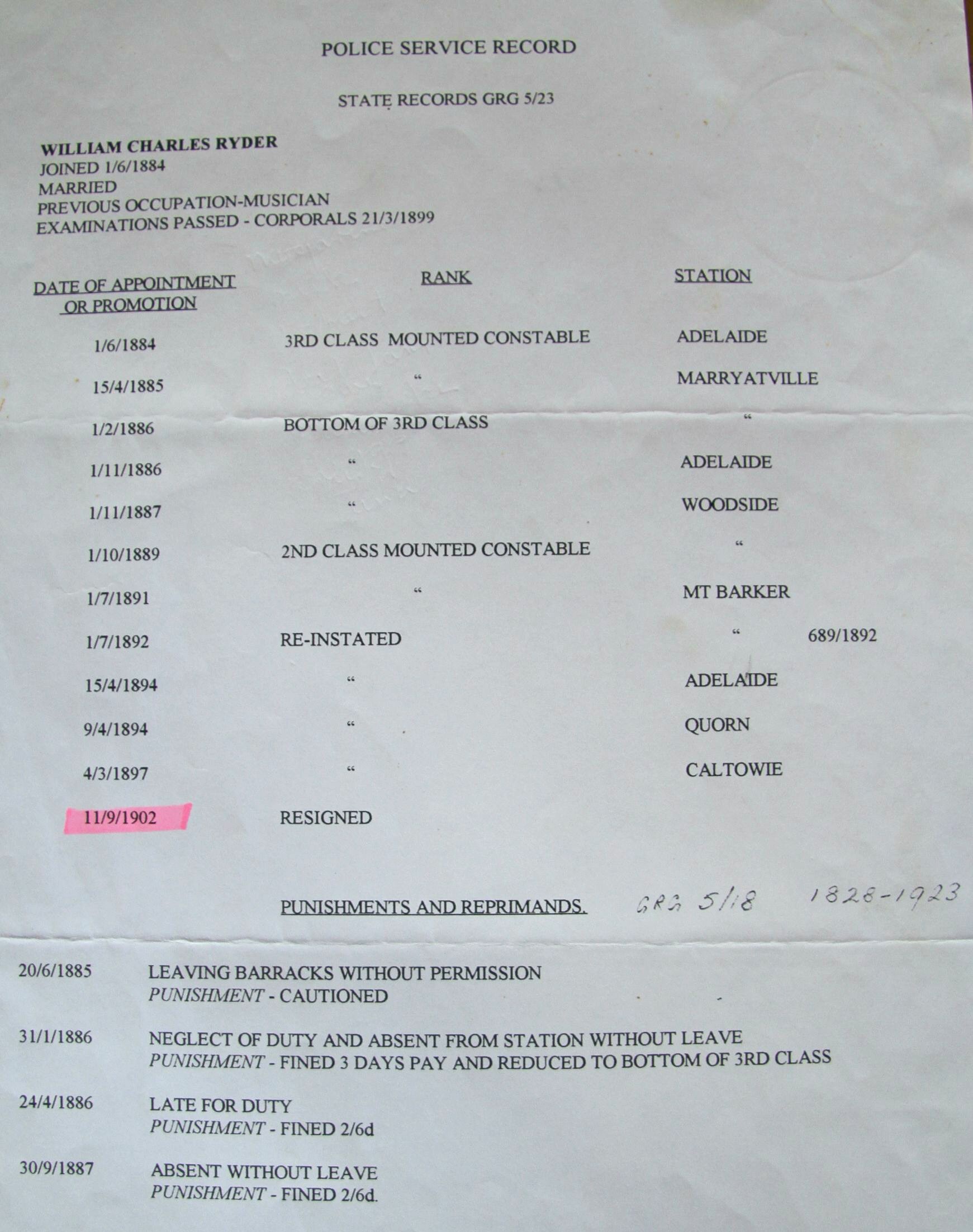
• Police Service Record: Resigned, 1902, Caltowie, South Australia.
• Removed to: Cir 1904, Perth, Western Australia.
• Australian Electoral Rolls 1903-1980: caretaker, 1906, Freemans Hotel, Perth, Western Australia.
• Australian Electoral Rolls 1903-1980: caretaker, 1909, 13 Moore st, Perth, Western Australia.
• Australian Electoral Rolls 1903-1980: Caretaker, 1910, 13 Moore st, Perth, Western Australia.
• Australian Electoral Rolls 1903-1980: caretaker, 1912, 13 Moore st, Perth, Western Australia.
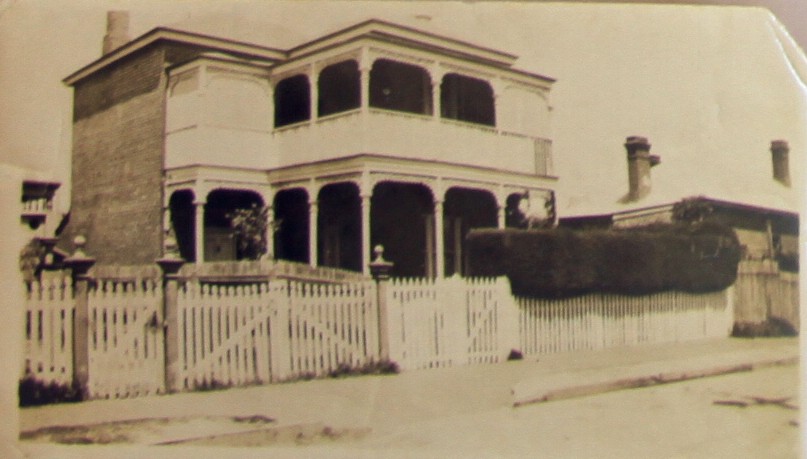
• Photograph: residence, 2 Norbert St., East Perth, Western Australia.
• Australian Electoral Rolls 1903-1980: caretaker, 1915, 2 Norbert st, Perth, Western Australia.
• Australian Electoral Rolls 1903-1980: caretaker, 1916, 2 Norbert st, Perth, Western Australia.
• Australian Electoral Rolls 1903-1980: caretaker, 1917, 2 Norbert st, Perth, Western Australia.
• Australian Electoral Rolls 1903-1980: caretaker, 1919, 2 Norbert st, Perth, Western Australia.
• Perth Western Australia, Rate Book, 1880-1946: rate book, 1919, 2 Norbert st, Perth, Western Australia.
.jpg "William Ryder c.1920 (7691 KB)
(Click on Picture to View Full Size)")
• Photograph: William Charles, 1920, Perth, Western Australia.
• Australian Electoral Rolls 1903-1980: caretaker, 1921, 2 Norbert st, Perth, Western Australia.
• Perth Western Australia, Rate Book, 1880-1946: rate book, 1922, 2 Norbert st, Perth, Western Australia.
• Australian Electoral Rolls 1903-1980: caretaker, 1924, 2 Norbert st, Perth, Western Australia.
• Perth Western Australia, Rate Book, 1880-1946: rate book, 1924 To 1926, 2 Norbert st, Perth, Western Australia.

William married Mary KIRKWOOD [932], daughter of William KIRKWOOD [1007] and Janet READ [1008], on 4 Jul 1888 in Baptist Church, Flinders Street, Adelaide, South Australia. Mary was born on 15 Jun 1857 in Adelaide, South Australia and died on 12 Feb 1908 in Perth, Western Australia at age 50.
Marriage Notes:
1888 SA Marriage 156/77 RYDER William Charles KIRKWOOD Mary Adelaid
General Notes:
1857 SA Birth KIRKWOOD Mary William KIRKWOOD Janet READ Adelaide 11/87
1908 WA Death Registration 105 Perth
The Advertiser (Adelaide) Tuesday 25 February 1908
Death Notice:
RYDER.-On the 12th February, at Perth, W.A., after a long illness, Mary, the beloved wife of W. C. Ryder, late of S.A. Mounted Police. At rest.
The Register (Adelaide) Tuesday 3 March 1908 & Wednesday 4 March 1908 & Observer (Adelaide) Saturday 7 March 1908
Death Notice:
RYDER.'97 On the 12th February, at Perth, W.A., after a long illness, Mary, beloved wife of W. C. Ryder, late of S.A. Mounted Police. At rest.
Research Notes:
Image courtesy of D Hart
Other Records
• Australian Electoral Rolls 1903-1980: married, 1909, 13 Moore st, Perth, Western Australia.
Children from this marriage were:
+ 111 M i. Norman Charles RYDER [1005] was born on 21 Apr 1889 in Woodside, Nairne, South Australia, died on 6 Jun 1946 in York Road, Greenmount, National Park, Western Australia at age 57, and was cremated on 7 Jun 1946 in Karrakatta Cemetery, Perth, Western Australia.
+ 112 M ii. Geoffrey Kirkwood RYDER [1006] was born on 2 Feb 1892 in Mt Barker, South Australia, died on 30 Jan 1983 in Adelaide, South Australia at age 90, and was cremated on 3 Feb 1983 in Centennial Park Cemetery, Adelaide, South Australia.

William next married Ann SMITH [3424], daughter of Alexander SMITH [3593] and Ann Elizabeth BRICE [3600], on 26 Sep 1908 in Res W C Ryder at 13 Moore St, Perth, Western Australia. Ann was born on 8 Jan 1872 in Yankalilla, South Australia, died on 1 Sep 1950 in Perth, Western Australia at age 78, and was buried on 4 Sep 1950 in Karrakatta Cemetery, Perth, Western Australia.
Marriage Notes:
1908 WA Marriage RYDER WILLIAM C Male SMITH ANN Female PERTH 481 1908
General Notes:
1872 SA Birth SMITH Ann Alexander SMITH Ann Elizabeth BRICE Yankalilla 103/308
1978 WA Death RYDER ANN Female PERTH 1978 1950
The West Australian Monday 4 Sep 1950
Death Notices:
RYDER: On September 1, 1950, at Perth, Ann Ryder, dearly loved and devoted wife of the late William Charles Ryder, devoted mother of Marjorie (Mrs. F. Hart), Joyce (Mrs. F. O. Roberts, Greenmount), step-mother of Norman (deceased), Geoff (Melbourne).
RYDER: On September 1, 1950, at Perth, Ann, dearly loved and devoted sister of Tot (South Australia).
Funeral Notice:
RYDER: The Friends of the late Ann Ryder, of 2 Norbert-street, East Perth, beloved wife of the late William Charles Ryder, are respectfully informed that a Congregational Service will be conducted in the Crematorium Chapel, Karrakatta, at 4 o'clock THIS (Monday) AFTERNOON. The Funeral appointed to leave our Chapel, 281 Newcastle-street, Perth. at 3.40 o'clock. C. H. SMITH AND CO., Perth. Tel. B8008. BA2974.
Memories recorded by Lois Ryder (nee Crawford) in Perth 2012, of Ann Elizabeth Ryder (nee Smith):
Lois remembers visiting Grandma Ryder at her home at 2 Norbert Street which was a 2 storied house and rather imposing in the area. When our eldest daughter, Margaret, was a baby I took her once or twice to visit Grandma Ryder. When I mentioned that Margaret's second name was Ann Grandma was particularly pleased because that was her second name, something that I had not known.
Other Records
• Australian Electoral Rolls 1903-1980: Married, 1910, 13 Moore st, Perth, Western Australia.
• Australian Electoral Rolls 1903-1980: married, 1912, 13 Moore st, Perth, Western Australia.
• Australian Electoral Rolls 1903-1980: home duties, 1914, 2 Norbert st, Perth, Western Australia.
• Australian Electoral Rolls 1903-1980: home duties, 1915, 2 Norbert st, Perth, Western Australia.
• Australian Electoral Rolls 1903-1980: home duties, 1916, 2 Norbert st, Perth, Western Australia.
• Australian Electoral Rolls 1903-1980: home duties, 1917, 2 Norbert st, Perth, Western Australia.
• Australian Electoral Rolls 1903-1980: home duties, 1919, 2 Norbert st, Perth, Western Australia.
• Australian Electoral Rolls 1903-1980: home duties, 1921, 2 Norbert st, Perth, Western Australia.
• Australian Electoral Rolls 1903-1980: home duties, 1925, 2 Norbert st, Perth, Western Australia.
• Perth Western Australia, Rate Book, 1880-1946: rate book, 1925 To 1935, 2 Norbert st, Perth, Western Australia.
• Perth Western Australia, Rate Book, 1880-1946: rate book, 1926 To 1928, 2 Norbert st, Perth, Western Australia.
• Perth Western Australia, Rate Book, 1880-1946: rate book, 1929, 2 Norbert st, Perth, Western Australia.
• Perth Western Australia, Rate Book, 1880-1946: rate book, 1930, 2 Norbert st, Perth, Western Australia.
• Australian Electoral Rolls 1903-1980: home duties, 1931, 2 Norbert st, Perth, Western Australia.
• Perth Western Australia, Rate Book, 1880-1946: rate book, 1931, 2 Norbert st, Perth, Western Australia.
• Perth Western Australia, Rate Book, 1880-1946: rate book, 1932, 2 Norbert st, Perth, Western Australia.
• Perth Western Australia, Rate Book, 1880-1946: rate book, 1934, 2 Norbert st, Perth, Western Australia.
• Perth Western Australia, Rate Book, 1880-1946: rate book, 1935 To 1936, 2 Norbert st, Perth, Western Australia.
• Australian Electoral Rolls 1903-1980: home duties, 1936, 2 Norbert st, Perth, Western Australia.
• Australian Electoral Rolls 1903-1980: home duties, 1937, 2 Norbert st, Perth, Western Australia.
• Perth Western Australia, Rate Book, 1880-1946: rate book, 1937, 2 Norbert st, Perth, Western Australia.
• Perth Western Australia, Rate Book, 1880-1946: rate book, 1941 To 1944, 2 Norbert st, Perth, Western Australia.
• Perth Western Australia, Rate Book, 1880-1946: rate book, 1942, 2 Norbert st, Perth, Western Australia.
• Australian Electoral Rolls 1903-1980: home duties, 1943, 2 Norbert st, Perth, Western Australia.
• Perth Western Australia, Rate Book, 1880-1946: rate book, 1943, 2 Norbert st, Perth, Western Australia.
• Perth Western Australia, Rate Book, 1880-1946: rate book, 1944, 2 Norbert st, Perth, Western Australia.
• Perth Western Australia, Rate Book, 1880-1946: rate book, 1945, 2 Norbert st, Perth, Western Australia.
• Perth Western Australia, Rate Book, 1880-1946: rate book, 1946, 2 Norbert st, Perth, Western Australia.
• Australian Electoral Rolls 1903-1980: home duties, 1949, 2 Norbert st, Perth, Western Australia.
Children from this marriage were:
+ 113 F i. Marjorie Anne RYDER [3425] was born on 15 Jul 1909 in Perth, Western Australia and died on 31 Oct 1987 in Perth, Western Australia at age 78.
+ 114 F ii. Joyce Brice RYDER [3426] was born on 28 Dec 1910 in Perth, Western Australia and died on 3 Jul 2003 in Albany, Western Australia. at age 92.
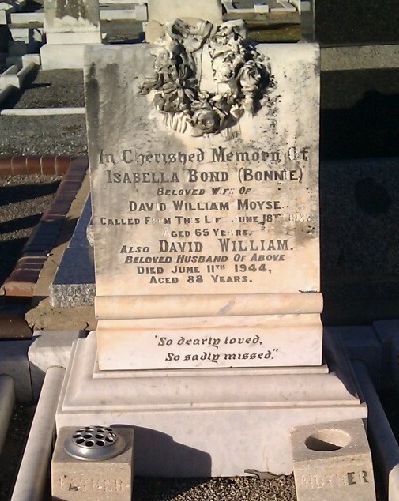
30. Isabella Bond RYDER [929] (Joseph12, William6, Thomas2, William1) was born on 13 Sep 1860 in Nairne, South Australia, died on 18 Jun 1927 in Royston Park, Adelaide, South Australia at age 66, and was buried on 20 Jun 1927 in Payneham Cemetery, Adelaide. She was usually called Bonnie.
General Notes:
1860 SA Birth 21/370 RYDER Isabella Bond, Joseph RYDER, Mary HILL, Nairne
South Australian Register Tuesday 24 July 1877
COUNCIL OF EDUCATION, Monday July 23
Mistresses: Mary Ryder, Noarlunga, from September 30; and Susannah Broadbent, Kangarilla, from June 30. Provisional Teachers : . . . Isabella Ryder, Noarlunga, from September 30; and . . .
South Australian Register Saturday 28 Jun 1879
PROVISIONAL SCHOOLS: Provisional Teachers: . . . Isabella Ryder, Windsor, transferred from Milang; . . .
The Advertiser (Adelaide) Monday 20 June 1927
Observer (Adelaide) & Saturday Journal (Adelaide) Saturday 25 June 1927
Death Notice:
MOYSE.On the 18th June (suddenly), at her residence, Oaklands avenue, Royston Park, Isabella Band, beloved wife of David William Moyse, aged 65.
The Advertiser (Adelaide) Monday 20 June 1927
Funeral Notice:
MOYSE.THE FRIENDS of Mr. DAVID MOYSE are respectfully informed that the Funeral of his late WIFE (lasbella Bond) will leave his residence, Oakland-avenue, Royston Park on MONDAY, at 11.40, for the Payneham Cemetery. P. Gannoni & Sons, Undertakers, Norwood.
Research Notes:
University Library of South Australia:
http://www.library.unisa.edu.au/condon/teachers/Teachers.asp?TeacherID=1915
RYDER, Isabella
Teacher ID: 1915
Teacher number: PT 25
Name: RYDER, Isabella
Sex: F
Rank : Appointed Date : Appointed School : Service Year : Inspector's Comments
PUPT 1
PUPT 2
PUPT 2
PUPT 2
PUPT 2
PUPT 2
Teacher ID: 1494
Teacher number:
Name: RYDER, Isabella
Sex: F
Rank : Appointed School : Service Year : Inspection %
PT Noarlunga 1876 DEC 1876
PT Noarlunga 1877 DEC 1877
Prov T Windsor 1879 67.07

Bonnie married David William MOYSE [933], son of William MOYSE [378] and Jane SNELL [3709], on 19 Feb 1881 in Res of Joseph Ryder, Windsor, South Australia. David was born about 1856 in Menheniot, Cornwall, England, died on 12 Jun 1944 in North Adelaide, South Australia aged about 88, and was buried on 14 Jun 1944 in Payneham Cemetery, Adelaide.
Marriage Notes:
1881 SA Marriage 126/661 MOYSE David William RYDER Isabella Bond, Gilbert
The South Australian Advertiser, Fri 4 Mar 1881
MARRIAGE
MOYSE-RYDER. On the 19th February, at the residence of the bride's father, by Mr. R. Woolcock, David William, eldest son of Mr. William Moyse, of Albion Farm, near Windsor, to Isabella Bond, youngest daughter of Mr. Joseph Ryder, Windsor.
General Notes:
1855 MOYSE DAVID WILLIAM, Births & baptisms, Liskeard, Cornwall, England - England & Wales births 1837-2006
1944 SA Death 676/2383 MOYSE David William, Adelaide (recorded death date 12 June 1944)
Cemetery: Payneham - Headstone records death date as 11 June 1944
The Register Saturday 13 Oct 1928
D. W. MOYSE LIMITED.
Capital £5,000, divided into 5,000 share of £1. Objects- To acquire the business of chaff, grain and general merchants, carried on by David William Moyse at 279 Rundle street, Adelaide. Applicants for the formation of the company, David William Moyse, Gerald Albion Moyse, William Arthur Moyse, Thomas McMurray Robinson, and Charles Edwin. Medley. First directors- D.W.Moyse, and two or four others to be appointed by subscribers to memorandum of association. Registered office, 46 Grenfell Buildings, Grenfell street. Adelaide. In corporated October 8, 1928.
The Advertiser (Adelaide) Thursday 15 June 1944
Death Notice:
MOYSE. - On June 12, at Adelaide, David William Moyse, of Melrose House, Archer St., North Adelaide, father of Vida, Will, Ella, Queenie, Dessie, Gerald, Clarice, Gillian, and Connie, and Amy (deceased). Aged 88 years.
Funeral Notice:
MOYSE. '97The friends of the late Mr. David William Moyse, late of Melrose House, Archer street, North Adelaide, are
respectfully informed that his remains were privately laid to rest on Wednesday, on June 14, in the Payneham Cemetery, Rev. J. G. Jenkin officiated. Pengelley & Knabe. Funeral Directors Head Office and Chapel 210 Rundle
street. Central 496 2 lines).
Chronicle Thursday 22 June 1944
Death Notice:
MOYSE. - On June 12, at Adelaide, David William Moyse, of Melrose House, Archer St., North Adelaide, father of Vida, Will, Ella, Queenie, Dessie, Gerald, Clarice, Gillian, and Connie, and Amy (deceased). Aged 88 years.
Other Records
• Resided: 1913, Wellington Rd, North Norwood, Adelaide.
Children from this marriage were:
+ 115 F i. Vida Isabel MOYSE [1482] was born on 5 Oct 1881 in Windsor, South Australia, died on 14 Jan 1965 in Woodville, Adelaide, South Australia at age 83, and was buried on 15 Jan 1965 in Centennial Park Cemetery, Adelaide, South Australia.
+ 116 M ii. William Arthur Ryder MOYSE [1483] was born on 31 Mar 1883 in Wild Horse Plains, nr Windsor, South Australia, died on 29 Aug 1967 in St Peters, Adelaide, South Australia at age 84, and was buried on 31 Aug 1967 in Centennial Park Cemetery, Adelaide, South Australia.
+ 117 F iii. Mary Ella Jane MOYSE [1481] was born on 25 Nov 1885 in Wild Horse Plains, nr Windsor, South Australia, died on 26 Apr 1973 at age 87, and was buried on 28 Apr 1973 in Murray Bridge Adelaide Rd Cemetery, South Australia.
+ 118 F iv. Constance Maude MOYSE [1476] was born on 11 Dec 1887 in Wild Horse Plains, nr Windsor, South Australia, died on 7 Aug 1941 in Blyth, South Australia at age 53, and was buried in 1941 in Blyth Cemetery, South Australia.
+ 119 F v. Queenie Alberta MOYSE [4840] was born about 1892 in Nantawarra, South Australia, died on 3 Mar 1975 in Adelaide, South Australia aged about 83, and was cremated on 6 Mar 1975 in Centennial Park Crematorium, Adelaide.
+ 120 F vi. Decima MOYSE [1478] was born on 14 Oct 1892 in Port Wakefield, South Australia, died on 29 Mar 1950 in Mount Gambier, South Australia at age 57, and was cremated on 31 Mar 1950 in West Terrace Cemetery, Adelaide, South Australia.
+ 121 M vii. David Kingsley MOYSE [1477] was born on 8 Jan 1894 in Port Wakefield, South Australia and died on 11 Apr 1894 in Port Wakefield, South Australia.
+ 122 M viii. Gerald Albion MOYSE [1480] was born on 24 May 1896 in Port Wakefield, South Australia, died on 2 Aug 1971 in Norwood, Adelaide, South Australia at age 75, and was cremated on 3 Aug 1971 in Centennial Park Crematorium, Adelaide.
+ 123 F ix. Ninon Amy MOYSE [1045] was born on 30 Oct 1897 in Wild Horse Plains, nr Windsor, South Australia, died on 27 Nov 1939 in Adelaide, South Australia at age 42, and was buried on 28 Nov 1939 in West Terrace Cemetery, Adelaide, South Australia.
+ 124 F x. Clarice Jean MOYSE [1475] was born on 9 Dec 1898 in Wild Horse Plains, nr Windsor, South Australia, died on 12 Aug 1959 in Myrtle Bank, Adelaide, South Australia at age 60, and was buried on 14 Aug 1959 in Centennial Park Cemetery, Adelaide, South Australia.
+ 125 F xi. Gillian Hope MOYSE [1479] was born on 20 Jul 1901 in Glenelg, Adelaide, South Australia, died on 16 Sep 1969 in Unley, Adelaide, South Australia at age 68, and was cremated on 17 Sep 1969 in Centennial Park Crematorium, Adelaide.
Copyright © and all rights reserved to Audrey Mary Fenn and all other contributors of personal data. No personal data to be used without attribution or for commercial purposes. Interested persons who wish to share this data are welcome to contact audrey@thelockedjournal.com to arrange same and be given the details.
Home | Table of Contents | Surnames | Name List
This Web Site was Created 3 Jun 2017 with Legacy 8.0 from Millennia