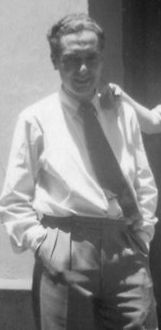
Maxwell Henley HARRIS AO Literature [4844]
- Born: 13 Apr 1921, Henley Beach, Adelaide, South Australia
- Marriage (1): Yvonne Ruby HUTTON [4989] about 1944
- Died: 13 Jan 1995, Gilberton, Adelaide, South Australia at age 73
- Crem.: 19 Jan 1995, Centennial Park Crematorium - Memorial Plaque, Mary MacKillop Park

 General Notes: General Notes:
1921 SA Birth 74A/103 HARRIS Maxwell Henley Victor HARRIS Clarice Jean MOYSE, Adelaide
1995 Max's ashes scattered in Mary MacKillop Park.
Border Watch Saturday 22 December 1934
Vansittart Scholarship:
One Awarded; Selection of Second Deferred
Mt. Gambier high School
Boy's Success.
One of the Vansittart Scholarships tenable for three years at St. Peter's College, Adelaide has been won by Maxwell Henley Harris, son of Mr. and Mrs. Vic Harris, of Mount Gambier. Max is 13½ years of age, and a student at the Mt. Gambier High School. He has had remarkable success in school examinations, having been dux of every class at the Mount Gambier Primary School as he passed through, and a close second, in the first year class at the Mount Gambier High School. He has just completed 12 months there. Bagot's Executor and Trustee Company Ltd., in announcing the success of BARRETT, Donald Winston. - , advise that for the second scholarship they were unable, on their applications and on personal interviews, to separate 3 applicants for all round merit, and final selection has been deferred until the Results of the recent University Intermediate examinations (for which all three applicants sat) are available.
The Chronicle (Adelaide) Thursday 29 December 1938
Leaving Honours:
Girl Tops List
Elizabeth Reay Carter, of the Wilderness School, has come top of the State in the general honors list of the 1938 leaving honors examination, the results of which were announced last week. In the general honors list, Miss Carter has come top in French, and wins the medal awarded by the French Government, top in modern history, top in economics, equal second in English, and second in Latin. Miss Carter has been a student at Wilderness School for twelve years. Her parents are Mr. and Mrs. H. O. Carter, of Avenel Gardens road, Medindie. The Tennyson Gold Medal has been awarded to Maxwell Henley Harris for gaining the highest marks in English literature. He is a son of Mr. and Mrs. Victor Harris, of Torrensville. John Edward Bromley, who came equal second in English literature, won the Tennyson Medal last year.
The Daily News (Perth) Tuesday 26 September 1944
Varsity Man's Poems Offend:
Adelaide, Tues - University undergraduates packed the Adelaide Police Court today for the hearing- of a charge laid under the Indecent Advertisements Act against 23 year-old undergraduate Maxwell Henley Harris. Harris was charged with having during June sold, offered or distributed certain indecent advertisements in printed Titles include 'Night Place.' 'Sweet William,' 'Night Piece,' Perspective Love Song, 'Egyptian Register,' 'Young Prince on Tyre, 'The Fence,' 'I Have Never Spoken of Your Nakedness,' all of which had been published in the 1944 autumn number of the 'Angry Penguins.' Harris denied the charge. He said that the basic principal of the publication was to provide a means for the expression of creative writers and potentially creative writers in Australia. He said the literature had a serious purpose behind it. Harris said he had devoted most of his time since he was 14 to English literature. He had won the Tennyson medal and Bundey prize for English, he said, and was one of the editors of 'Angry Penguins.' It was originally published by Adelaide University Arts Association. Autumn edition this year was published by the firm of Reed and Harris. Interpretations: Harris gave his interpretation of poems involved in the charge. 'Sweet William' discussed conflicts within a man who found himself in mental or almost schezophrenic conflict, he said. Words of another poem - depicted human loss in all its brutalities because 'I happen to be like that at times' he said.
In discussing three - particular words in one poem he said that these had changed from vulgarity to the vernacular. Poem on page 67 was inspired by Milton's description of the nuptials of Adam and Eve. 'It simply means that the spirit of nakedness or of anything seen stripped of its irrelevancies is a subject for the mind to climb into higher spheres and for silence and reverence,' he said. The passage objected to in another poem was directed against the conditions which brought abortion into existence. It could not possibly be interpreted to advocate abortion. It was part of the policy of the committee not to turn the magazine into a commercialised proposition, said Harris. It was sold all over Australia and internationally. South Australian sales were restricted. There were two New York agents and exchanges were made with other publications in London. (Proceeding)
The Argus (Melbourne) Friday 29 September 1944
Ern Malley Poems:
'Bewildering'
Psychiatrist's Opinion
Adelaide, Thurs: Effect of the Ern Malley poems on the average person would be one of bewilderment, a Victorian expert witness for the defence said when the case was resumed today in which Maxwell Henley Harris, student, of Glandore, was charged with having sold, offered, or delivered certain indecent printed matter in the 1944 autumn number of Angry Penguins, which featured about 30 pages of Malley poems.
The witness. Dr Reginald Spencer Ellery, psychiatrist, of Hawthorn, Vic, said his experience covered all forms of mental ills and disorder. The majority of persons were men- tally lazy and would not interpret the poems. Those not mentally lazy would come to conclusions along the same lines as the defendant. Others again would be satisfied with an emotional satisfaction such as one gets from listening to music. The sexual references in the Malley poems were too involved in their meaning to have a direct sexual appeal to the reader.
John Reed, solicitor, of Heidelberg, co-editor of Angry Penguins, said he was particularly interested in development of literature and art. He was a foundation council member and honorary secretary of the Con- temporary Art Society of Australia. Angry Penguins had not been a pay- able proposition since he had been associated with its publication.
Asked by Mr D. C. Williams, prosecutor, if he regarded the Ern Malley poems as great literary works, Reed said that, compared with other work being done in Australia, he regarded the poems as great literary work. He knew that those poems were said to be a hoax, but he would not like to make a final statement on whether he believed that or not. He would not say that any of the poems could not be interpreted literally.
In reply to Mr Williams, Harris, referring to a classical picture, "The Rape of the Sabines," said it depicted men seizing women. He knew the picture, but knew nothing of the legend that the followers of the mythical founder of Rome were short of wives and seized a number of Sabine maidens by guile. He thought the picture referred to opposite forces in conflict, not sexual connotation.
Border Watch Saturday 21 Oct 1944
"Angry Penquins"
Harris Fined
Adelaide, Today.-In the Police Court yesterday, before Mr. L E. Clark, S.M., who, in a 22 page reserved judgment, found that Maxwell Henley Harris, of Churchill Avenue, Glandore, was guilty of having about June this year, sold, offered or distributed certain indecent advertisements published in the 1944 Autumn number of "Angry Penguins," which commemorated the poet Ern Malley.
Defendant, who described himself in evidence as co-editor of the publication, was fined £5 with £2l 11/ costs.
It was the sixth day of hearing of the case.
The Daily News (Perth) Saturday 21 Oct 1944
'Inspired' By Sex
Adelaide, Sat - University student 23-year-old Maxwell Henley Harris was today found guilty of having sold indecent advertisements in the autumn number of Angry Penguins this year; He was fined £5, with £21/11/ costs, in default six weeks' imprisonment. In delivering a 23-page judgment, Mr Clarke, S.M. in the Police Court said that none of the matters complained of was immoral or obscene but the passages to which he had referred were of an indecent nature and indecent advertisements within the meaning of the term in Section 108 of the Police Act. Mr Clarke said that Harris would seem to have derived most of his inspiration, if it could be called such, from sex. In his opinion, Harris displayed far too great a fondness for sexual reference. It almost suggests this to be the limit of his experience and while recognising his youth I cannot but regard it as an unhealthy sign, even from a literary point of view, said Mr Clarke. Boldness in sexual reference is too often mistaken for brilliance. I think Harris should either endeavour to acquire that art of delicacy in handling of sexual topics which is so necessary in literature or avoid the topic altogether. Harris said that he intends to appeal against the decision. Harris said that if necessary he would take the case to the High Court of Australia. In the meantime Angry Penguins would continue to be published in Victoria but would not be distributed in South Australia.
Army News (Darwin NT) Sunday 22 Oct 1944
"Angry Penguins"
Adelaide, Saturday.--Maxwell Henley Harris, 23, University student, was fined £5, with £22 costs for having published indecent matter in poems in the publication "Angry Penguins," In its earlier stages, the case aroused much inter-State interest, literary witnesses having been brought from Victoria to refute allegations by the prosecution that certain poems and advertisements were immoral or obscene.
Harris, Maxwell Henley (1921-1955)
Papers
MSS 92 H315p
Max Harris, poet, editor and publisher, has generally been regarded as the founding father of Australian modernism in the arts.
Born in Adelaide in 1921 and educated at the University of Adelaide, Harris published his first book of poetry The Gift of Blood in 1940 at the age of 19. He achieved notoriety through the "Ern Malley" poetry hoax of 1944, which aimed to discredit the modernist movement in Australian poetry, and through his subsequent prosecution of Harris for publishing obscene literature.
Between 1941 and 1945 he edited the avant-garde journal Angry Penguins which aimed to promote the international influences of surrealism and modernism into the Australian artistic scene. The Angry Penguins journal produced no major Australian poet but had a real and lasting influence on artists such as Sidney Nolan, John Perceval and the Boyds. During this period Harris also co-founded, with John Reed, the firm of Reed and Harris, a pioneer publisher of modern Australian poets, novelists and intellectuals. In subsequent years Harris co-edited with Henry Dutton the literary quarterly Australian Letters (1957-1968), the monthly Australian Book Review (1961-1974) as well as books of criticism.
Max Harris also played a central role in establishing Penguin and Sun Books paperback imprints in Australia and became, through his Mary Martin Bookshop, one of the best known booksellers in Australia. He was also a senior columnist of literary and social criticism for The Australian, in addition to his role as a well known and sometimes controversial drama, theatre and arts critic on radio and television.
Courtesy of State Library of South Australia
South Australian People -
Harris, Maxwell Henley (known as Max) 1921-1995
Born: 13 April 1921 Adelaide, South Australia. Died: 13 January 1995 Adelaide, South Australia Poet, publisher, bookshop proprietor, social commentator. Born at Henley Beach, Adelaide, Harris grew up in Mount Gambier, in South Australia's South East. He won a scholarship to attend secondary school at St Peter's College, Adelaide, as a boarding student. He won the Tennyson medal for the best English student in South Australia. After school Harris worked for the Shell Company and at The News newspaper as both a copy boy and cadet journalist before entering university to study arts and economics. Harris wrote poetry and his work was published by The Jindyworobaks. Initially writing in lyrical style, Harris later developed a surrealist voice. In 1941 Harris founded the literary magazine Angry penguins. Two years later he moved to Melbourne and published Angry penguins there, with John Reed. Harris became part of the circle of artists and writers who congregated at Reed's home outside of Melbourne, Heide. The group included Sidney Nolan, John Perceval, Arthur Boyd and Albert Tucker. The magazine was embroiled in Australia's most famous literary hoax, the Ern Malley affair. Harris dedicated the autumn 1944 issue of Angry penguins to the work of the modernist poet Ern Malley. Malley had supposedly died at an early age and his work was submitted to the magazine by his sister, Ethel. Several months later it was revealed that Ern and Ethel did not exist and the poems had been concocted by two traditional poets, McAuley and Harold Stewart, for the purpose of lampooning the modernist style which they detested. The content of the poems scandalised some and, even after the hoax had been revealed, Harris was prosecuted for publishing 'indecent' material. Harris, however, felt that the hoax backfired on Stewart and McAuley as the publicity it created if fact helped Australian modernists gain wider acceptance of their work. By 1950 Harris was back in Adelaide and he founded, with Mary Martin, the Mary Martin Bookshop. They pioneered buying and selling books at discounted prices and mail order sales, facilitated by a booklist compiled by Harris in which he included jokes and spoof books. Harris and Martin opened other stores interstate and the company still trades in South Australia and Victoria today. Harris and Martin produced a publication, Mary's own paper, about arts and culture in South Australia. They imported foodstuffs and folk art from overseas and sold these alongside their books. Harris was associated with the establishment of Australian letters in 1957, the Australian book review in 1961 and the Australian publishing house, Sun Books. He is credited with helping Penguin Books become established in Australia and assisted in their commissioning Donald Horne to write the Lucky country, a seminal work on Australian society. Harris later had his own small publishing company, Maximus Books. Harris also had a notable career as a journalist. He wrote the column 'Browsing' in The Australian from 1964 to 1991 and had a long-running column in Adelaide's Sunday mail, which was anecdotally the newspaper's best read feature. Harris was an admirer of the work and legacy of Mother Mary MacKillop, the South Australian founder of the Order of the Josephites and he was a staunch supporter of her beatification. Although not a Catholic, Harris' ashes were buried at the premises of the nunnery and Mary MacKillop College at Kensington. The State Library has endeavoured to identify and contact copyright holders of material digitised for this website. Where the copyright owner has not been able to be traced, or where the permission is still being sought, the Library has decided in good faith to proceed with digitisation and publication. The State Library invites persons who believe they are copyright owners to contact Library staff to discuss usage of this item.
Key achievements:
1940: Poetry collection The Gift of blood published by The Jindyworobaks
1941: Founded the literary magazine Angry penguins
1950: Established Mary Martin Bookshop, with Mary Martin
1957-68: Co-founded and co-edited Australian letters
1961: Co-founded Australian book review
12 June 1989: Made Officer of the Order of Australia (AO) for services to literature
Courtesy Wikipedia
Early Life: Harris was born in Adelaide, South Australia, and raised in the city of Mount Gambier where his father was based as a travelling salesman. His early poetry was published in the children's pages of the Adelaide newspaper, The Sunday Mail. He continued to write poetry through his secondary schooling on scholarship to St Peter's College, Adelaide, and by the time he attended the University of Adelaide, he already was recognised as a poet and intellectual. He edited two editions of Adelaide University's student newspaper On Dit in 1941 when John Allison resigned.
Angry Penguins: Max Harris with Joy Hester, ca.1943, taken by Albert Tucker Harris's involvement in poetry and his passion for the burgeoning European modernist movement underscored the creation of a modernist literary journal called Angry Penguins. This name was taken from one of his poems, Mithridatum of Despair. Fellow founders of Angry Penguins in 1940 were D.B. "Sam" Kerr, Paul G. Pfeiffer and Geoffrey Dutton. The first issue of the journal attracted the interest of the Melbourne lawyer and arts patron John Reed who sought out Harris in Adelaide, suggesting a collaboration in publishing the journal. Harris, already active in trying to establish a Contemporary Art Society in South Australia, was lured to the Reeds' Melbourne art enclave at Heide wherein Sidney Nolan was the primary artist under Reed's patronage. By the second issue of Angry Penguins, Harris had incorporated visual art into the journal - and, later, Nolan became an active member of the editorial team. Other artists such as Albert Tucker, Joy Hester, James Gleeson, Arthur Boyd and John Perceval also came under the wing of Angry Penguins and, through their careers and into posterity, have been known as "Angry Penguin artists". Harris was too vivid and charismatic a young intellectual for the conservative Establishment of the period, and particularly the traditionalist poets were outraged by the success of Angry Penguins with its progressive content and promotion of surrealism. It was publishing the works of Dylan Thomas, Gabriel García Márquez, James Dickey and the American poet Harry Roskolenko. The poet and critic A. D. Hope was among those most virulently opposed to Harris and the modernists and inspired two young poets serving in the army, Harold Stewart and James McAuley, to "get Maxy". Under the name of "Ern Malley", the poets crafted a series of poems in the modernist style and submitted them to Harris at Angry Penguins. The poems were accompanied by a letter from the poet's supposed sister, Ethel Malley, explaining that Ern had died of Graves' disease and she did not know if the poems were any good so she was giving them to Max Harris to do what he wished with them. Harris thought the poems were brilliant and he published them with some fanfare in Angry Penguins. The poems were controversial but well received - except by the police in South Australia, where Angry Penguins was published. The police interpreted some lines in the poetry as lewd (one poem used the word "incestuous"[1]) and Harris was charged with obscenity. Reed and Harris who, by this time, also were publishing books, employed a detective to discover more about the mystery poet - and then word emerged that Ern Malley was a hoax. The poets were unrepentant. The trial went forward, its bizarre constabulary logic and valiant defence arguments from Harris and noted literary critics attracting international press attention. Harris was found guilty and fined five pounds. Harris never wavered in his belief in the quality of the poetry - and Ern Malley has lived on to some acclaim. His poetry continues to be published and studied, his story dramatised and fictionalised.
Later life: Max Harris went on, partnered by his university friend Mary Martin, to run the Mary Martin Bookshop in Adelaide, publishing a monthly newsletter which continued literary criticism and comment as well as listing and reviewing books for a clientele which stretched into remote regions of Australia. Mary Martin moved to India and Harris expanded the book empire with shops around Australia and in Hong Kong. He championed the rights of Australian readers by fighting the stranglehold of overseas publishers over the Australian book market, founding the book remainder industry in Australia, and taking on the major publishing houses to ensure accessibly-priced supplies for the Australian market. He also rose to the forefront of the movement against literary and art censorship in Australia and was an early voice in the Australian republican movement. He founded and co-edited the literary journals Australian Letters and the Australian Book Review. He continued to encourage a relationship between visual artists and writers by commissioning artists to illustrate poetry in Australian Letters. In the quest of Australian books for Australians, he also was one of the instigators and founders of Sun Books. Meanwhile, he became a long-serving and controversial columnist for the national newspaper, The Australian, many of his "Browsing" columns later published in book form. It was in this context that he was dubbed "Australia's Cultural Catalyst". He also wrote columns for Adelaide newspapers and contributed to literary publications. He published his poetry privately, although much was included in classic Australian anthologies. A collection of his work was published posthumously by the National Library of Australia as The Angry Penguin.[2] As a founder of the Contemporary Art Society, a champion of the surrealist movement and an art critic, he was later awarded the title of "Father of Modernism in the Australian Arts" by the Alumni Association of Adelaide University. His contribution to Australian Arts and Letters was recognised with an appointment as Officer of the Order of Australia. Although he was not a Roman Catholic, Harris championed the then little-known Australian nun and teacher, Mary MacKillop, founder of the Josephite Order, calling her "a saint for all Australians". He became a prominent lay spokesman for her cause - which now is being realised. In return, the Josephites took him into their care when he died. His ashes lie in a park between the Mary MacKillop College and the Josephite Convent in Adelaide.
The Canberra Times (ACT : 1926-1995) Monday 12 June 1995
Queen's Birthday honours
Order of Australia Companions in the General Division (AC)
. . . Maxwell Henley Harris, Gilberton, SA: For service to literature. . . .
The Advertiser Monday 16 January 1995
Death Notices:
HARRIS Max Harris A.O. died on Friday the 13th of January, 1995. Beloved husband of Von, father of Samela, grandfather of Ryder and Samuel.
HARRIS, Max. - The world knew the poet, publisher and provoker. i knew the gentle and generous kind spirit of the man. Thankyou for your love, your life and your laughter. A privilege to know and love. Goodbye my friend, Paul.
HARRIS, Max. - To meet him was to enjoy his wit, his enthusiasm for life. To have his friendship was wonderful. Thank you for everything Max, loved you. - Pat and Ray.
The Advertiser Wednesday 28 January 1995
HARRIS Max. - Thank you dear gentle Max and Von for many, many years of kindness, love and loyalty to my family, Josie and Mercia.
Other Records
• Resided: At Death, 1995, Gilberton, Adelaide, South Australia.
Max married Yvonne Ruby HUTTON [4989] [MRIN: 1660], daughter of William HUTTON [4991] and Ruby Isabel SCOTT [4992], about 1944. (Yvonne Ruby HUTTON [4989] was born on 31 Jul 1922 in Rose Park, Adelaide, South Australia, died on 21 Feb 2012 in Norwood, Adelaide, South Australia and was cremated on 27 Feb 2012 in Centennial Park, Adelaide - Ashes with family.)
|